

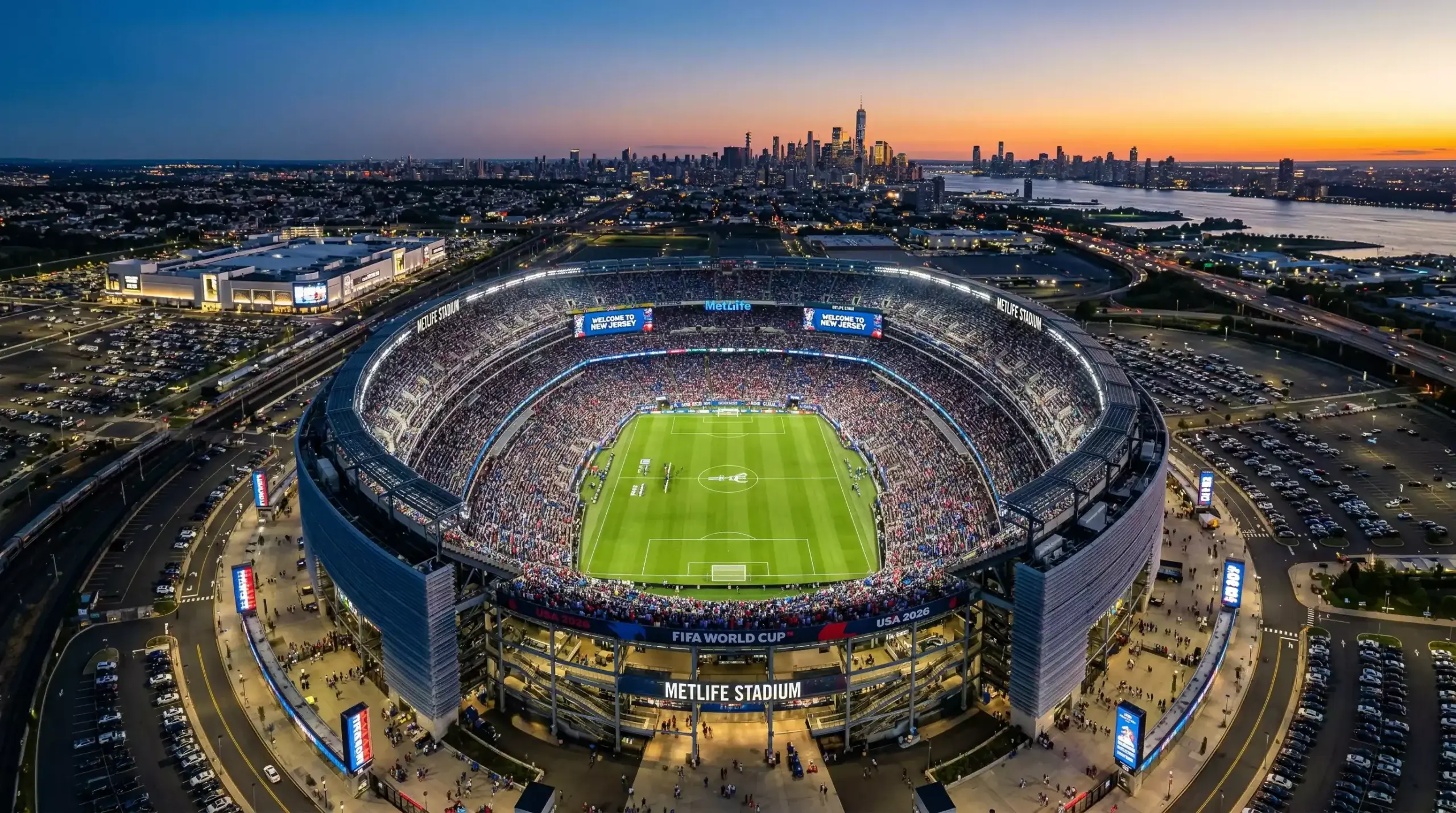
On 19 July 2026, the biggest match in football will be played in the biggest metropolitan area in the Americas, in a stadium that sits on a patch of New Jersey marshland eight miles from Times Square. MetLife Stadium — home to two NFL franchises, host to Super Bowls and WrestleManias, built for spectacle at scale — becomes the stage for the 2026 World Cup Final. For the millions of Irish-born and Irish-descended people who call the New York-New Jersey corridor home, this is not just another venue. It is the World Cup arriving in Ireland’s second capital.
From the Meadowlands to the World Stage
MetLife Stadium opened in 2010, replacing the old Giants Stadium that had stood on the same Meadowlands site since 1976. The new build cost $1.6 billion — at the time, the most expensive stadium ever constructed — and was designed with a dual-purpose philosophy: serve as the permanent home for both the New York Giants and New York Jets NFL teams while being adaptable for major events that demand a scale beyond what most purpose-built football stadiums can deliver. The capacity for the World Cup Final is expected to reach approximately 82,500 in a football-specific configuration, with the pitch laid out to meet FIFA’s dimensional requirements.
The stadium’s design is open-air, which matters for a July final in New Jersey. Summer temperatures in the region average between 24 and 30 degrees Celsius, with humidity levels that can push the “feels like” temperature significantly higher. Players and fans will need to contend with conditions that are warm but manageable — nothing approaching the extreme heat that dominated the 2022 World Cup in Qatar. The open-air element also means weather is a factor: July in New Jersey brings occasional thunderstorms, and a rain-soaked World Cup Final at MetLife would add another layer of drama to an already extraordinary occasion.
The pitch itself will be a temporary natural grass surface, installed specifically for the World Cup over the synthetic turf that serves the NFL tenants during American football season. FIFA’s requirement for natural grass has been a recurring discussion point in the tournament’s preparation, and MetLife’s solution — a modular grass system grown off-site and installed weeks before the first match — represents the kind of engineering compromise that hosting a World Cup in American stadiums demands. The playing surface will meet FIFA’s quality standards, though purists will note that a temporary installation never quite matches the consistency of a purpose-built football pitch that has been grown and maintained over years.
World Cup 2026 Matches at MetLife
MetLife Stadium will host multiple matches throughout the tournament, building from group-stage fixtures through the knockout rounds to the final itself on 19 July. The progression is deliberate: FIFA uses the group stage matches to test operations, refine logistics, and build the stadium’s World Cup identity before the pressure of elimination football arrives.
The group-stage fixtures at MetLife will feature teams from groups allocated to the New York-New Jersey venue cluster — the specific matchups depend on scheduling decisions finalised closer to the tournament. Regardless of which teams play, the atmosphere at MetLife during the group stage will benefit from the extraordinary diversity of the New York metropolitan area. The city is home to significant Brazilian, Mexican, Colombian, Ghanaian, and Irish communities, among dozens of others, meaning every group-stage match will feature passionate support for at least one team. For punters watching from Ireland, the crowd composition at MetLife matters: a hostile or supportive atmosphere can influence match results in ways that pure form analysis misses.
The knockout rounds at MetLife will feature quarter-final and semi-final matches in addition to the final. This concentration of high-stakes fixtures means the stadium will host approximately six to eight matches across the tournament — more than any other venue. For Irish fans following the tournament from home, MetLife’s matches will receive premium broadcast slots, with kick-off times optimised for both the North American and European audiences. Expect evening starts in ET (Eastern Time), which translate to late-night viewing in IST — midnight or later for the marquee fixtures.
The Irish in New York: A World Cup in Ireland’s Second Capital
The connection between Ireland and New York is not a footnote. It is the defining story of the Irish diaspora. An estimated 1.5 million people of Irish descent live in the New York-New Jersey metropolitan area — more than the entire population of Dublin. The neighbourhoods that shaped Irish-American identity — Woodlawn in the Bronx, Bay Ridge in Brooklyn, the Jersey Shore towns — remain centres of a community that has maintained its sporting and cultural ties to Ireland across generations. When the World Cup Final takes place at MetLife, it happens in a region where Irish pubs outnumber Starbucks outlets in certain zip codes.
For the thousands of Irish fans who will travel to the New York area during the tournament, the logistics of reaching MetLife Stadium from Manhattan are straightforward but require planning. The stadium sits in East Rutherford, New Jersey, accessible by NJ Transit trains from Penn Station in midtown Manhattan — a journey of approximately thirty minutes on match days when dedicated services run. Driving is possible but inadvisable on match days: the Meadowlands complex hosts over 80,000 people, and parking requires advance booking and patience in equal measure. The smarter approach is to base yourself in Manhattan, take the train, and enjoy the pre-match atmosphere in the tailgating areas that surround the stadium — a tradition borrowed from NFL culture that the World Cup organisers have embraced rather than resisted.
The pub scene in Manhattan and the surrounding boroughs will be transformed during the World Cup. Irish bars in Midtown — The Perfect Pint, Foley’s, and others along the Third Avenue corridor — will screen every match, and the late-night kick-off times in IST that frustrate viewers at home will be perfectly timed for an evening in New York. If Scotland advance deep into the tournament, expect the Irish bars of Manhattan to become unofficial Tartan Army headquarters — the Celtic bond transcending geography as it always does.
Practical Information for Travelling Fans
MetLife Stadium’s address is 1 MetLife Stadium Drive, East Rutherford, New Jersey 07073. The venue is located within the Meadowlands Sports Complex, which also includes the Izod Center and various entertainment facilities. The nearest airport is Newark Liberty International (EWR), approximately twenty minutes by car. John F. Kennedy International (JFK) and LaGuardia (LGA) are alternatives, though both require crossing into New Jersey via bridges or tunnels that add travel time.
Tickets for the World Cup Final and other MetLife fixtures were distributed through FIFA’s official ticketing portal, with prices for the final ranging from approximately $300 for category three seats to over $1,500 for premium positions. The secondary market will be active closer to the tournament, though FIFA’s anti-tout measures aim to limit resale prices. Irish fans should be cautious of unofficial ticket sources — the demand for MetLife matches, particularly the final, guarantees that counterfeit tickets will circulate.
Accommodation in the New York-New Jersey area during the World Cup requires early booking and realistic budgeting. Hotel rates in Manhattan during major events routinely exceed $400 per night, and the World Cup will push prices higher. Alternatives include hotels in Jersey City (accessible to MetLife via NJ Transit), Airbnb rentals in Brooklyn or Queens, or — for the adventurous — accommodation in the New Jersey suburbs closer to the stadium. The key is to book early: New York’s hotel inventory is vast but not infinite, and the combination of summer tourism and World Cup demand will strain capacity.
For Irish fans watching from home rather than travelling, MetLife’s matches will be broadcast across RTÉ, Virgin Media, and streaming platforms available in Ireland. The final on 19 July will kick off at approximately 21:00 ET (02:00 IST on 20 July) — a late start, but the kind of occasion where sleep is a secondary concern. Plan the viewing party. Stock the fridge. The World Cup 2026 stadiums guide covers all sixteen venues, but MetLife is the one that matters most.
