

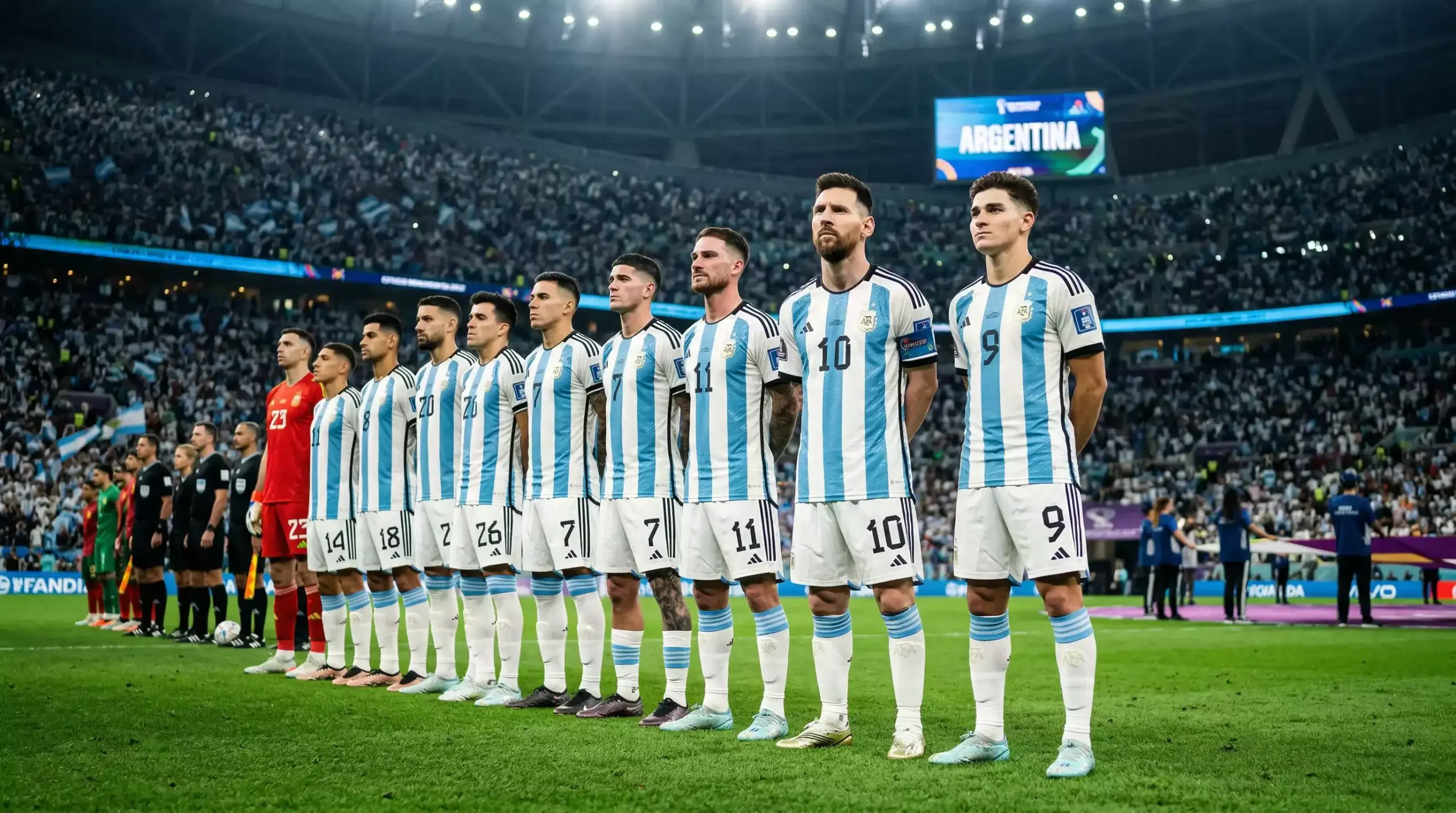
The photograph still gives me chills. Messi, shirtless, trophy overhead, surrounded by teammates in various states of euphoria and exhaustion, the Qatar sky behind them. That was December 2022 — the night Argentina won their third World Cup and Messi completed football’s greatest individual story. Now the morning after has arrived, and it’s colder than anyone expected.
Argentina at the 2026 World Cup face the hardest question in tournament football: how do you replace the irreplaceable? Messi won’t be in North America. His international retirement, confirmed in early 2026 after a final Copa America appearance, closed the chapter that defined Argentine football for two decades. What’s left is a squad that still contains genuine world-class talent but has lost the gravitational centre around which everything orbited. For the first time since 2004, Argentina will play a major tournament without the safety net of knowing that Messi could produce a moment of magic to bail them out of any situation.
I’ve been modelling Argentina’s chances for three months, and the numbers suggest the market has got their price almost exactly right — which means there’s limited value in the outright but plenty of angles in the subsidiary markets. The defending champions arrive in North America with the best manager at the tournament, one of the deepest squads, and a group draw that should allow them to cruise into the knockout rounds. Whether they have the x-factor to win seven consecutive matches against increasingly difficult opponents — without the greatest x-factor the sport has ever known — is the question that makes Argentina at the 2026 World Cup such a fascinating betting proposition.
Life After Messi: The Players Carrying the Legacy
The first thing to understand about Argentina without Messi is that they aren’t starting from scratch. The 2022 World Cup squad was never a one-man team, despite the narrative that Messi carried them. Rodrigo De Paul ran more kilometres than any outfield player in Qatar. Enzo Fernandez won the Best Young Player award. Julian Alvarez scored four goals. The supporting cast delivered. The question is whether they can be the main act.
Julian Alvarez is the player Argentina’s hopes now rest on. At 26, he enters the tournament as the most complete forward in South American football, combining the technical ability of a classic Argentine number 10 with the pressing intensity of a modern striker. His move from Manchester City — where he grew frustrated playing second fiddle to Haaland — to a starring role at Atletico Madrid has unlocked a new level of performance. Alvarez scored 24 goals across all competitions in the 2025-26 season and has become Argentina’s captain, inheriting the armband from Messi with the kind of quiet authority that suggests he was born for leadership rather than thrust into it.
Enzo Fernandez has developed into one of the best midfielders in the world. His ability to control tempo, break up opposition attacks, and deliver precise passes over any distance makes him the metronome that Argentina’s play flows through. At Chelsea, his performances have been transformative — he’s the reason Chelsea returned to the Champions League — and at international level, his understanding with De Paul and Leandro Paredes creates a midfield triangle that few opponents can disrupt. If Alvarez is Argentina’s sword, Fernandez is the hand that guides it.
In defence, Cristian Romero anchors the backline with the aggressive, front-foot defending that makes him such a compelling watch at Tottenham. His partnership with Lisandro Martinez — compact, combative, technically excellent — gives Argentina one of the strongest centre-back pairings at the tournament. Martinez’s versatility means he can also drop to left-back if required, offering Scaloni tactical flexibility that few other managers enjoy. At right-back, Nahuel Molina provides tireless running and a genuine threat in the final third, while Nicolas Tagliafico holds down the left. Emiliano Martinez remains in goal, and his reputation as a penalty shootout specialist (two saves in Qatar’s final, two more in the Copa America) adds a psychological edge that opponents will be aware of from the first whistle of the first match. His gamesmanship on the line is controversial but devastatingly effective — three consecutive penalty shootout victories tell their own story.
The wide positions are where Argentina’s squad depth impresses most. Alejandro Garnacho has exploded at Manchester United, his pace and directness offering a different option to the more methodical Nico Gonzalez. Irish Premier League viewers know Garnacho well — his ability to drop a shoulder and accelerate past full-backs has produced some of the most exciting moments in the 2025-26 season. Thiago Almada provides creative spark from attacking midfield, his compact dribbling style reminiscent of a young Messi in how he receives the ball in tight spaces and turns to face goal. Lautaro Martinez, despite his struggles in previous tournaments, remains a lethal finisher when played in the right system — his 28-goal Serie A season at Inter confirms the quality is there when the confidence flows.
The talent is undeniable — what’s missing is the certainty that came from having Messi on the pitch, the knowledge that even when everything went wrong, one man could produce a moment of divine intervention. Argentina in 2026 are a collective. They press as a unit, defend as a unit, and attack through combination play rather than individual brilliance. Whether they can win a World Cup as a collective, without a transcendent individual, is the experiment this tournament will answer. The early evidence from qualifying suggests they can compete with anyone — but competing and winning are different things when the margins narrow in a semi-final or final.
South American Qualifiers: Champions Under Pressure
Defending champions rarely have smooth qualifying campaigns. The pressure to maintain standards, the target on their back in every fixture, and the gradual ageing of key players conspire to make the path back to the World Cup harder than it should be. Every opponent raises their game against the reigning champions — it becomes a cup final for teams that would normally approach Argentina with caution. Argentina’s qualifying experience confirmed this pattern — they qualified, but with fewer smiles than expected.
Argentina finished second in the CONMEBOL table behind Brazil on goal difference, a reversal of their recent superiority that raised eyebrows. They won 10 of their 18 matches but lost three — including a shock 2-0 defeat in Bolivia, where the altitude of La Paz claimed another scalp, and a 1-0 loss in Uruguay that ended their 25-match unbeaten run in competitive fixtures. A bruising 1-0 defeat in Colombia, decided by a Luis Díaz goal in stoppage time, was the low point of the campaign. The draws were more concerning: 0-0 at home to Paraguay, 1-1 with Ecuador in Buenos Aires — matches where the absence of Messi’s creativity was felt most acutely. The Buenos Aires crowd, accustomed to Messi pulling rabbits from hats, grew restless as Argentina struggled to break down deep-sitting defences.
The goals-scored column told a story of transition. Argentina netted 28 goals in qualifying, down from 36 in the previous cycle. Without Messi’s ability to unlock tight defences with a single pass, Argentina had to find new methods of creation. The solution, gradually, was to push Alvarez deeper into a number 10 role and use Fernandez as the primary ball-progressor from midfield. By the final four matches of qualifying, the system had clicked — three wins and a draw, with Alvarez scoring five goals and providing three assists. The timing was fortunate, but the evidence suggests Argentina found their post-Messi identity just in time.
One element that survived the transition intact is Argentina’s defensive resilience. They conceded just 14 goals across the qualifying campaign — the second-best record in CONMEBOL behind Uruguay’s 12. Scaloni’s team remains exceptionally difficult to break down, with the Romero-Martinez partnership conceding fewer than 0.8 goals per match when both started together. That defensive platform, combined with the improving attacking chemistry, gives Argentina the structural foundations for a deep tournament run even without the individual brilliance that Messi provided.
Group J: Austria, Algeria, Jordan
If ever a group draw flattered defending champions, it’s this one. Argentina landed in Group J alongside Austria, Algeria, and Jordan — a draw that virtually guarantees progression and should allow the coaching staff to manage minutes carefully ahead of the knockout rounds. The contrast with Brazil’s group (Morocco, Scotland, Haiti) is striking — Argentina face no team ranked in the world’s top twenty. The bookmakers have Argentina at 1/8 to win the group, and I struggle to argue with that price. The question isn’t whether Argentina qualify but whether they emerge sharpened or complacent.
Austria are the most dangerous opponent. Ralf Rangnick’s side have become one of the most impressive teams in European football, built on a relentless pressing system that suffocates opponents and forces turnovers in dangerous areas. Their Euro 2024 performance — topping a group that included France — proved they can compete with anyone over ninety minutes. Marcel Sabitzer and Konrad Laimer bring Bundesliga-level intensity to the midfield, while Christoph Baumgartner provides goals from attacking positions. The Argentina-Austria match, likely on matchday two, is the fixture most likely to produce an upset, and Austria at 7/1 to beat Argentina is not as long as it should be given their tactical sophistication under Rangnick.
Algeria have qualified for their fourth World Cup and bring pace, physicality, and the memory of their 2014 run where they came within minutes of eliminating Germany in the Round of 16. Their squad is largely French-based, with several Ligue 1 starters offering quality across the pitch. The Algerian diaspora in France has produced a generation of dual-eligible players who bring European tactical education to an African team’s athleticism. They won’t be pushovers, but their defensive organisation isn’t at the level needed to contain Argentina’s attack over ninety minutes.
Jordan are the group’s outsiders, qualifying from the Asian confederation with a squad built around discipline and tactical awareness rather than individual brilliance. Their recent Asian Cup final appearance showed they can compete at a high level, and they’ll approach the World Cup with a clear plan: defend deep, frustrate, and hope for set-piece opportunities. Their goalkeeper, Yazeed Abulaila, was the standout player of the Asian Cup and could produce a performance that keeps the score respectable. Argentina should handle them comfortably, but late kick-offs (potentially 02:00 IST for Irish viewers) and the heat of a North American summer could introduce variables that the odds don’t capture.
Argentina’s Odds: Still the Team to Beat?
At 6/1 to win the tournament, Argentina sit third in the market behind France and Brazil. That price represents a slight drift from the 5/1 available immediately after the draw, reflecting the market’s growing awareness that this is a different Argentina than the one that won in Qatar. I think 6/1 is fair — perhaps even slightly generous — but I wouldn’t call it value in the traditional sense.
The case for Argentina at 6/1 rests on three pillars. First, Scaloni’s tactical system is the most battle-tested in the tournament — he’s managed Argentina through a World Cup, two Copa Americas, and a Finalissima, winning three of those four competitions. No other manager at the 2026 World Cup has that pedigree. Second, the squad’s spine — Emiliano Martinez, Romero, Fernandez, Alvarez — is entering peak years, with all four players aged between 24 and 32. Third, the group draw is favourable enough that Argentina can reach the quarter-finals without facing a top-tier opponent, preserving energy for the matches that matter most.
The case against is equally compelling. No team has successfully defended the World Cup since Brazil in 1962. The historical pattern is clear: winners suffer from post-triumph complacency, squad ageing, and the loss of the hunger that drove them to victory. Argentina’s qualifying campaign showed symptoms of all three. The squad’s average age has crept up — several key players from Qatar (Di Maria retired, Otamendi phased out, Messi gone) have been replaced, but the core of De Paul, Paredes, and Tagliafico are all in their thirties. At 6/1, the price doesn’t adequately compensate for the risk of a defending champion’s hangover, particularly one compounded by the loss of the greatest player in the tournament’s history.
My recommendation: skip the outright and focus on Argentina to reach the semi-finals at 11/8. That’s their floor based on squad quality and draw, and the price offers a more efficient return than the outright market where you need seven things to go right. For punters who want exposure to the outright market, an each-way bet at 6/1 with semi-final place terms is the cleanest angle — you get paid if they reach the last four, regardless of whether they lift the trophy. The each-way approach hedges against the defending champion’s curse while still capturing upside if Scaloni’s men go all the way.
Defending Champions: What History Tells Us
The record of defending World Cup champions is a cautionary tale for anyone backing Argentina at short prices. Since 1962, every defending champion has failed to retain the trophy. France were eliminated in the group stage in 2002. Spain went out in the group stage in 2014. Germany suffered the same fate in 2018. Italy didn’t even qualify in 2022. The pattern is so consistent that it’s tempting to treat it as a law of tournament football rather than a coincidence.
The reasons are varied but interconnected. Winning a World Cup creates internal pressure that corrodes squad unity — players who weren’t selected feel aggrieved, those who were selected expect enhanced roles, and the coaching staff face the impossible task of motivating a group that has already achieved the ultimate goal. There’s also a tactical element: the defending champion’s style of play is studied and dissected by every opponent, removing the element of surprise that often contributes to a tournament run. Argentina’s 4-3-3 pressing system, so effective in Qatar, has been analysed in forensic detail by coaching staffs around the world. Every team in Group J will have a specific plan to neutralise Fernandez and isolate Alvarez. Whether Scaloni can evolve his approach while maintaining the core principles that won the World Cup is the coaching challenge of the tournament.
Argentina, though, have one historical advantage. They won their first World Cup in 1978 and reached the final four years later in 1982. They won again in 1986 and reached the final in 1990. The Argentine football culture produces squads that sustain excellence across cycles in a way that few other nations manage. The passion of the Argentine fan base — perhaps the most intense in world football — creates an environment where complacency is punished immediately and publicly. Scaloni’s side may not have Messi, but they have a group of players who grew up watching the Qatar victory and are determined to prove that it wasn’t a one-off. The generation of Fernandez, Alvarez, and Garnacho didn’t just witness Argentine glory — they see themselves as custodians of it. That psychological drive, combined with Scaloni’s tactical discipline, gives Argentina a path to the final that few teams in North America can match.
The Value Question: Back Them or Fade Them?
Nine years of covering betting markets has taught me one consistent lesson about defending champions: the value is almost never in backing them outright. The emotional weight of the crown, combined with the market’s tendency to price in recent success rather than current form, creates a structural overvaluation that punters can exploit by looking at alternative angles.
For Argentina at the 2026 World Cup, the value lies in specific markets rather than the headline price. Alvarez to be the tournament’s top scorer at 12/1 is interesting — he’s Argentina’s primary goalscorer, he’ll play every match, and the group stage opponents are weak enough to pad his tally early. Emiliano Martinez to keep the most clean sheets at 16/1 is another angle — Argentina’s defence is elite, and the group draw means at least two of three matches should be comfortable enough for shutouts.
The market I’d actively fade is Argentina to win the tournament and Alvarez to score in the final — a popular speculative double that requires too many variables to align. Instead, I’d build my Argentina positions around the quarter-final and semi-final stages, where their squad quality gives them a genuine edge over all but four or five teams. Argentina will be dangerous in North America — their familiarity with the continent, having won the 2024 Copa America in the United States, gives them a home-ground advantage that European teams won’t enjoy. The squad knows the stadiums, the climate, the travel logistics. That experience is worth something, even if the odds don’t explicitly price it in. But dangerous and champions are different things. At 6/1, the market agrees. So do I.
For Irish punters watching from a neutral perspective, Argentina offer the intriguing spectacle of a dynasty in flux. The Qatar winners are trying to prove that their triumph was the beginning of an era, not the end of one. Scaloni’s ability to manage that transition — to keep the winning mentality while integrating new players and a new system — is one of the most compelling storylines among all 48 teams at this tournament. Whether the crown sits comfortably or crushes them under its weight, Argentina in North America will be worth every late night.
