
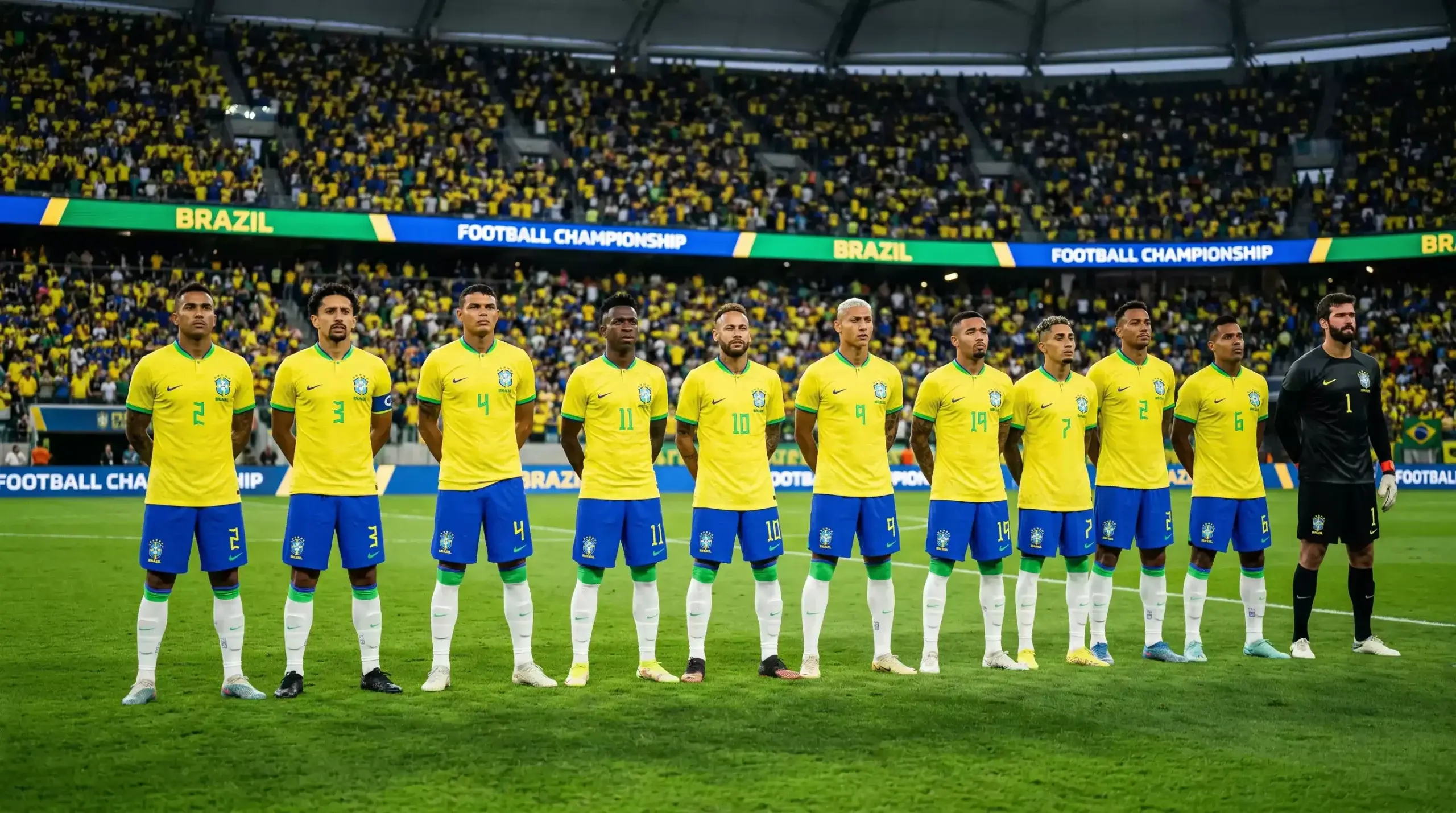
Twenty-four years. That’s how long Brazil have been waiting to lift the World Cup trophy. The last time a Brazilian captain held it above his head was Cafu in Yokohama in 2002, and an entire generation of supporters has grown up knowing only near-misses, humiliations, and the slow erosion of the certainty that Brazil would always be football’s ultimate force. Brazil at the 2026 World Cup carry five stars on their shirt and the heaviest burden in the sport — the expectation that greatness isn’t optional, it’s inherited.
I’ve watched Brazil’s odds fluctuate more dramatically than any other contender since the draw. They opened as joint-favourites at 9/2 after Qatar, drifted to 7/1 during a turbulent qualifying campaign, and have settled at 11/2 heading into the tournament. That price movement tells the story of a team the market doesn’t quite trust but can’t bring itself to dismiss. And for punters, that uncertainty is where opportunities live.
A Rocky Road Through South American Qualifiers
South American World Cup qualifying is the most demanding path in international football. Eighteen matches against nine opponents across two years, played at altitude in La Paz, in the heat of Barranquilla, in the hostility of Buenos Aires. There are no easy games, no minnows, no guaranteed points. Brazil have historically dominated this process. Not this time.
The 2026 qualifying campaign was Brazil’s most troubled since the 1990s. They lost four matches — to Uruguay at home, Colombia away, Argentina away, and Paraguay in Asuncion — and drew three more, including a damaging 1-1 with Venezuela in Manaus that prompted widespread criticism. The final record of 9 wins, 3 draws, and 4 defeats across 16 matches left them in fourth place in the CONMEBOL table, behind Argentina, Colombia, and Uruguay.
The defensive record was the primary concern. Brazil conceded 18 goals in qualifying, their worst return in a World Cup cycle since 1994. The centre-back partnership changed nine times across sixteen matches as the coaching staff searched for a combination that could provide the solidity Brazil’s midfield and attack needed. Set-piece defending was particularly alarming — seven of those 18 goals came from corners and free kicks, a structural problem that speaks to organisation rather than individual errors.
Coaching instability compounded the on-pitch issues. The decision to move on from Tite after the 2022 quarter-final exit was understandable, but the replacement cycle — three different coaches in two years — destroyed continuity. The current manager inherited a squad that had been pulled in multiple tactical directions and was asked to impose a new identity with barely a year before the tournament. That context matters when assessing Brazil’s readiness for North America.
The positives, though, are significant. Brazil’s attack remains among the most talented in world football. They scored 26 goals in qualifying despite the chaos behind them, and when the front line clicked — as it did in a devastating 4-1 dismantling of Peru in Lima or the 3-0 destruction of Chile in São Paulo — the quality was unmistakable. Vinicius scored eight goals across the qualifying campaign, his best return in a Brazil shirt, and Raphinha added six from the right flank. The issue was consistency, not ability. Brazil could produce a world-class performance on Tuesday and look disjointed by Thursday, a pattern that suggested the team’s problems were systemic rather than technical.
If the coaching staff can find a defensive structure that holds for seven matches, Brazil’s attacking talent is capable of winning any game in the tournament. The pre-tournament training camp in the United States, starting four weeks before the opener, is the longest preparation period any Brazil coach has had in recent cycles. Whether that time is sufficient to install the defensive organisation that eighteen months of qualifying couldn’t achieve remains the central question of Brazil’s 2026 campaign.
The Squad: New Guard, Old Ghosts
Neymar’s shadow looms over this squad even in his absence. His departure from the national team — a combination of persistent injuries, advancing age, and the Saudi Arabian adventure that took him away from Europe’s elite — left a creative void that no single player has filled. For a decade, Brazil’s attacking system revolved around Neymar’s ability to create something from nothing in the final third. Without him, the team must find a new identity. Brazil’s challenge at this World Cup is playing without a number 10 for the first time in decades, relying instead on a collective attacking approach built around pace and movement rather than individual genius.
Vinicius Junior is the player the tournament will revolve around. At 25, he enters North America as the reigning Ballon d’Or holder and Real Madrid’s most important player. His ability to beat defenders in one-on-one situations, score from improbable angles, and produce moments of magic in knockout matches makes him the most dangerous individual threat in the tournament. The concern is that opposing teams will target him physically — Vinicius has struggled at previous tournaments when man-marked aggressively, and his temperament under provocation has led to red cards at club level. How he handles the physical approach of World Cup football will determine Brazil’s ceiling. His club teammate Rodrygo provides the balance on the opposite flank. Less explosive than Vinicius but more consistent in his decision-making, Rodrygo’s versatility — he can play across the front three or drop into midfield — gives the coach tactical flexibility that few other squads possess.
Raphinha has established himself as a key creative outlet from the right, his deliveries from wide positions supplying the ammunition for aerial threats in the box. His work rate off the ball is an underappreciated asset — Raphinha covers more ground per ninety minutes than any other Brazilian attacker, making him essential for the pressing triggers that the current system demands. When Brazil lose possession high up the pitch, Raphinha is typically the first to initiate the counter-press.
The midfield has undergone a generational shift. Bruno Guimarães anchors the centre from his base at Newcastle, offering the defensive discipline and passing range that Brazil have lacked since Casemiro’s decline. Lucas Paquetá provides creativity and set-piece quality, while Joao Gomes adds energy and pressing intensity. The balance of this midfield three will be critical — too attacking and Brazil’s vulnerable defence is exposed; too conservative and the supply line to Vinicius dries up.
In defence, Marquinhos remains the leader at centre-back despite his advancing years at 32. His partnership with Gabriel Magalhaes — an Arsenal regular who Irish Premier League fans watch every week — offers the best combination of experience and physicality available. At left-back, Wendell and Guilherme Arana compete for the shirt, neither fully convincing at international level. At right-back, Danilo’s experience fights against the dynamism of younger options. The goalkeeper position belongs to Alisson, whose Liverpool career has made him one of the best shot-stoppers in the world — a genuine advantage when margins tighten in knockout football.
The squad’s depth is formidable on paper. Endrick, still only 19, provides a different option up front — a natural centre-forward with a striker’s instinct in the box. Eder Militao, when fit, gives defensive options. Antony and Savinho offer width and pace from the bench. But depth only matters if the starting eleven is settled, and Brazil’s constant rotation during qualifying suggests the coach hasn’t yet found his best team. That’s a problem when the tournament starts in two months.
Group C: Morocco, Scotland, Haiti
Group C is the most scrutinised group at the 2026 World Cup, and Brazil’s presence as the top seed is the reason. Everyone wants to see whether the Seleção can handle the pressure of being favourites in a group that contains a 2022 semi-finalist (Morocco), a disciplined European side (Scotland), and a fairy-tale debutant (Haiti). The drama writes itself, and the fixtures will be among the most-watched of the group stage. For Irish audiences, this is the group to follow — Scotland’s involvement makes it personal, and Brazil’s presence makes it unmissable.
Brazil open against Morocco in a match that could define the group. Morocco’s semi-final run in Qatar was no accident — Regragui built a team that defends deep, transitions quickly, and has the individual quality to hurt any opponent. The Atlas Lions’ defensive structure, anchored by Hakimi and Saiss, is designed to frustrate exactly the kind of possession-dominant approach Brazil favour. If Morocco take points off Brazil in the opener, the entire dynamic of Group C shifts.
The Scotland fixture on matchday three is the one every Irish fan will watch with split loyalties. Brazil’s historical dominance at World Cups — they’ve never lost a group-stage match to a European team ranked below them since 1966 — suggests they should handle Scotland comfortably. But this Scotland side, under Steve Clarke, is built to frustrate superior teams, and if the match arrives with Brazil already qualified, the intensity may drop. Scotland are live underdogs in that fixture, and the 6/1 available for a Scottish victory offers value that history doesn’t fully capture.
Haiti will provide the emotional highlight of the group regardless of the result. Their qualification is a football miracle, and every neutral in the stadium — Irish fans included — will want them to produce something memorable. Brazil should win this match comfortably, but the carnival atmosphere and Haiti’s fearless approach could create an unpredictable opening twenty minutes. The 40/1 on Haiti to beat Brazil would be the single greatest result in World Cup history if it landed.
How Brazil Will Play — and the Question Marks
The formation is expected to be a 4-2-3-1, with Vinicius and Raphinha on the flanks, Paquetá behind a central striker, and Bruno Guimarães alongside Joao Gomes in the double pivot. It’s a shape that prioritises width and pace, using Vinicius’s one-on-one ability to isolate defenders on the left and Raphinha’s crossing from the right to create chances for whoever leads the line.
The tactical uncertainty centres on the striker role. Brazil don’t have a natural number 9 in the Ronaldo or Romario mould — a gap that has haunted them for over a decade. Richarlison offers physicality and movement but his finishing has been inconsistent at international level, converting just 14% of his chances in the qualifying campaign. Endrick offers raw finishing ability and an instinct for being in the right place, but asking a 19-year-old to lead the line at a World Cup is a significant gamble. Rodrygo can play as a false nine dropping deep to create space for the wingers, an option that worked well against Peru but struggled against teams that pressed high. The choice between these options — target man, poacher, or false nine — will vary by opponent, and Brazil’s ability to adapt mid-match will be tested by teams like Morocco who switch between high press and deep block within the same game.
The biggest question mark is the defensive transition. When Brazil lose the ball in the opposition half, the space between their advanced full-backs and central defenders is vast. Counter-attacking teams will target that gap, and Morocco, Scotland, and even Haiti have the pace to exploit it. Brazil conceded the majority of their qualifying goals on the counter, and unless the coaching staff have solved that structural problem in the pre-tournament camps, it will be their undoing against the best teams in the knockout rounds. The high defensive line that worked for Tite’s best teams relied on Casemiro sweeping behind the midfield — no player in the current squad offers that same combination of reading the game and recovering pace.
Brazil’s Odds: Favourites No More?
At 11/2 to win the tournament, Brazil are no longer the automatic market leaders they were for every World Cup from 1994 to 2014. France at 5/1 are shorter, and Argentina’s price is similar. The market is telling us that Brazil’s aura has faded — that the five stars on the shirt no longer guarantee a place among the final four.
I think the market is right to be cautious. Brazil’s qualifying campaign raised legitimate concerns about defensive organisation, coaching stability, and the absence of a clear tactical identity. These are not problems that disappear because the tournament starts. If anything, the compressed schedule of a World Cup — where you can’t hide weaknesses over seven matches — amplifies them. At 11/2, you’re being asked to trust that Brazil will fix in two months what they couldn’t fix in two years. That’s a lot of faith for a price that doesn’t even give you 6/1.
Where I do see value is in the group-stage markets. Brazil to win Group C at 1/5 looks short, but Brazil to score over 2.5 goals in the group stage at 4/5 is attractive given their attacking firepower. Vinicius Junior to be the top Brazilian scorer at the tournament is available at evens and represents fair value — his advanced position and penalty-taking duties mean he’ll have the most opportunities. For Irish punters looking for an each-way angle, Brazil to reach the semi-finals at 11/10 is the sweet spot — deep enough to reflect genuine achievement, short enough to suggest the market believes it’s likely.
The price I’d avoid is Brazil to win the World Cup outright. At 11/2, you’re paying for the name and the history rather than the current evidence. This is a transitional team with a new coach, a leaky defence, and a creative framework that hasn’t yet gelled. They could still win it — the talent is undeniable — but the odds don’t compensate for the risk. I’d rather back them in specific markets where the prices are better calibrated to their actual strengths. The smart money on Brazil at this World Cup isn’t on the outright — it’s on the margins. Group-stage goals, individual player markets, and specific match outcomes are where the value sits for a team whose attacking talent outstrips their collective organisation.
One more market worth watching: Brazil to concede in every group match at 6/4. Their defensive vulnerabilities are well-documented, and all three opponents — Morocco, Haiti, Scotland — have the capacity to score. Morocco scored in every match at the 2022 World Cup except the semi-final. Scotland scored in nine of their ten qualifiers. Even Haiti, for all their underdog status, averaged 1.8 goals per game in CONCACAF qualifying. At 6/4, that price reflects real probability rather than speculative value.
Five Stars and the Burden They Carry
No nation in football carries more weight than Brazil at a World Cup. Five titles — 1958, 1962, 1970, 1994, 2002 — and a mythology built on jogo bonito, the beautiful game, the idea that football played with joy and artistry will always triumph over rigid systems and defensive discipline. That mythology is both Brazil’s greatest asset and their heaviest chain.
The 2002 triumph was the last time the myth and the reality aligned. Since then, Brazil have suffered the 7-1 humiliation against Germany in 2014 — a result so catastrophic that it transcended football and became a national trauma — a quarter-final exit to Belgium in 2018 where they created countless chances and finished none, and the penalty-shootout loss to Croatia in 2022 where Neymar’s extra-time goal deserved to win any tournament. Each exit has chipped away at the certainty that Brazil will eventually win another World Cup. The question is no longer if they can — it’s whether the current structure of Brazilian football, with its coaching carousel, club-versus-country conflicts over release dates, and political interference at federation level, allows them to build the sustained programme needed to compete with European nations that have spent the past decade professionalising every aspect of international football.
The contrast with France and Spain is instructive. Both European rivals have invested in long-term coaching projects, centralised player development pathways, and consistent tactical philosophies across age groups. Brazil’s approach has been the opposite — short-term appointments, tactical reinventions every two years, and a reliance on individual brilliance to compensate for collective deficiencies. That approach produced five World Cup titles in an era when individual talent was sufficient. In 2026, with the tactical gap between nations narrowing and the physical demands of the sport increasing, it may no longer be enough.
For Irish fans watching from the outside, Brazil at a World Cup still carries a romance that transcends the sport. The yellow shirt, the samba drums in the stands, the audacious skill that makes other teams look like they’re playing a different game — Brazil represent what football can be at its best, even when the results don’t follow. If they reach the final in New Jersey on July 19, it will feel like the tournament has delivered on its promise. If they fall short, the post-mortem will be brutal and the mythology will fracture a little more. Either way, Brazil at the 2026 World Cup is the story no one can look away from. They remain the team that every group-stage fixture is built around, and their presence among the 48 teams at this tournament guarantees the spectacle that only Brazil can provide.