
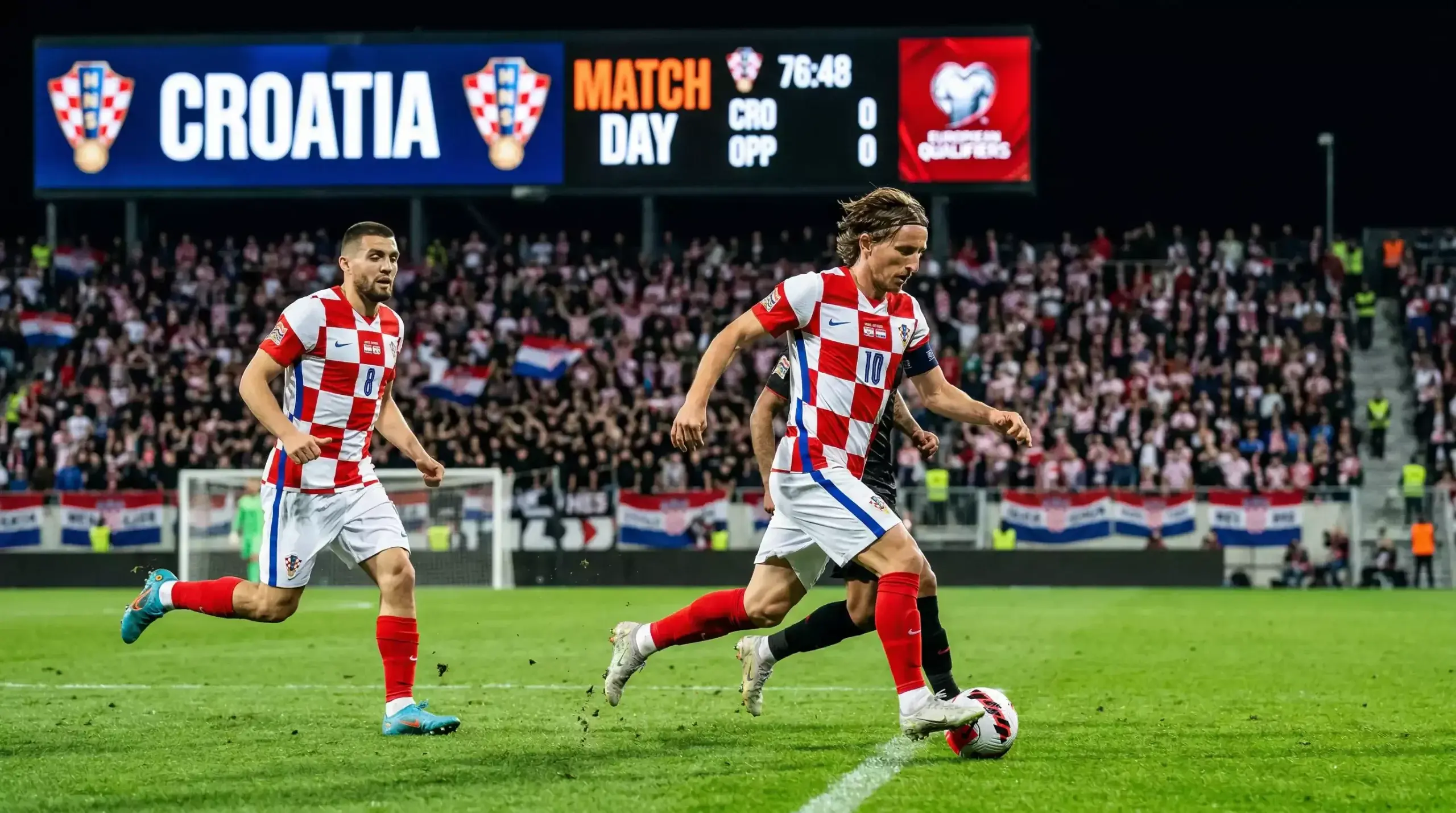
A nation of four million people. A World Cup final in 2018. A third-place finish in 2022. A Nations League title in 2023. Croatia’s ability to punch above their weight at international tournaments isn’t a fluke or a coincidence — it’s a cultural programme embedded in the DNA of a country where football excellence is treated as a national priority second only to independence itself. Croatia at the 2026 World Cup face the biggest challenge of their modern era: competing at the highest level without Luka Modrić, the player who made the impossible seem routine for two decades.
Modrić’s international retirement in late 2025 — after the Nations League campaign — closed a chapter that elevated Croatian football from respected underdog to legitimate tournament power. At 40, his body could no longer sustain the demands of competitive international football, and his farewell match against Portugal in Split was one of the most emotional occasions in European football’s recent memory. Now Croatia must prove that the system Modrić operated within — the tactical intelligence, the midfield control, the tournament mentality — was built into the team rather than residing in one man’s left foot.
After Modrić: The Transition Squad
The transition has been smoother than many predicted. Mateo Kovačić at Manchester City has assumed the creative responsibilities that Modrić carried, and while he doesn’t possess Modrić’s otherworldly passing range, his ball-carrying ability and pressing resistance give Croatia a midfield presence that functions differently but equally effectively. Kovačić’s experience in Premier League title races has hardened him for tournament football — he understands the mental demands of must-win matches in a way that less decorated midfielders can’t replicate.
Alongside Kovačić, Marcelo Brozović continues to provide the defensive midfield security that has been a constant in Croatia’s tournament campaigns. His positional awareness, his ability to intercept passes before they become dangerous, and his capacity to play simple, risk-free football when the situation demands it make him the unsung hero of Croatian football. At 33, this is likely his last World Cup, and his motivation to deliver one more deep run will drive performances that his club form doesn’t always preview.
Josko Gvardiol at Manchester City has developed into one of the best centre-backs in the world. Irish Premier League fans watch him every week and know the quality he brings — aggressive, technically excellent, and capable of stepping forward from defence to create numerical advantages in midfield. His 2025-26 season at City saw him score six goals from centre-back, an extraordinary return that reflects his comfort in advanced positions and his timing on runs into the box from deep. His partnership with a more conservative centre-back (likely Josip Sutalo or Duje Caleta-Car) gives Croatia the defensive foundation that their midfield-focused system requires — Gvardiol provides the ambition, his partner provides the cover.
Up front, Andrej Kramarić continues to score goals with the consistency and intelligence that has defined his career — 15 Bundesliga goals in the 2025-26 season at 34 years old, a remarkable output that proves his movement and finishing are age-proof. Bruno Petković offers a physical alternative when Croatia need to change their approach, his hold-up play and aerial ability providing a different route to goal when the more technical approach is stifled. The wide positions have been strengthened by the emergence of Lovro Majer, whose creative passing from the right side gives Croatia an additional source of chance creation that previous squads lacked outside the central midfield corridor.
The goalkeeping position belongs to Dominik Livakovic, whose 2022 World Cup performances — saving three penalties in the round of 16 against Japan and producing a man-of-the-match display against Brazil — made him a national hero. His penalty-saving record adds a psychological dimension to every knockout match Croatia play: opponents know that if the match goes to a shootout, the Croatian goalkeeper has a track record of winning them. That knowledge alone changes the behaviour of penalty takers, introducing doubt at the moment when confidence is most needed.
Group L: England’s Toughest Opponent
For Irish fans watching Group L with mixed emotions about England, Croatia provide the complication. The England-Croatia rivalry at World Cups is genuine and recent — Croatia beat England in the 2018 semi-final, England beat Croatia in the 2022 group stage, and the tactical chess match between the two teams has produced some of the most absorbing football at recent tournaments. The matchday two fixture between England and Croatia will be one of the most-watched matches of the group stage globally, and the result could determine whether England top the group or face a tougher path through the knockout rounds.
Croatia’s approach against England will be familiar from 2018: control the midfield, slow the tempo, deny England’s attackers the space they need to operate, and wait for opportunities to counter-attack through the wide areas. Whether Kovačić can replicate Modrić’s 2018 masterclass — where the Madrid midfielder outplayed the entire English midfield across 120 minutes — is the key tactical question. Kovačić’s knowledge of Rice’s positioning from their time as Chelsea teammates adds an interesting dimension — he knows Rice’s defensive habits better than almost any midfielder at the tournament, and that familiarity could be exploited in the match. Against Panama, Croatia should be comfortable, though Panama’s physical approach and willingness to foul strategically to disrupt rhythm will test Croatia’s composure. Ghana’s pace on the break could cause problems if Croatia commit too many players forward — Gvardiol’s recovery speed will be essential in covering the spaces that Croatia’s attacking system inevitably leaves behind the advanced full-backs.
Croatia are 9/2 to win Group L — a price that reflects their quality while acknowledging England’s status as favourites. I’d back Croatia to qualify from the group at 4/9, a bet that their tournament pedigree fully supports. The value lies in Croatia to beat England at 7/2 — a result that their recent history against England at World Cups suggests is more likely than the odds imply.
Croatia’s Odds: Tournament DNA in the Price
At 25/1 to win the tournament, Croatia are priced as outsiders — a fair assessment given the post-Modrić transition and the squad’s ageing profile in several key positions. But Croatia’s tournament DNA — the ability to produce their best football when the stakes are highest — is a quality that odds models struggle to capture. No statistical model predicted Croatia’s run to the 2018 final, and no model captured the resilience that took them to third place in 2022 after losing the semi-final to Argentina. Croatia at World Cups are a different animal to Croatia in qualifying, and the 25/1 price reflects the latter rather than the former. Their record since 2018 — final, third place, Nations League winners — is the most impressive tournament run by any team outside France over that period, and that pedigree isn’t fully erased by Modrić’s retirement.
My recommendation: back Croatia to reach the quarter-finals at 5/2, a bet that their group position (second in Group L behind England) and knockout bracket position support. The quarter-final is their realistic ceiling without Modrić, but reaching it would represent a significant achievement for a transitional squad and would deliver a return that justifies the stake. For a speculative punt, Croatia to beat England in the group at 7/2 is the value play that their tournament history and tactical approach support — and for Irish fans watching with complicated feelings about England, it’s a bet that adds a layer of emotional investment to an already compelling fixture.
The Nation of 4 Million That Keeps Delivering
Croatia’s success at World Cups defies every conventional metric of footballing power. They don’t have the population base of Brazil, the financial resources of England, the academy infrastructure of France, or the league competition of Spain. What they have is a cultural commitment to producing footballers that borders on obsession — every boy in Croatia grows up wanting to be a footballer, and the country’s coaching system, refined over three decades of independence, identifies and develops talent with an efficiency that larger nations struggle to match.
The result is a national team that consistently produces world-class midfielders — Boban, Prosinečki, Modrić, Rakitić, Kovačić, Brozović — in a production line that no other small nation can replicate. For Irish fans, there’s a kinship in Croatia’s story: a small country, a passionate supporter base, and the belief that on any given night, anything is possible. If Scotland represent Ireland’s Celtic ally at this World Cup, Croatia represent our aspirational mirror — the small nation that proves it can be done. Their presence at the 2026 World Cup enriches a tournament that would be poorer without them.