
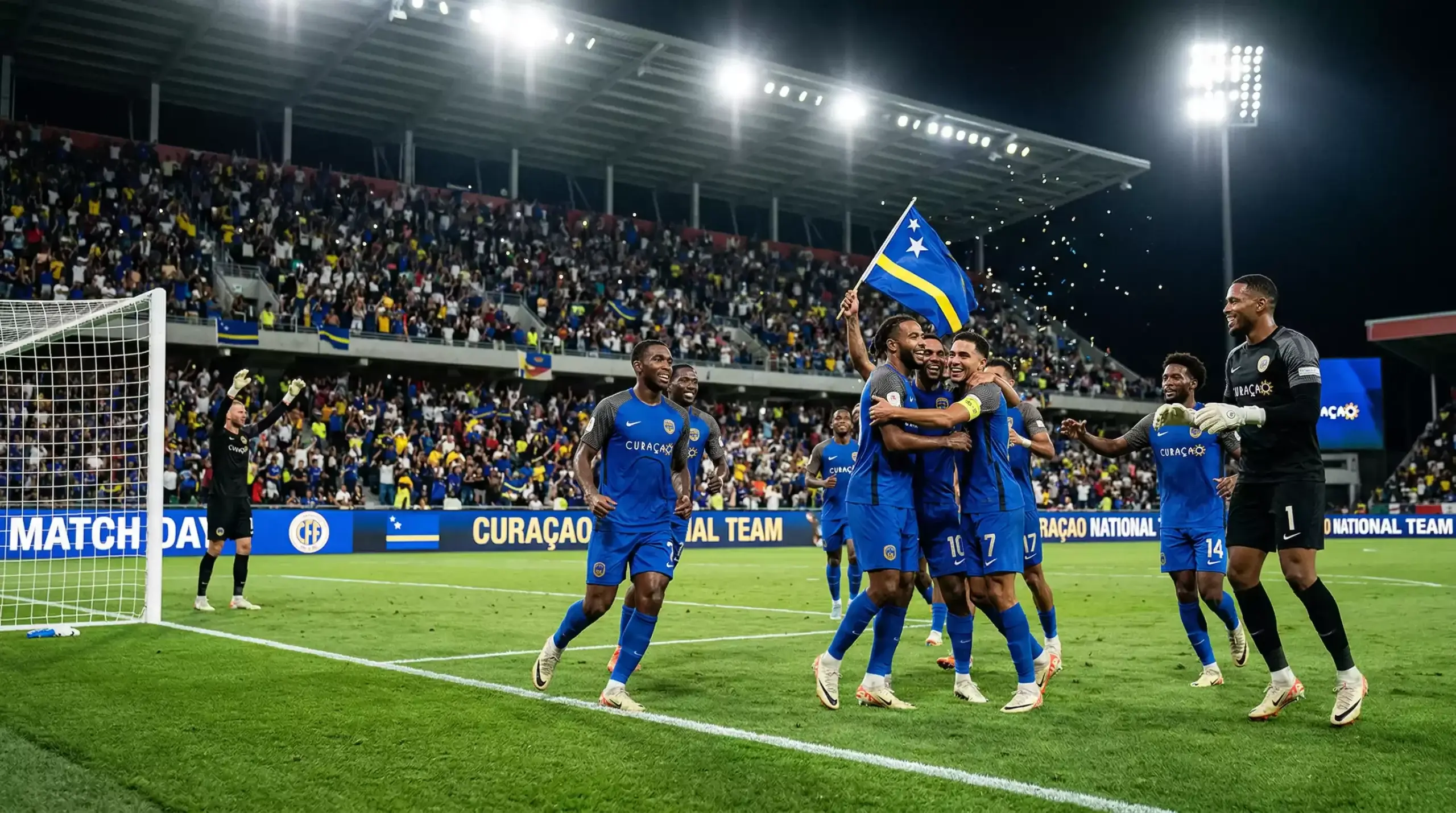
An island smaller than County Dublin. A population of 150,000 — roughly the size of Galway city and its suburbs. A football federation that operated on a budget smaller than most League of Ireland clubs until a decade ago. And now, against every statistical probability, a World Cup squad. Curaçao at the 2026 World Cup is the kind of story that makes the expanded 48-team format worth every logistical headache and every purist’s complaint about diluted quality. This is football at its most romantically improbable, and for Irish fans who understand what it means for a small nation to dream beyond its means, Curaçao’s journey resonates on a deeply personal level.
How Curaçao Qualified: Against All Odds
Curaçao’s qualification came through the CONCACAF process, where their path required beating teams with ten and twenty times their population. The journey began in the preliminary rounds against smaller Caribbean islands — matches that Curaçao were expected to win but which required professional preparation against opponents whose motivation to cause an upset was enormous. As the rounds progressed, the opposition quality increased. Victories over Suriname and Trinidad and Tobago in the group phase proved that Curaçao could compete with the region’s established mid-tier nations, and a dramatic penalty shootout win over Panama in the quarter-final — after 120 minutes of exhausting, physical football in the Panamanian heat — showed the mental resilience that would define their entire campaign.
The decisive moment came in the final qualifying round — a 1-0 victory over Guatemala in Willemstad, the island’s capital, secured by a Juninho Bacuna goal in the 84th minute that sent an entire nation into delirium. The scenes from the Ergilio Hato Stadium that night — fans spilling onto the pitch, players in tears, the coaching staff embracing with the bewildered joy of people who’ve achieved something they weren’t supposed to — will be replayed throughout the World Cup as the tournament’s defining qualification story. The stadium holds just 15,000 — one-tenth of the island’s entire population was inside watching, and the other nine-tenths were watching on screens in bars, homes, and public squares across Willemstad.
The squad relies almost entirely on dual-nationality players from the Netherlands, where the Curaçaoan diaspora has produced several professional footballers who chose to represent their parents’ island rather than compete for a place in the Dutch squad. This pipeline — from the Eredivisie and Dutch lower divisions to the Curaçao national team — is the foundation of the island’s footballing competitiveness. Without it, Curaçao would struggle to compete with Caribbean neighbours ten times their size. With it, they’ve produced a squad that can match the technical level of mid-tier CONCACAF nations while carrying the emotional weight of an entire island’s identity.
Juninho Bacuna, born in Groningen to Curaçaoan parents, is the team’s most recognisable player. His Championship and European league experience gives him a physical and technical edge over many of the opponents Curaçao faced in qualifying, and his goalscoring threat from midfield provides the attacking outlet that the team’s defensive system requires. Cuco Martina, a veteran defender with Premier League experience at Southampton and Everton, provides leadership and organisational quality at the back that belies the squad’s overall level. The rest of the squad draws from the Dutch second division, Belgian lower leagues, and the increasingly competitive Curaçaoan domestic league — a mix that produces inconsistency but also the occasional performance that defies all expectations.
Group E: Germany, Ecuador, Côte d’Ivoire
There is no sugar-coating Group E for Curaçao. Germany, Ecuador, and Côte d’Ivoire represent three of the most physically and technically superior opponents they could have drawn, and the realistic objective is not victory but respectability — keeping scorelines close enough to maintain pride and producing moments that the island will celebrate for decades regardless of the final results. The odds reflect this reality: Curaçao are 750/1 to win the tournament, the longest price alongside a handful of other debutants, and 14/1 to win any individual group match.
Against Germany, Curaçao will defend deep and hope for a set-piece opportunity or a counter-attacking goal that comes from nothing. The 33/1 available for Curaçao to beat Germany is fantasy territory, but the 5/1 on Curaçao to score in the match is more interesting — their Dutch-trained attackers have the technical ability to take advantage of any momentary lapse in German concentration, and Germany’s defensive record, while improved, is not impregnable. Against Ecuador and Côte d’Ivoire, the matches are more competitive on paper — Curaçao’s defensive organisation and European-level tactical discipline could produce performances that trouble opponents accustomed to more open, attacking approaches from Caribbean teams.
My prediction is that Curaçao finish with 0-1 points from three matches, but the point total doesn’t capture the impact they’ll have on the tournament’s atmosphere. Their supporters — many of whom will travel from the Netherlands rather than Curaçao itself, given the diaspora’s concentration in cities like Amsterdam, Rotterdam, and The Hague — will add colour, noise, and joy to every match. The Curaçaoan fan culture, rooted in Caribbean music and Dutch sporting traditions, produces an atmosphere unlike anything else in world football.
The Island Story: 150,000 People, One Dream
Curaçao’s World Cup qualification is not just a sporting achievement — it’s an existential statement about what a small island community can accomplish when talent, diaspora connections, and institutional support align. The island’s football federation underwent a professionalisation process in the mid-2010s that transformed it from a semi-amateur organisation into a properly functioning body with coaching programmes, youth development structures, and a systematic approach to identifying and recruiting dual-nationality players from the Netherlands.
The comparison with Ireland is instructive. Both nations punch above their weight in football through a combination of passion, diaspora connections, and the kind of stubborn refusal to accept limitations that defines small-nation sporting cultures. Curaçao’s population is roughly one-thirtieth of Ireland’s, which makes their achievement proportionally even more remarkable — if Ireland’s population were equivalent to Curaçao’s, our qualification would require competing against nations of just 5,000 people. The scale of what Curaçao have accomplished becomes clearer when you realise that their squad is drawn from a talent pool smaller than most Dublin suburbs.
For Irish fans watching the 2026 World Cup as neutrals — forced into that role by our own playoff heartbreak — Curaçao offer the purest form of the underdog narrative that makes football worth watching. They’re not here to win the tournament, or even to win a match. They’re here because they refused to accept that a small island couldn’t dream as big as a continent. That’s a sentiment every Irish person understands, and it’s the reason Curaçao will find friends in every pub in Ireland when their World Cup matches kick off on those long North American nights. I’ll be raising a glass to them. They’ve earned it.