
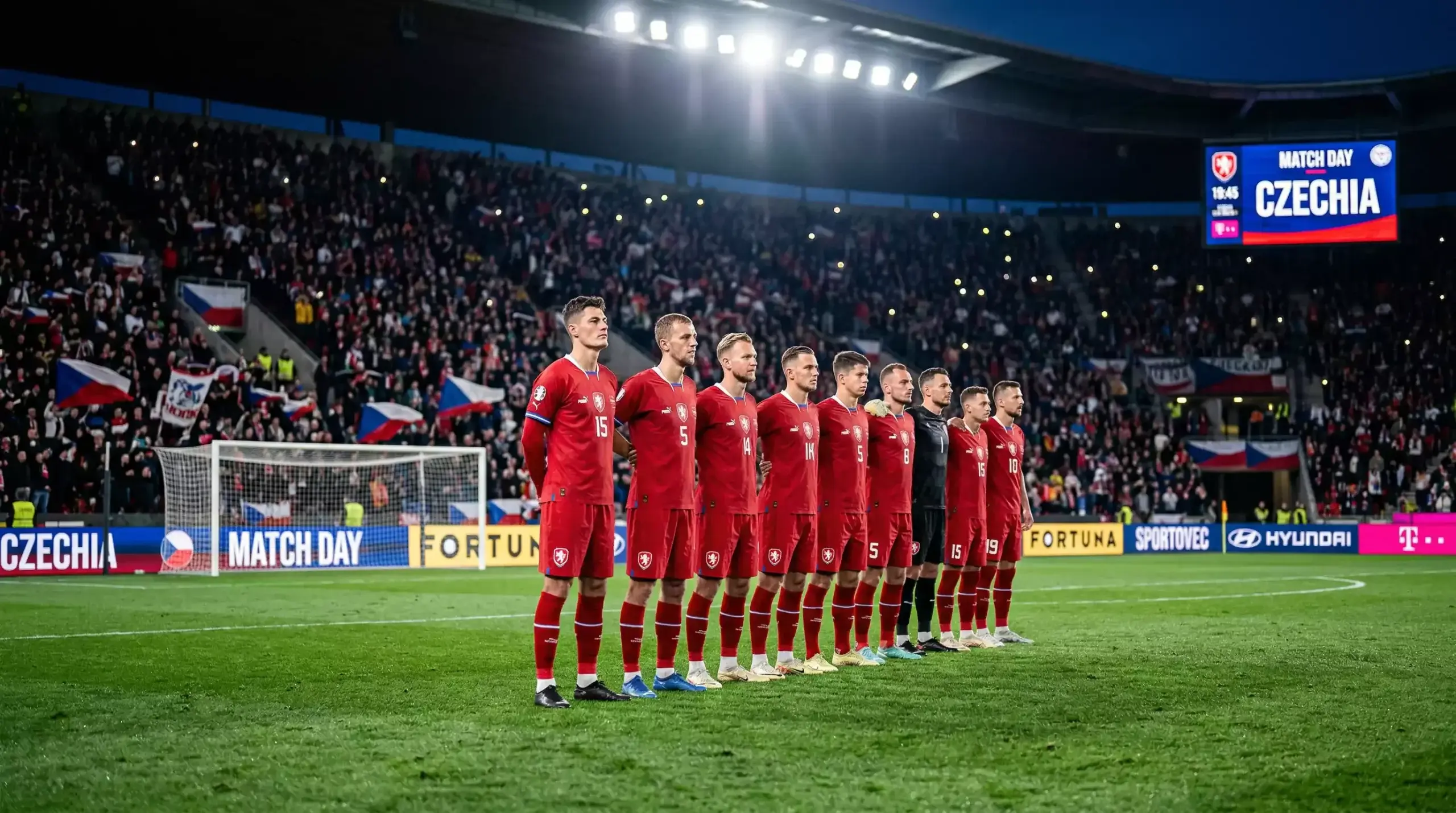
Prague. March 26, 2026. A date burned into the memory of every Irish football fan alive. The Sinobo Stadium, a playoff semi-final, Ireland needing ninety minutes and maybe penalties to reach the World Cup for the first time since 2002. We got the ninety minutes — 2-2, Troy Parrott scoring twice, each goal met with screams that could be heard across the Vltava. Then we got the penalties. And then we got the silence. Three missed from four Irish takers, Czechia converting with the cold efficiency that defines Central European football. They’re at the World Cup. We’re watching from the couch. If you need a reason to pay attention to Czechia at the 2026 World Cup, that’s it — they took our place, and the least we can do is understand exactly who they are.
The Playoff: Prague, 26 March 2026
I was in the press box that night, and the atmosphere defied any stadium of that size. Twenty thousand Czech supporters whistled and chanted from the first minute, creating a wall of sound that tested Irish composure before a ball was kicked. Czechia took the lead in the 23rd minute through a Patrik Schick header from a corner — the kind of set-piece goal that European teams drill into their system from the under-15s upward. Ireland responded through Parrott, who equalised with a curling left-footed shot from the edge of the box that briefly, deliriously, restored hope.
The second half was chaos. Czechia scored again through Adam Hlozek, a quick counter-attack that caught Ireland’s defence pushing forward. Parrott equalised again in the 78th minute, a header from a Caoimhin Kelleher long kick that bounced off the Czech centre-back and fell perfectly for the Tottenham striker. 2-2 at full time. Extra time produced nothing but exhaustion and tactical stalemate. Then penalties — and the worst thirty minutes of Irish football since Thierry Henry’s handball.
The detail still stings: Ireland’s first taker hit the post. Their third had his shot saved by Jindrich Stanek, who guessed correctly three times out of four — a record that suggests either extraordinary instinct or meticulous preparation, probably both. Czechia converted all four of theirs with the composure of a team that had practiced this specific scenario dozens of times in training. Each penalty was struck firmly, low, and into the corners — no hesitation, no theatrics, just execution. The final Czech penalty, struck low into the bottom right corner by Hlozek, was greeted with an eruption that I could feel through the concrete of the press box. For Czechia, it was the culmination of a qualification campaign that had exceeded expectations — they’d finished third in their qualifying group and entered the playoffs as underdogs, beating their way through with the defensive discipline and set-piece efficiency that Czech football has produced for decades. For Ireland, it was the cruellest possible ending to the most promising campaign in two decades. The flight home from Prague was the longest ninety minutes since the match itself.
Squad and Key Players
Patrik Schick leads the line with the experience of a player who has scored at multiple major tournaments — his long-range goal against Scotland at Euro 2020 remains one of the most replayed strikes in European Championship history. At 30, he’s entering the final phase of his career, but his positioning, heading ability, and composure in front of goal make him a reliable source of goals against opponents who don’t defend set pieces rigorously. Adam Hlozek provides the pace and dynamism that Schick lacks — his runs in behind defences stretch opponents and create the space that Schick exploits in the penalty area.
In midfield, Antonin Barak provides the creative fulcrum that Czechia’s system depends on. His passing range and ability to arrive late in the box give Czechia a goal threat from midfield that complements Schick’s penalty-area presence. Tomas Soucek at West Ham is the Premier League connection that Irish fans know best — his aerial ability from set pieces (he’s scored more headed goals than any midfielder in Premier League history) and his defensive contributions make him one of the most valuable box-to-box midfielders at the tournament. His presence alone gives Czechia a competitive edge in the physical battles that World Cup group matches often become.
The defence is organised and experienced, built around Ladislav Krejci and Robin Hranac in the centre. Jindrich Stanek’s penalty-saving heroics in Prague will follow him to North America as a psychological weapon — every opponent who faces Czechia in a knockout match will know that their goalkeeper has recent tournament experience of winning shootouts. The squad’s weakness is depth — their starting eleven is competitive, but the substitutes represent a significant drop in quality, which could become problematic if injuries or suspensions hit during the group stage.
Group A: Mexico, South Korea, South Africa
Czechia landed in Group A alongside hosts Mexico, South Korea, and South Africa — a draw that offers a realistic chance of qualification but no easy matches. Mexico’s home advantage at the Azteca makes them prohibitive favourites for first place, and the Czechia-Mexico fixture will be the match where Czechia’s defensive discipline is tested most severely. South Korea’s technical quality and World Cup experience make them the most likely rival for second place, and the Czechia-South Korea fixture could decide whether our penalty heartbreak in Prague leads to World Cup football beyond the group stage or an early flight home.
South Africa are the group’s most beatable opponent on paper, but their pace in wide areas and physical intensity in midfield will test Czechia’s composure. The African qualifiers produced a squad that is faster and more athletic than Czechia in almost every position, and the transitional speed that South African wingers bring can expose the ageing Czech full-backs who lack recovery pace. The Czechia-South Africa match, likely on matchday one, is the fixture where Czechia must establish their credentials — a confident victory would settle nerves and provide the platform for competitive performances against Mexico and South Korea. A draw or defeat would create immediate pressure in a group where margins are thin and every point matters for the third-place qualification route.
Czechia are 7/2 for second place in the group, a price that reflects their competitive but limited squad. I’d give them closer to a 30% chance of qualifying, which makes the 7/2 approximately fair. For Irish punters with a grudge, Czechia to be eliminated in the group stage at 6/4 is the bet that combines revenge with reasonable probability.
Czechia’s Odds: Long Shots, But Stranger Things Have Happened
At 150/1, Czechia are among the longest-priced teams at the tournament. That price accurately reflects their squad limitations and the difficulty of their group. The outright is not a serious bet. The value, if any, lies in specific group-stage markets: Czechia to beat South Africa at 6/4, Soucek to score at the tournament at 5/2 (his aerial threat from set pieces will produce at least one goal), and under 2.5 goals in the Czechia-South Korea match at 4/5 (both teams are defensively disciplined and will prioritise not losing).
For Irish fans, Czechia at the 2026 World Cup represent the road not taken — the team that goes to North America in our place, wearing the World Cup badge that Troy Parrott’s two goals in Prague nearly earned for Ireland. Watching them will be bittersweet. If they fail in the group stage, Irish fans will feel the complicated satisfaction of knowing that the team that beat us wasn’t good enough for the World Cup either. If they surprise everyone and produce a deep run, the sting of Prague will sharpen. Either way, we’ll be watching. We always do.