
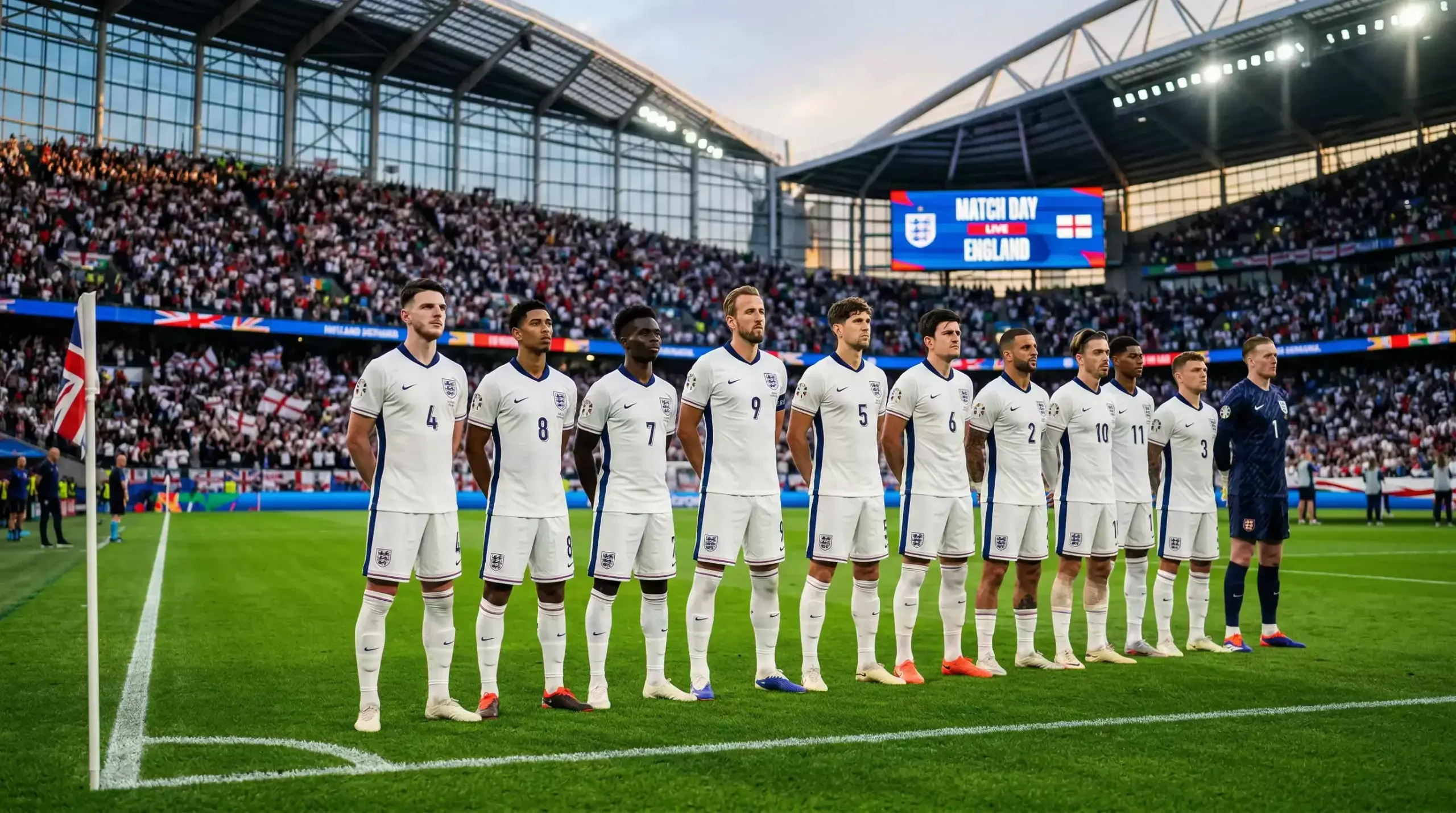
Here’s the thing about England at the 2026 World Cup that every Irish punter needs to understand: you already know this squad better than your own relatives. You’ve watched Bellingham orchestrate midfields on Sunday afternoons. You’ve cursed Saka for scoring against your fantasy league rival. You’ve argued about whether Rice is worth the hype. England at a World Cup isn’t foreign football for Irish viewers — it’s the Premier League with flags and anthems.
That familiarity is both a blessing and a trap for punters. We think we know what England are capable of because we watch these players every week. But club form and international form are different animals entirely, and England’s tournament history is a graveyard of squads that looked unstoppable on paper and crumbled under the weight of expectation. I’ve been tracking England’s odds movement since the draw, and the market tells an interesting story — one of cautious optimism rather than the blind faith that usually inflates English prices at major tournaments.
England’s Qualification: Serene or Stumbling?
The short answer is serene on the surface, scrappy underneath. England qualified from Group B with 26 points from ten matches, winning eight and drawing two. The numbers look comfortable. The performances were anything but.
A pattern emerged across the qualifying campaign that should concern anyone thinking of backing England at short prices. Against weaker opponents — Azerbaijan, Moldova — they dominated without ever reaching top gear, racking up comfortable wins that flattered the final record. Against teams with genuine quality — Italy and Ukraine — they laboured. The 1-1 draw in Rome was a match England were fortunate not to lose, saved by a Bellingham equaliser in the 88th minute that papered over a disjointed display. The return fixture at Wembley finished 2-0, but Italy controlled possession for long stretches and were undone by individual errors rather than English brilliance.
The qualifying campaign exposed a problem that has followed England through three tournament cycles: tempo control. When England have the ball in the final third, they can be devastating. When they’re asked to build patiently from the back against a team that presses intelligently, they look vulnerable. The midfield pivot — whoever plays alongside Rice — has been the position that successive managers have failed to solve convincingly. It was a problem under Southgate, it was a problem during the transition, and it remains a problem heading into North America. Kobbie Mainoo offers energy and ball-carrying ability, but his positional discipline in a tournament knockout match against a top-tier opponent remains untested at senior international level.
What the qualifying campaign did confirm is that England’s attacking talent is generational. Bellingham, Saka, Foden, Palmer — this is a front four that would walk into almost any national team in the world. England scored 31 goals in qualifying, with 14 different goalscorers contributing — a spread that suggests the manager has multiple options for breaking teams down. The question has never been whether England have the players. The question is whether they can function as a team when the pressure reaches the level that only a World Cup quarter-final or semi-final can produce.
Squad and Key Players: Bellingham’s Tournament
Let me start with the obvious. Jude Bellingham is the best midfielder at this World Cup. I don’t say that as an opinion — his numbers over the past two seasons at Real Madrid put him in a category that only Zidane and Matthäus have occupied at a similar age. Bellingham will be 23 during the tournament, entering his peak years with two Champions League titles, a La Liga crown, and a Euro 2024 final appearance already on his CV. If England are to win the World Cup, Bellingham will be the reason.
His role in the national team is different from his club role. At Madrid, he operates as an advanced midfielder with freedom to roam. For England, he’s been asked to play deeper at times, linking defence and attack from a position that doesn’t fully utilise his goalscoring instincts. The tension between using Bellingham where he’s most effective and accommodating the other creative talents around him is the central tactical dilemma of this England squad. Every formation choice revolves around the same question: how do you get Bellingham into the box without leaving the midfield exposed? Getting it right could be the difference between a semi-final exit and a trophy.
Bukayo Saka has matured into England’s most important wide player. His ability to beat defenders on either side, deliver crosses, and score from distance makes him undroppable. Phil Foden’s relationship with the national team has been complicated — brilliant at Manchester City, inconsistent for England — but the talent is undeniable, and a World Cup in North America, away from the suffocating intensity of Wembley, might liberate him. Cole Palmer’s emergence adds a different dimension: a player who is almost preternaturally calm under pressure, who slows the game down rather than speeding it up.
In defence, the spine depends on which Premier League centre-backs are fit and in form. Marc Guehi has established himself as a first-choice partner for John Stones, but the depth options — Levi Colwill, Ezri Konsa — lack major tournament experience. The centre-back pairing will define how high England can push their defensive line, and Stones’ fitness is a perpetual concern after a season disrupted by muscle injuries at Manchester City. Jordan Pickford remains the number one goalkeeper, a polarising choice given his occasional erratic distribution, but his shot-stopping record in tournament football is outstanding. Pickford has saved penalties in shootouts at the 2018 World Cup and Euro 2020, and that experience is invaluable in a format where knockout matches can go to spot-kicks. His command of his area, once a weakness, has improved measurably over the past two seasons at Everton.
Harry Kane’s status is the question that generates the most debate. At 32, he remains England’s all-time top scorer and a clinical finisher when chances fall to him. But his pace has diminished further, and the argument for starting a more mobile forward — whether that’s Ollie Watkins or Ivan Toney — grows louder with each passing season. Kane will almost certainly be in the squad, but whether he starts every match is no longer certain. That uncertainty itself is a story — England transitioning from Kane’s team to Bellingham’s team in real time, at a World Cup.
Group L: Croatia, Panama, Ghana — Trickier Than It Looks
On paper, Group L is comfortable for England. In practice, it contains Croatia — a team that has beaten England at a World Cup more recently than England have beaten Croatia at one. The 2018 semi-final in Moscow, where Croatia came from behind to win in extra time, remains a scar on the English psyche. Modrić may have retired from international duty, but Croatia’s ability to produce tournament performances that exceed their squad’s individual quality is embedded in their DNA.
The England-Croatia match on matchday two is the fixture I’ll be watching most closely. By that point, both teams will have played their opening games — England against Ghana, Croatia against Panama — and the result of the head-to-head will likely determine who tops the group. England are 1/3 favourites to win Group L, and that price looks about right. But Croatia at 9/2 to finish first aren’t dismissed easily. If Kovačić and Brozović control the midfield, if England’s tempo problems resurface, Croatia have the quality to pull off an upset.
Panama return to the World Cup after their debut in 2018, where they lost all three group matches but captured hearts with their passion and commitment. They’ve improved since, qualifying through a competitive CONCACAF process, and they’ll treat every match as a cup final. Ghana are rebuilding under a new generation of talent, with several Bundesliga and Ligue 1 based players offering pace and physicality that could trouble England’s high defensive line. Neither Panama nor Ghana are expected to challenge for qualification, but both are capable of taking points off a complacent England. The history of World Cup group stages is littered with examples of favourites dropping points against teams they should beat — England’s 0-0 draw with Algeria in 2010 being the most painful English example.
The scheduling is kind to England. They open against Ghana in Philadelphia (20:00 IST), face Croatia in Atlanta (23:00 IST), and close against Panama in Miami (02:00 IST). That final match kicks off after midnight Irish time — one for the dedicated neutrals and the insomniacs. The spread of venues along the eastern seaboard minimises travel for the squad, an underrated advantage in a tournament where teams crossing time zones can suffer from fatigue by the knockout rounds. My prediction: England top the group with 7 points, Croatia qualify in second with 6, and Ghana finish third with 3 points, narrowly missing out on the best third-place route.
Tactical Blueprint: What to Expect Under the Manager
England have moved on from the cautious pragmatism of the Southgate era, but the transformation hasn’t been as radical as the media narrative suggests. The shape remains a 4-3-3 in possession that can shift to a 4-2-3-1 depending on the opposition, with Rice as the deepest midfielder and Bellingham given freedom to push forward. The biggest change is in the pressing — England now press higher and more aggressively than they did under Southgate, attempting to win the ball in the opponent’s half rather than sitting in a mid-block and waiting for transitions.
That pressing intensity is a double-edged sword. Against weaker teams, it suffocates — England’s press during qualifying forced an average of 14 turnovers per match in the opposition half, the highest rate in the European qualifiers. Against teams that can play through the press — Croatia, for instance, who are among the best in the world at patient build-up — the high line can leave spaces behind the midfield that quick forwards exploit. This is the tactical gamble at the heart of England’s World Cup campaign: press high and dominate, or get caught out and concede.
The full-back positions are crucial to the system. Trent Alexander-Arnold’s involvement remains debated — his passing range from right-back is elite, but his defensive positioning against fast wingers is a liability that better opponents will target. Kyle Walker’s decline in pace means England lack the recovery speed at the back that covered for attacking full-backs in previous tournaments. The solution may be a hybrid role for Alexander-Arnold, inverting into midfield when England have possession and tucking back into a conventional back four without it. It’s a tactical innovation that Guardiola pioneered at Manchester City, and its success at international level is far from guaranteed. If it works, England will have solved their creativity problem from deep. If it fails, they’ll be exposed against teams with pace on the counter — and in Group L, Ghana have exactly that kind of speed on the flanks.
The bench strength is where England separate themselves from most rivals. Bringing on Palmer for Foden, or Watkins for Kane, or Gordon for Saka gives the manager options that can change a match in the final thirty minutes. Tournament football is increasingly won by substitutes — four of the eight quarter-final goals at Euro 2024 were scored by players who came off the bench. England’s depth in attacking positions is arguably the best at the tournament, and if the manager uses it intelligently, that depth could be the difference in tight knockout matches where tired legs and fresh ideas decide outcomes.
England’s Odds: Outright, Group, and Top Scorer
England are third favourites to win the World Cup at 7/1, behind France (5/1) and Brazil (11/2). That price has shortened from the 8/1 available immediately after the draw, reflecting both the favourable group and the general consensus that this is England’s strongest squad in a generation. I think 7/1 is fair — not value, but not an overreaction either. England’s tournament pedigree since 2018 (semi-final, final, quarter-final) justifies a short price, even if none of those runs ended in a trophy.
The market that interests me most is England to reach the semi-finals at 13/8. Their likely Round of 32 opponent (a third-placed team from Groups I, J, or K) should be beatable, and the quarter-final draw opens up a path that could avoid Brazil and France until the semi-final stage. Reaching the last four has been England’s floor in recent tournaments. Whether they can take the final step remains football’s most tantalising question, but at 13/8, the semi-final price represents decent each-way value.
For top scorer, Bellingham at 14/1 is the pick I keep coming back to. He scored three goals at Euro 2024 and his advanced role means he’ll have more chances than Kane if the latter starts on the bench for key matches. Saka at 20/1 is another option — his goal involvement rate for Arsenal suggests the 2025-26 season has taken his finishing to another level. Kane at 10/1 is the obvious market leader, but his price doesn’t account for the genuine possibility that he won’t start every match.
England at World Cups: The Weight of ’66
Sixty years. One trophy. That statistic defines England’s relationship with the World Cup more than any individual performance or result. The 1966 victory at Wembley — Hurst’s hat-trick, Moore lifting the Jules Rimet, the Russian linesman — has become less a memory and more a millstone. Every English generation since has been measured against it, and every generation has fallen short.
The near-misses have become part of English football’s mythology. Maradona’s Hand of God in 1986. The penalty shootout losses to Germany in 1990 and 1996. Ronaldinho’s free kick in 2002. The 2018 semi-final against Croatia. The Euro 2020 final against Italy. England keep getting close enough to taste it, then stumbling at the penultimate or final hurdle. For punters, the lesson is clear: England’s talent gets them to the business end of tournaments, but something — pressure, tactical limitations, sheer bad luck — prevents them from closing the deal. The pattern is so consistent that it has become a market inefficiency: bookmakers price England based on their squad talent, but the actual results suggest they should be priced based on their tournament conversion rate, which is significantly lower than their talent would suggest.
The 2026 squad has one advantage over its predecessors: lower public expectation. After the Euro 2024 quarter-final exit, the media narrative shifted from “this is our year” to “this team needs to prove itself.” That reduction in hysteria could actually benefit the players. The 2018 squad thrived on low expectations, reaching the semi-final with a group of players nobody expected to get past the round of 16. If the 2026 squad can tap into that underdog energy — difficult for a team priced at 7/1, but not impossible — they might finally break through.
The Irish View: Love, Hate, and Sunday Afternoons in the Premier League
Let’s be honest about the complicated relationship Irish fans have with England. It’s not hatred — that cliché belongs to a previous generation. It’s something more nuanced: a reluctant fascination tinged with just enough rivalry to make it interesting. We watch the Premier League more devotedly than most English fans. We know the players, the tactics, the storylines. We have opinions on whether Southgate was treated fairly and whether his successor has done enough to change the culture. We just don’t want England to actually win anything.
That dynamic creates a unique betting opportunity. Irish punters who follow the Premier League have a genuine informational edge when it comes to England’s squad. You know that Palmer performs better as a substitute than a starter. You know that Rice’s positioning has improved dramatically under Arteta. You know that Foden disappears in big away games. You know that Alexander-Arnold’s defensive lapses come in clusters, usually against quick, direct wingers. That granular knowledge — the kind that comes from watching 38 league matches a season — is more valuable than any statistical model when it comes to predicting how England’s players will perform under pressure. Use it. The bookmakers price England based on aggregate data and public perception. Irish punters can price them based on intimate, match-by-match observation.
My advice to Irish punters watching England at this World Cup is straightforward. Back them to reach the semi-finals — they have the squad depth and the draw to get there. Fade them in the outright market — 7/1 doesn’t offer enough compensation for England’s historical inability to win the final match. And enjoy the drama, because England at a World Cup always deliver drama, even when they can’t deliver a trophy. Whether you’re cheering or jeering, you’ll be watching. We always are. The England matches will be among the most-watched fixtures in Irish pubs this summer, and the banter — win or lose — will fuel conversations for years. There’s a reason the Irish relationship with English football is described as complicated. It’s because we care more than we’d ever admit.