
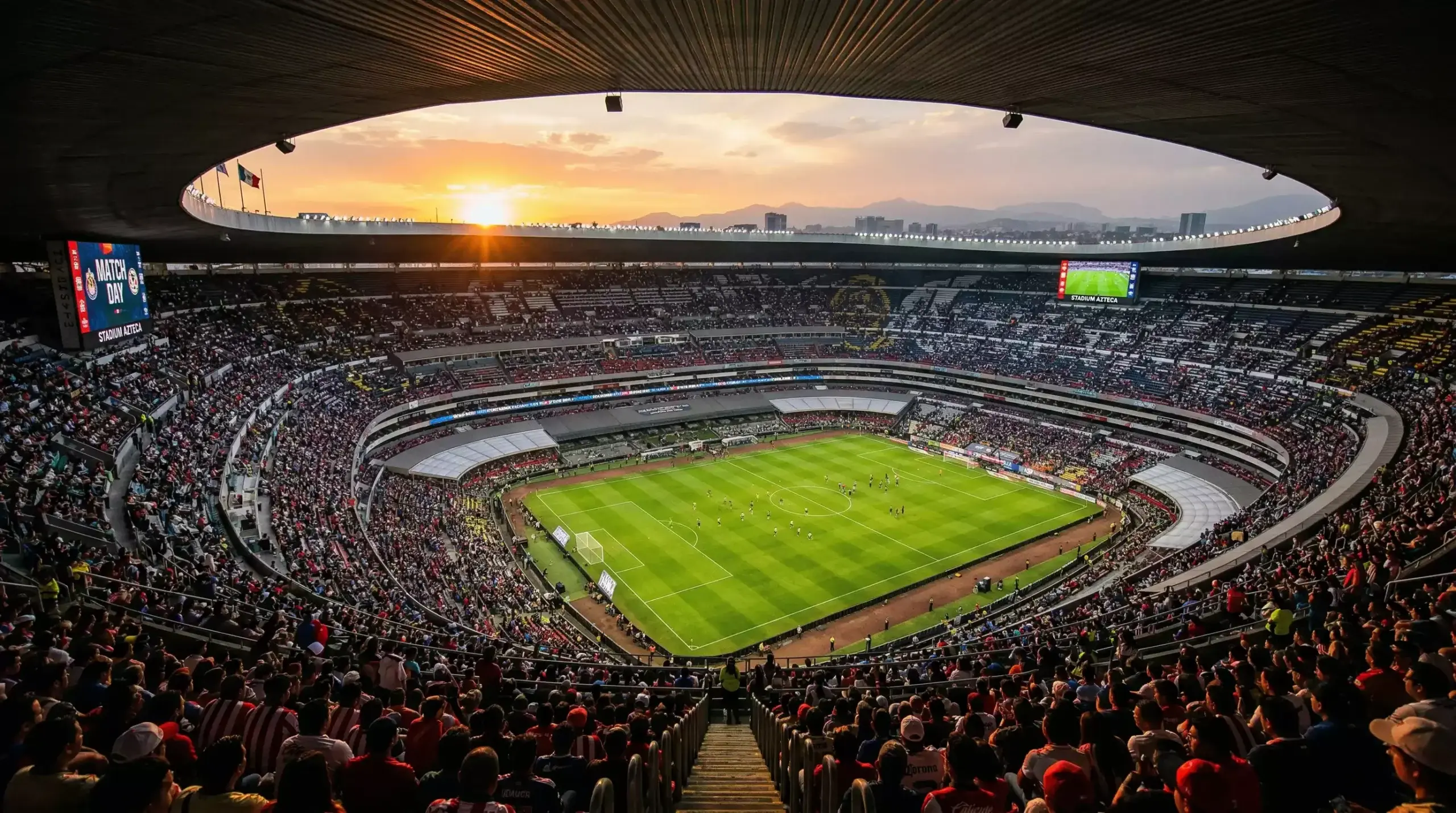
Three World Cups. Two of football’s most transcendent moments — Pelé’s coronation in 1970 and Maradona’s Hand of God in 1986. Ninety thousand seats carved into the volcanic soil of Mexico City at an altitude that makes visiting players gasp by the sixtieth minute. The Estadio Azteca is not merely a football stadium. It is the sport’s most hallowed cathedral, and on 11 June 2026, it opens its doors for the World Cup once more — becoming the first venue in history to host matches at three separate FIFA World Cup tournaments.
The Stadium That Saw It All
The Azteca was inaugurated on 29 May 1966, built to serve as the centrepiece of Mexico’s 1970 World Cup bid. The architect, Pedro Ramírez Vázquez — who also designed the National Museum of Anthropology — created a bowl that sinks into the earth rather than rising above it, using the natural topography of the Santa Ursula Coapa district to create an amphitheatre effect that concentrates sound and emotion in a way that few modern stadiums can replicate. The original capacity exceeded 105,000, though renovations and safety modernisations have reduced it to approximately 87,000 for the 2026 World Cup.
The 1970 World Cup Final — Brazil 4-1 Italy — remains widely regarded as the greatest single match in football history, and it was played here. Pelé, Jairzinho, Gerson, Tostão, and Rivelino produced a performance that transcended the sport and became a cultural event watched by an estimated 600 million people worldwide. The Azteca’s pitch was the canvas, and the Mexican sun provided the light. Sixteen years later, the same stadium hosted the most controversial moment the game has ever produced: Maradona’s “Hand of God” goal against England in the 1986 quarter-final, followed — four minutes later — by the “Goal of the Century,” a solo run that started in his own half and ended with five English defenders trailing in his wake.
These moments are not mere history. They are the reason the Azteca carries a spiritual weight that no other stadium on the planet possesses. Every player who walks onto that pitch knows what happened there. Every punter who watches a match from those seats — or from a pub six thousand kilometres away in Dublin — understands that this is where football’s mythology was written. The 2026 World Cup could have opened at MetLife, SoFi, or any of the gleaming American venues. FIFA chose the Azteca because some decisions are not about logistics. They are about legacy.
World Cup 2026 Matches at the Azteca
The Estadio Azteca hosts the tournament’s opening match — Mexico versus South Africa on 11 June 2026 — along with additional group-stage fixtures and a round-of-32 knockout match. The opening match is the centrepiece: a host nation stepping out to the roar of ninety thousand people in a stadium that has witnessed more World Cup drama than any other building on earth.
The group-stage fixtures at the Azteca will feature teams from Group A (Mexico, South Korea, South Africa, Czechia) and potentially fixtures from other groups allocated to the Mexican venue cluster, which includes Monterrey’s Estadio BBVA and Guadalajara’s Estadio Akron. The Azteca is likely to host at least three group-stage matches plus the knockout fixture, giving visiting fans multiple opportunities to experience the stadium’s atmosphere across the tournament’s opening fortnight.
For punters assessing match outcomes at the Azteca, the altitude is the critical variable that most casual viewers underestimate. At 2,240 metres above sea level, Mexico City’s thin air reduces oxygen availability by approximately twenty percent compared to sea level. For players accustomed to performing at altitude — Mexico, some South American teams, certain African nations — this is manageable. For European teams visiting from sea-level training camps, the effect is measurable and significant. Reduced stamina, slower recovery between sprints, and impaired decision-making in the final twenty minutes are all documented consequences of altitude. The home-side advantage at the Azteca is not merely about crowd support. It is physiological.
Betting markets account for altitude through home advantage adjustments, but I have found over nine years of analysing fixtures at elevation that the market consistently underestimates its impact in the second half. Backing the team acclimatised to altitude in the second half of matches at the Azteca — through in-play betting on second-half goals or handicap markets — has historically produced positive returns. The 2026 World Cup will likely follow the same pattern: Mexico and other altitude-adapted teams will find the final thirty minutes at the Azteca considerably easier than their sea-level opponents.
Mexico City: Football, Culture, and Altitude
Mexico City is one of the world’s great metropolises — a sprawling, vibrant, chaotic, and magnificent city of over twenty-one million people that operates at an intensity few places on earth can match. For travelling fans, the city offers a World Cup experience that extends far beyond the stadium gates. The historic centre, with its Zocalo plaza, cathedral, and Templo Mayor ruins, sits on the bed of a drained lake that the Aztec capital of Tenochtitlan once dominated. The juxtaposition of ancient history and modern urgency defines the city’s character.
Football is woven into Mexico City’s daily rhythm. The Azteca sits in the southern district of Coyoacán, surrounded by working-class neighbourhoods where Club América — the stadium’s primary tenant — commands fierce loyalty. On match days, the streets around the stadium transform into an open-air festival: food vendors selling tacos al pastor and tlayudas, merchandise stalls draped in green-white-red, and a noise level that builds from the morning and reaches crescendo pitch by kick-off. The walk from the nearest metro station (Tasqueña, Line 2, then a bus or taxi) takes approximately thirty minutes on match days, and every step of the journey feels like a procession towards something sacred.
The altitude affects visitors beyond the stadium. Arriving in Mexico City from sea level, most people notice shortness of breath during physical exertion within the first twenty-four hours. The medical advice is consistent: hydrate aggressively, avoid alcohol for the first day, and allow forty-eight hours for acclimatisation before attending a match where you will be standing, shouting, and climbing stadium stairs. The symptoms are not dangerous for healthy individuals but can make the experience uncomfortable if ignored. Drink water. Accept the altitude. The Azteca rewards those who prepare.
Practical Information
The Estadio Azteca is located at Calzada de Tlalpan 3465, Colonia Santa Ursula Coapa, Mexico City. The nearest metro station is Tasqueña on Line 2 (Blue Line), from which a dedicated bus service or taxi reaches the stadium in approximately twenty to thirty minutes. Alternatively, the Xochimilco light rail line stops at Estadio Azteca station, a ten-minute walk from the venue. On match days, traffic congestion around the stadium is severe — public transport is the strongly recommended option.
Mexico City’s Benito Juárez International Airport (MEX) is the primary arrival point, located approximately forty-five minutes from the stadium by car outside of rush hour. Direct flights from Dublin are not available; Irish fans will connect through US hubs (New York, Houston, Dallas) or through European gateways (Madrid, Amsterdam). Accommodation in Mexico City is significantly more affordable than in American World Cup cities — quality hotels in the Condesa, Roma Norte, and Coyoacán neighbourhoods are available from approximately EUR 80–150 per night, a fraction of Manhattan rates.
Safety and security at the Azteca have been upgraded significantly for the 2026 World Cup. FIFA’s stadium requirements include enhanced CCTV coverage, modernised entry gates with electronic ticketing, and dedicated zones for families and accessibility needs. The stadium’s steep terracing — a product of its 1966 design — means some seats offer limited legroom, but the sightlines from every section are exceptional due to the bowl’s natural gradient. Lower-tier seats behind the goals provide the most atmospheric experience; upper-tier seats along the sidelines offer the best tactical views of the pitch.
For Irish fans watching the Azteca matches from home, the time difference to Mexico’s Central Time Zone is six hours during Irish Summer Time. A 6pm local kick-off at the Azteca becomes midnight IST — late but watchable, especially if you have planned the morning after. The opening match on 11 June will set the tone for the entire tournament, and the Azteca will deliver an atmosphere that no American venue can replicate. You can explore the full guide to all sixteen World Cup 2026 stadiums, but the Azteca is where football history lives and breathes.