
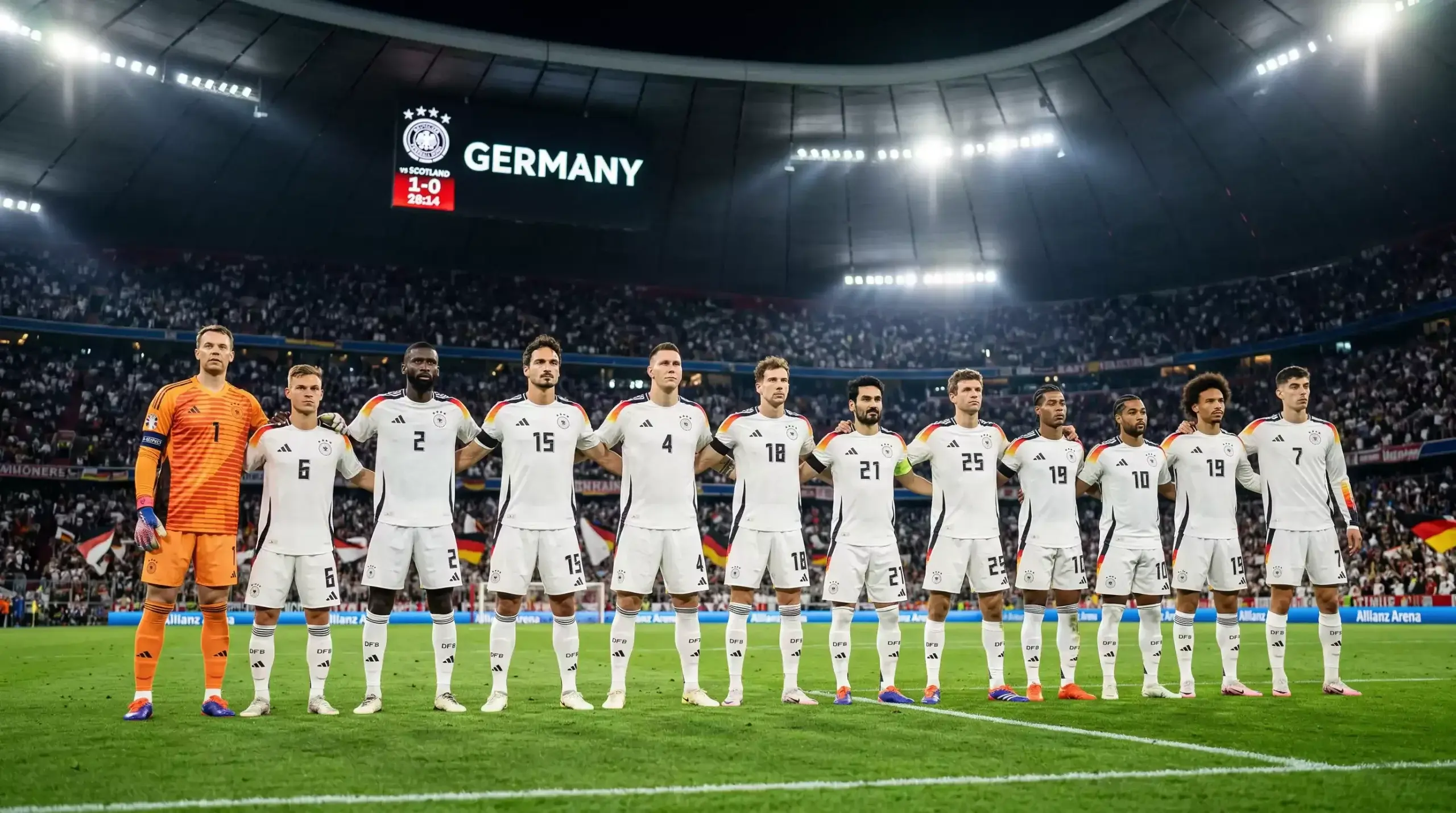
Two consecutive group-stage exits. For any other nation, that might be considered a rough patch. For Germany — four-time World Cup winners, inventors of tournament football as a discipline — it constitutes a crisis. The 2018 and 2022 exits weren’t just disappointing results. They shattered the fundamental German belief that Die Mannschaft always deliver when it matters, that the machine always fires when the stakes are highest. Germany at the 2026 World Cup aren’t just chasing a trophy. They’re chasing proof that the crisis is over.
The home Euros in 2024 offered a partial restoration. Germany played with energy and intent, beating Scotland 5-1 in the opening match and producing performances that reminded the country what their national team could be. The quarter-final exit to Spain — a last-minute Mikel Merino header — was cruel but not humiliating. It showed that Germany could compete with the best again, even if they weren’t yet at the level required to beat them consistently over ninety minutes. The tournament reignited public interest in a national team that had lost the affection of its own supporters after years of stale, uninspiring football.
Now, two years later, the question is whether that Euro 2024 momentum has been sustained or squandered. My analysis of the qualifying data suggests the answer lies somewhere between those two extremes — which, for punters, creates an interesting set of betting angles. Germany have improved enough to reach the knockout rounds comfortably but may not have improved enough to contend for the trophy. That gap between “better” and “best” is where the value sits in the German markets, and understanding it requires a closer look at the qualifying campaign, the squad, and the group draw.
The Road Back: Germany’s Qualifying Campaign
Germany qualified from their European group with 24 points from ten matches, finishing second behind France. That runner-up position matters — it reveals that Germany are not yet back among the very elite but are firmly re-established as a top-eight team in world football. The 3-0 defeat in Paris was a chastening experience, with France’s pressing overwhelm exposing the gaps in Germany’s midfield structure that better opponents can exploit. The 2-1 loss at home to France in the reverse fixture was closer in quality but equally revealing — Germany created chances, played with intent, but couldn’t match France’s clinical finishing in the decisive moments. These results were the clearest evidence of where Germany stand: competitive against the best but ultimately a tier below France, Spain, and arguably England in terms of tournament-winning capability.
Against the rest of the group, Germany were dominant. Seven victories from eight matches against Norway, Israel, and Hungary produced a goal difference of +18 and a defensive record that conceded just four goals outside the France fixtures. The performances against Norway were particularly encouraging — a 4-0 home win and a 3-1 away victory showcased an attacking fluency that had been missing from German football for years. Florian Wirtz scored in both Norway matches, his movement between the lines reminiscent of the kind of creative midfielder Germany haven’t produced since Mesut Özil’s prime.
The defensive improvements were the most significant development. Germany’s 2022 World Cup exit was built on a defence that leaked goals against Japan and Costa Rica — matches they should have won comfortably. The current set-up, built around a more disciplined midfield pressing structure, has reduced the defensive errors that plagued previous campaigns. Germany conceded just eight goals in ten qualifiers, their best qualifying record since the 2014 World Cup cycle that ended with the trophy in Brazil. Whether that defensive resilience holds against World Cup-level opposition — rather than the middling quality of the qualifying group — is the question that June will answer.
The squad rotation during qualifying was intelligent. Key players like Wirtz, Musiala, and Sane were rested for less demanding fixtures, ensuring they arrive at the World Cup fresh rather than fatigued. It’s a lesson learned from 2018 and 2022, where Germany’s squad looked physically and mentally exhausted before the tournament even began. The planning this time has been meticulous — fewer friendlies, more targeted training camps, and a clear first-choice eleven that has played together enough to develop the automatisms that tournament football demands.
The Squad: Rebuilding with Familiar Faces
Jamal Musiala is the player around whom Germany’s World Cup hopes are constructed. At 23, he’s established himself as one of the most creative attacking midfielders in world football, combining the dribbling ability of a winger with the passing vision of a classic number 10 and the goalscoring instinct of a striker. His ability to carry the ball through congested midfields, resist challenges, and find the right pass or shot in the final third makes him unplayable on his day. Irish fans will know Musiala from his youth career at Chelsea’s academy — he was born in Stuttgart, raised partly in England, and chose Germany over the Three Lions in a decision that England’s coaching staff reportedly tried desperately to reverse. His 2025-26 Bayern Munich season produced 19 Bundesliga goals and 12 assists, numbers that placed him among the top five most productive attacking midfielders in European football.
The concern — and it’s a significant one for punters — is consistency. Musiala’s best performances tend to come in clusters, followed by quieter spells where he drifts out of matches and appears disconnected from the team’s structure. A World Cup demands peak performance in every game, and whether Musiala can sustain his brilliance across seven matches is the unknown that makes Germany such an unpredictable bet. His Euro 2024 was a microcosm of this pattern: outstanding against Scotland and Hungary, invisible against Spain in the quarter-final when it mattered most. The step from producing moments to controlling matches is the step Musiala needs to take in North America.
Florian Wirtz provides the creative partnership that elevates Musiala’s impact. Where Musiala carries the ball, Wirtz operates in the spaces between the lines — receiving, turning, and threading passes that unlock defences. His goal record from midfield at Bayer Leverkusen has been extraordinary — 14 Bundesliga goals and 11 assists in 2025-26, following the 18-goal campaign that drove Leverkusen’s invincible season. At 23, he’s entering his peak years at exactly the right moment. The Musiala-Wirtz axis is the most exciting midfield partnership Germany have produced since Müller and Özil in 2014, and if both players fire simultaneously, Germany have the creative quality to beat anyone in a single match. The challenge is getting both to perform at their best in the same game — during qualifying, there were matches where Musiala shone and Wirtz was quiet, and vice versa. The synchronisation of these two talents will determine how far Germany go.
In goal, Marc-Andre ter Stegen or Manuel Neuer — the selection debate that has defined German goalkeeping for a decade — continues to provide storylines regardless of who ultimately wears the gloves. Ter Stegen’s distribution and shot-stopping ability make him the more modern choice, while Neuer’s experience and command of the box provide tournament-specific advantages. The defensive partnership has settled around Antonio Rüdiger and Jonathan Tah, who offer the combination of physical presence and progressive passing that the system demands. Rüdiger’s intensity — bordering on aggression — sets the tone for Germany’s defensive approach: front-foot, confrontational, and designed to win the ball back quickly rather than sit and absorb pressure.
The full-back positions remain a concern. Joshua Kimmich, Germany’s most experienced outfield player, has shifted between right-back and midfield across the qualifying campaign without fully establishing himself in either role. His best position is in midfield alongside Wirtz, but the lack of a natural right-back forces tactical compromises. On the left, David Raum offers width and crossing ability but has been exposed defensively against faster wingers — a vulnerability that World Cup-level opponents will target.
Up front, Kai Havertz has repurposed himself as a false nine who drops deep, links play, and arrives late in the box — a role he perfected at Arsenal under Arteta. His Premier League transformation is one of the most remarkable career reinventions in recent football, and Irish fans who watch him every weekend know exactly what he offers: intelligent movement, underrated finishing, and the ability to perform in high-pressure matches without wilting. Havertz scored 16 Premier League goals in the 2025-26 season, his best return, and his understanding of the false nine role — when to drop, when to stay high, when to drift wide — has reached a level that makes him one of the most effective centre-forwards in Europe despite not being a traditional striker. Leroy Sane and Serge Gnabry provide pace on the flanks, though both have been inconsistent at international level — Sane’s tendency to disappear in big matches remains a concern, while Gnabry’s form has declined from the heights of his 2019-2020 seasons. The bench includes Niclas Füllkrug, whose traditional centre-forward play offers a different option when Germany need a target man rather than a false nine — his aerial ability and physical presence make him an effective plan B when subtlety isn’t working.
Group E: Ecuador, Côte d’Ivoire, Curaçao
Germany’s group draw is favourable without being easy. Ecuador represent a genuine test — South American qualifiers have produced a hardened, tactically disciplined squad that will not be intimidated by the German shirt. The Ecuadorians finished fifth in CONMEBOL qualifying, ahead of Chile and Paraguay, and their squad includes several MLS and European-based players who understand the tactical demands of high-level football. The Germany-Ecuador fixture could be tight, and Ecuador at 9/1 to win the match is not unreasonable given South American teams’ track record of upsetting European favourites in World Cup group stages.
Côte d’Ivoire are the African champions, having won the AFCON on home soil in early 2024 with a remarkable run that included a comeback from the brink of group-stage elimination. Their squad is experienced and physically imposing, with several Premier League and Ligue 1 players offering genuine quality across every position. Sébastien Haller, Franck Kessié, and Nicolas Pépé provide attacking firepower that can punish defensive lapses, while the midfield partnership of Ibrahim Sangaré and Seko Fofana offers both physical dominance and technical ability. The Germany-Côte d’Ivoire match will be a physical contest where Germany’s technical superiority is tested by African pace, power, and directness. Recent history suggests African champions perform well at subsequent World Cups — Cameroon (1990), Senegal (2002), and Côte d’Ivoire themselves have a tradition of exceeding expectations on the global stage.
Curaçao are the group’s debutants and the smallest nation at the tournament by population. Their presence is a beautiful story — an island of 150,000 producing a World Cup squad — but the competitive reality is that they’ll be outmatched against all three opponents. Their squad relies heavily on dual-nationality players from the Netherlands, where the Curaçaoan diaspora has produced several professionals who chose to represent their parents’ homeland rather than compete for a place in the Dutch squad. Germany should beat them comfortably, and the match represents an opportunity to rest key players and build goal difference before the knockout rounds. For Irish neutrals, the Curaçao matches will carry the same romantic appeal as Haiti’s games in Group C — small-island football on the biggest stage, a reminder of why the expanded 48-team format, for all its logistical challenges, has delivered stories that the old 32-team tournament never could.
Germany are 2/7 to win the group, a price that looks about right. The value in this group lies in Ecuador to finish second at 6/4 — they have the quality and the temperament to beat Côte d’Ivoire and Curaçao, and a draw against Germany would secure qualification. My prediction: Germany top with 7 points, Ecuador qualify in second with 6, and Côte d’Ivoire finish third with 4 points — enough for a shot at the best third-place route.
Germany’s Odds: Value or a Trap?
Germany are 12/1 to win the World Cup, a price that has drifted from 10/1 since the draw. The drift reflects two factors: the memory of consecutive group-stage exits, and the qualifying campaign’s revelation that Germany are a tier below France and Spain. I think 12/1 is approximately fair — Germany have a realistic chance of reaching the semi-finals but lack the defensive consistency and squad depth to be considered genuine favourites. The comparison with Spain is instructive: Spain’s squad is younger, deeper, and more tactically evolved, yet Spain are only 7/1. The 5/1 gap between Spain and Germany in the outright market accurately reflects the difference in quality between the two European contenders.
The market where I see the best value is Germany to reach the quarter-finals at 6/4. Their group draw should deliver a comfortable passage to the Round of 32, and the knockout bracket opens up a path that could avoid France, Brazil, and Argentina until the quarter-final stage. If the draw falls kindly, Germany’s attacking talent — Musiala, Wirtz, Havertz — is capable of winning any individual match. It’s sustaining that level over seven games that remains the challenge. The quarter-final is their most likely exit point — the stage where they’ll face a genuine contender for the first time and where their defensive vulnerabilities are most likely to be exposed.
For player markets, Musiala as Germany’s top goalscorer at the tournament is available at 7/4 — a price that doesn’t fully reflect his advanced role and shooting volume. Wirtz at 5/2 for the same market is the each-way alternative. Both players will have more goal opportunities than the traditional strikers because of their positions between the lines, where chances are more frequent and better quality. For a speculative angle, Füllkrug to score in every group match at 20/1 is the kind of long-shot punt that a tournament produces — he’s likely to start against weaker opponents where Germany will dominate possession and create chances for a traditional striker.
The Redemption Arc: Can Germany Stop the Slide?
Germany’s World Cup trajectory since 2014 reads like a cautionary tale. Champions in Brazil, semi-finalists at no major tournament since, and group-stage exits in both 2018 and 2022. The decline has been compounded by structural issues within German football — a Bundesliga that has become tactically predictable with Bayern Munich’s decade of domestic dominance reducing competitive intensity, a youth development system that prioritises technical ability over competitive mentality, and a national team culture that lost its edge after the 2014 triumph. The complacency that followed the Brazil victory seeped into every level of the programme, from player selection to tactical preparation.
The home Euros in 2024 arrested the slide without reversing it. Germany played with energy and passion, reconnected with their supporters, and produced performances that suggested the worst was behind them. But the quarter-final exit to Spain — conceding a goal in the last minute of extra time after leading for most of the second half — left a familiar feeling of near-miss. Toni Kroos retired after that match, taking with him the last direct connection to the 2014 triumph and leaving the squad in younger, less experienced hands. The pattern is clear: Germany can produce outstanding individual matches but can’t sustain that level across a tournament. The 5-1 win over Scotland at Euro 2024 was followed by a laboured 2-0 over Hungary. The attacking brilliance against the Netherlands in qualifying was followed by passive, cautious displays against France.
The cultural shift required goes deeper than tactics or personnel. German football’s identity was built on efficiency, discipline, and collective effort rather than individual brilliance. That identity has been diluted by a generation of players who grew up watching Barcelona’s tiki-taka and tried to replicate it rather than playing to traditional German strengths. The current coaching staff have attempted to blend the old German virtues — pressing intensity, physical dominance, set-piece efficiency — with the technical ability of the Musiala-Wirtz generation. The result is a hybrid team that’s more entertaining than recent German sides but less reliable in the decisive moments where tournament football is won and lost.
For punters, this inconsistency creates a specific market approach. Back Germany in individual match markets where their attacking talent can shine — match result, first goalscorer, total goals. Avoid tournament-long markets like outright winner and semi-finalist where their inability to maintain form across six or seven matches becomes a liability. Germany at the 2026 World Cup are a team you want to bet on match-by-match, not as a tournament accumulator. Their ceiling is the semi-final. Their floor, terrifyingly for a nation of their stature, is another group-stage exit. The truth will likely land somewhere between — a quarter-final departure that generates familiar questions about whether Germany have truly recovered or whether 2014 was the last great act of a footballing superpower entering a painful period of readjustment. I suspect it’s neither — Germany are transitioning, not declining, and the 2026 World Cup will reveal how far that transition has progressed.