
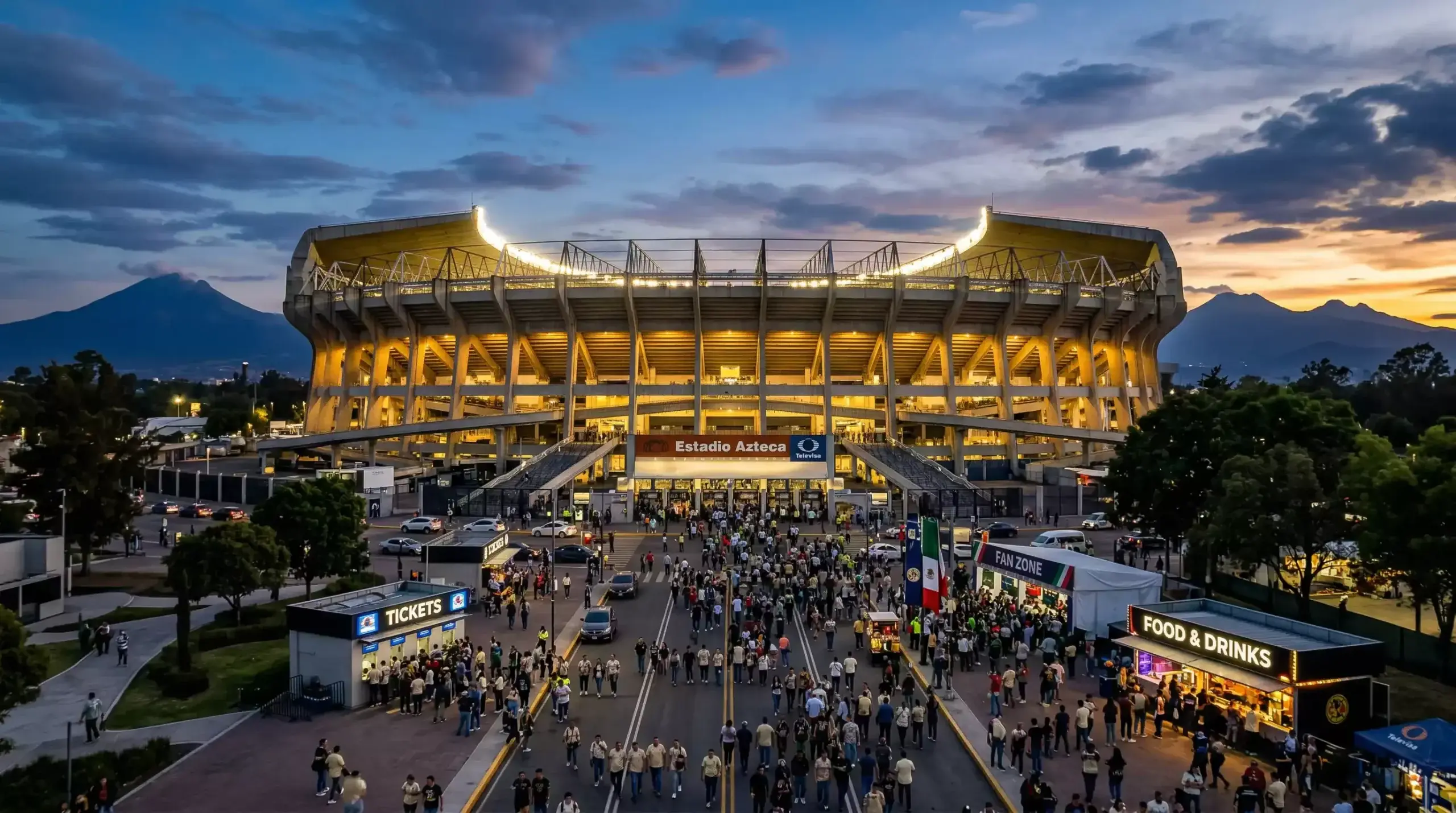
Every World Cup needs a beginning, and this one starts where three of them have started before — at the Estadio Azteca in Mexico City, 2,240 metres above sea level, where the thin air and ninety thousand voices will greet Mexico against South Africa on 11 June 2026. Group A is the tournament’s opening act, and it carries a particular sting for anyone watching from Ireland. Czechia — the team that knocked Ireland out on penalties in Prague just ten weeks before the tournament begins — sit in this group as a constant reminder of what might have been. The World Cup 2026 Group A preview starts with that ache and moves through four teams who each bring something distinct to the tournament’s first chapter.
Mexico: Hosting the Opening Night
The last time Mexico opened a World Cup was 1986. Diego Maradona scored the Hand of God goal in that tournament. Pelé starred in 1970, the other time the Azteca hosted a World Cup. The stadium has witnessed more legendary football moments than any other venue on the planet, and on 11 June 2026, it adds another chapter. Mexico versus South Africa under floodlights, the host nation stepping out to the roar of a crowd that has been waiting a generation for this moment.
Mexico’s squad for 2026 reflects a team in transition. The golden generation of Chicharito, Guardado, and Ochoa has passed the baton to a younger cohort with fewer European credentials but greater collective intensity. Santiago Giménez leads the forward line — a striker who sharpened his finishing at Feyenoord in the Eredivisie before making a move that brought him closer to Europe’s elite. Behind him, the midfield is built on work rate and tactical discipline, qualities instilled by a coaching staff that understands Mexico’s greatest strength has always been collective organisation rather than individual brilliance.
The “quinto partido” curse — Mexico’s inability to advance beyond the round of 16 in seven consecutive World Cups — hangs over every tactical discussion. In the new expanded format, simply reaching the round of 32 is the minimum acceptable outcome for a host nation. Mexico need to top Group A or finish as a strong second to guarantee a favourable knockout draw, and the combination of home support, altitude advantage at the Azteca, and a group lacking a genuine heavyweight makes this achievable.
Mexico are priced at around 8/13 (1.62) to top the group, which implies roughly a 62% probability. That pricing accounts for home advantage and a favourable draw but does not ignore the inconsistency that plagued Mexico’s recent CONCACAF Nations League campaigns. The value play is Mexico to win their opening match against South Africa at 4/6 (1.67) — a host nation in the opening fixture of a World Cup has an extraordinary record, and the emotional energy of the Azteca will be worth at least a goal.
South Korea: 2002’s Ghosts and Modern Ambitions
When South Korea co-hosted the 2002 World Cup, they reached the semi-finals — a result that remains the best performance by an Asian nation in tournament history. Twenty-four years later, that squad’s heroics still define how Korea approach major tournaments: with fearless pressing, extraordinary fitness levels, and a collective spirit that compensates for a gap in individual quality against Europe and South America’s elite. The 2026 squad carries forward that tradition while adding a level of technical sophistication that previous Korean generations lacked.
The headline name is obvious: Son Heung-min. At thirty-three, this is almost certainly his final World Cup, and the Tottenham captain will carry Korea’s hopes with a determination that borders on obsessive. Son’s left foot remains one of the most dangerous weapons in world football, and his ability to create something from nothing in tight spaces gives Korea a dimension that no other team in Group A possesses. Behind Son, the squad draws from the K League and lower tiers of European football, with a smattering of Bundesliga and Premier League experience in the defensive and midfield units.
Korea’s qualification through the Asian section was characteristically solid — they topped their final group ahead of Iran and Australia, winning seven of ten matches and conceding only six goals. The defensive organisation under their manager is the squad’s calling card: a compact 4-4-2 that transitions into a 4-2-3-1 when in possession, with Son drifting inside from the left to find pockets of space between opposition midfield and defensive lines.
The betting market has Korea at roughly 11/4 (3.75) to top Group A, making them the primary threat to Mexico. I think that price is slightly generous — Korea have the individual quality in Son and the collective discipline to beat any team in this group on a given day. The Korea-Mexico fixture will likely decide who finishes first, and the outcome depends heavily on which venue hosts it. If Korea play Mexico in the United States rather than at the Azteca, the altitude advantage disappears, and the match becomes significantly more competitive.
South Africa: Back After a Long Absence
South Africa’s last World Cup appearance was 2010, when they hosted the tournament and became the first host nation eliminated in the group stage — a distinction nobody wanted. Sixteen years later, Bafana Bafana return to football’s biggest stage through an African qualification campaign that finally delivered on years of promise and near misses. South Africa topped a group containing Morocco B-team-level opposition but also navigated tricky away fixtures in West Africa with a maturity that previous generations lacked.
The squad’s strength lies in its spine: a goalkeeper tested in European football, a centre-back pairing with physical attributes suited to the World Cup’s demanding schedule, and a midfield engine room that presses with intensity and recovers possession in advanced positions. The attacking options are less certain — South Africa lack a proven goalscorer at the highest level, and their creative output in qualification relied heavily on set pieces and wide deliveries rather than intricate combination play. Against Mexico in the opening fixture, South Africa will need to be defensively resolute and clinical with limited chances. The altitude at the Azteca adds an additional challenge for players unaccustomed to performing at 2,240 metres.
South Africa are priced at around 8/1 (9.00) to qualify from Group A, which makes them the group’s clearest outsider. The path to qualification likely requires a win against Czechia — the most evenly matched fixture in the group on paper — and points from at least one of the other two matches. A draw against Korea and a competitive defeat to Mexico could leave South Africa on four points, which might be enough for a third-place qualification spot depending on results in other groups. The value is thin at the current price, but South Africa’s physical attributes and set-piece threat make them dangerous in individual matches.
Czechia: The Team Ireland Fans Know All Too Well
Prague, 26 March 2026. I was watching from a hotel room in London with a group of Irish journalists, and the silence after the fourth Czech penalty hit the net was something I will not forget quickly. Czechia beat Ireland 4-3 on penalties after a 2-2 draw in the playoff semi-final, and the cruellest possible margin separated two nations heading in opposite directions — one to the World Cup, the other to the sofa. For Irish fans, Czechia’s presence in Group A is a wound that has not yet healed, and every match they play will be watched through the lens of what might have been.
Setting aside the emotional context, Czechia are a competent, well-coached team that overachieves relative to their resources. The squad features a blend of Bundesliga and Serie A professionals, anchored by a goalkeeper who ranks among the most reliable in European football and a centre-forward whose movement and finishing in the box make him a threat against any defence. The tactical approach is pragmatic: Czechia defend in a mid-block, transition quickly through direct passes into the forward line, and rely on the individual quality of two or three key players to create chances in the final third.
Their qualification for 2026 came through that playoff victory over Ireland followed by a second-leg win against Georgia in the playoff final. The journey through the group stage was solid — second place behind a dominant Spanish team, ahead of Hungary and Armenia. Czechia do not dazzle, but they rarely collapse. In a group with Mexico, South Korea, and South Africa, that consistency could be enough to secure third place and a potential route to the round of 32 through the third-placed qualification pathway.
Czechia are priced at around 9/2 (5.50) to qualify from Group A, which reflects their status as the group’s third or fourth strongest team depending on your assessment of South Africa. For Irish punters, there is a perverse entertainment value in betting against Czechia — but the market does not reward spite. Objectively, Czechia have the squad to compete in every match and the defensive organisation to take points off Korea and South Africa. A small each-way punt on Czechia to finish third at roughly 5/2 is the dispassionate play, however much it pains me to suggest it.
Fixtures and IST Kick-Off Times
Group A’s schedule is shaped by geography: two of the four teams have matches at the Azteca in Mexico City, which means kick-off times adjusted for the Central Time Zone (CT), one hour behind Eastern Time. For Irish viewers on IST (UTC+1 during summer), the conversion adds six hours to CT and five hours to ET.
The opening match — Mexico versus South Africa on 11 June — will kick off at a time designed for maximum global audience, likely 18:00 local time (01:00 IST on 12 June). This is a late start for Ireland but fits the pattern of World Cup opening ceremonies, which traditionally run into the early hours in European time zones. If you plan to watch, consider it a Thursday night special that bleeds into Friday morning — exactly the kind of occasion that justifies a day off work.
Subsequent Group A matches will rotate between Mexican and American venues. The South Korea fixtures in particular may be scheduled at US-based stadiums, where kick-off times of 13:00-18:00 ET translate to 18:00-23:00 IST — more comfortable viewing for Irish fans. The Czechia matches carry lower profile but remain emotionally charged: expect RTÉ to broadcast at least one Czech fixture given the Irish angle, and expect the pubs to fill with fans who are watching with complicated feelings.
The final matchday features simultaneous kick-offs, and if the group is tight — which it should be — those parallel fixtures will deliver the kind of permutation drama that makes the World Cup group stage irreplaceable theatre.
Group A Prediction
Group A is the kind of quartet where three teams genuinely believe they can qualify and the fourth — South Africa — has enough quality to spoil someone’s party. My prediction: Mexico top the group with seven points, benefiting from home advantage in their Azteca fixture and the emotional energy of opening the tournament. South Korea finish second with five points, taking a draw from Mexico and winning their other two matches with the controlled efficiency that Korean teams deliver at major tournaments. Czechia finish third with four points — a win against South Africa, a draw with Korea, and a defeat to Mexico. South Africa finish fourth with one point.
The accumulator legs I like from Group A: Mexico to beat South Africa in the opening match at 4/6 (1.67), and South Korea to qualify from the group at 2/5 (1.40). Both represent probabilities I rate higher than the market implies. For a longer-odds play, the South Korea versus Mexico fixture offers value on the draw market — two well-organised teams with clear tactical identities often cancel each other out, and the draw price around 12/5 (3.40) is worth considering for a standalone bet.
For Irish viewers, Group A’s real value is the narrative thread that connects Dublin to Prague and Prague to the Azteca. Watch Czechia and feel what you feel. Then switch to the full World Cup groups overview and find a team to adopt. The World Cup waits for no one’s broken heart.