
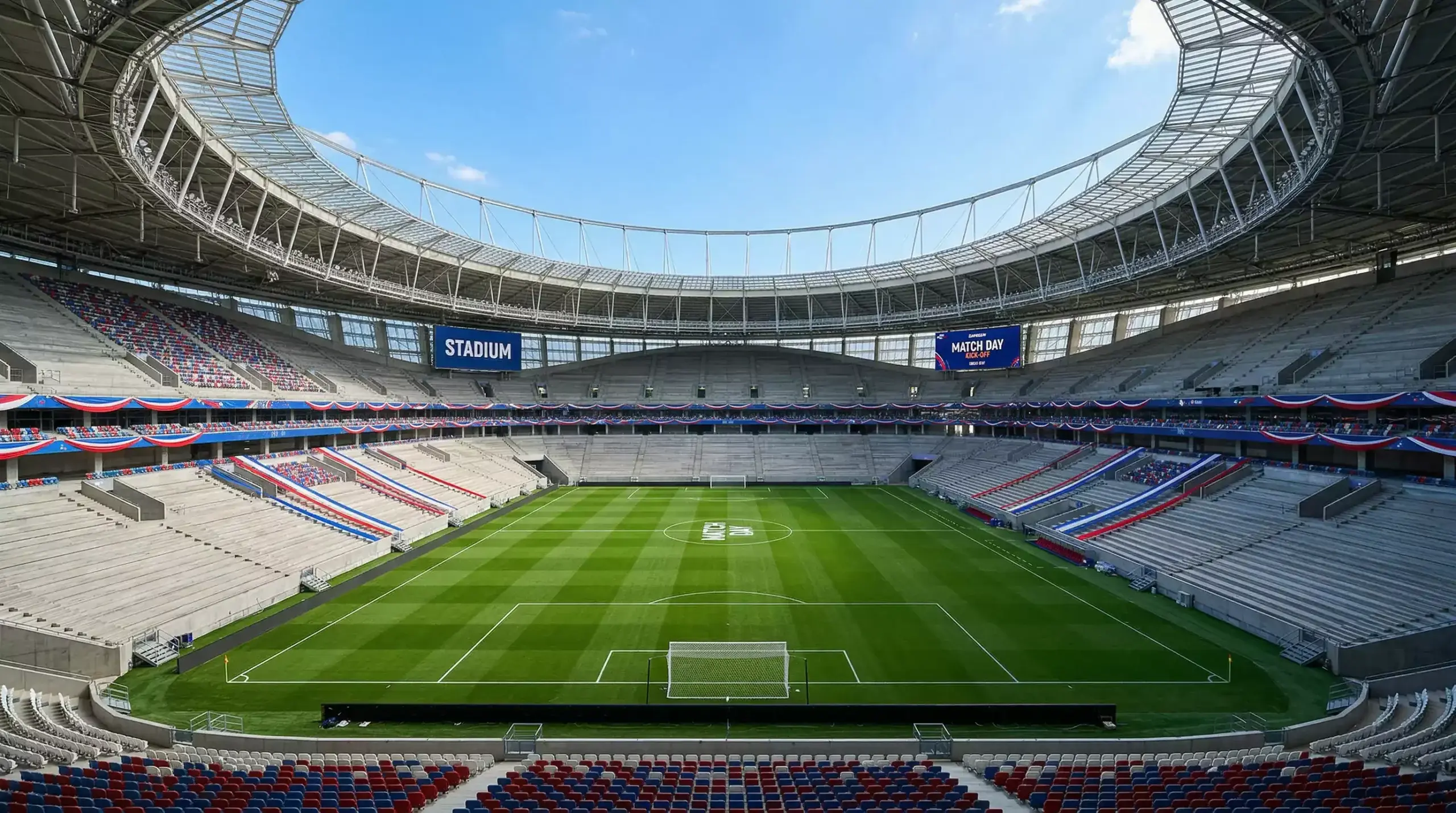
Home advantage at a World Cup is supposed to simplify things. The crowd is yours, the travel is manageable, and the group draw — whether by luck or design — tends to be kind. But Group D at the 2026 World Cup tests that theory, because the United States have drawn three opponents who each carry enough quality to make life uncomfortable. Australia bring their relentless physicality. Paraguay bring South American defensive stubbornness. And Turkey bring a golden generation of talent that has been threatening to explode at a major tournament for three years. The World Cup 2026 Group D preview asks one question above all: does hosting the tournament actually help?
USA: Home Crowd, Home Pressure
I spent a week in the United States last November, and the transformation in football culture since the 2022 World Cup is staggering. Kids in Brooklyn wear Pulisic shirts. Bars in Austin show MLS matches alongside the NFL. The sport has found a foothold that previous generations of American soccer advocates could only dream about. Now comes the test: can the USMNT convert cultural momentum into tournament performance in front of a home crowd that expects — for the first time in American football history — genuine contention rather than plucky participation?
The squad is the most talented in American football history. Christian Pulisic, now entering his peak years in his late twenties, leads the attacking line with a combination of pace, technical quality, and big-game temperament that makes him a genuine threat against any defence in the tournament. Weston McKennie provides the midfield box-to-box dynamism, while Gio Reyna — when fit and firing — offers the creative vision that unlocks defences in the final third. The defensive unit has matured significantly since the 2022 World Cup, with several players now established starters in the Premier League and Bundesliga.
The home advantage factor is real but complicated. Playing in American stadiums eliminates travel fatigue and jet lag, gives the crowd a partisan edge, and ensures the logistical support network is operating on home territory. However, World Cup history shows that host nations face a unique psychological burden. South Africa in 2010 became the first host eliminated in the group stage. Japan and South Korea in 2002 both advanced but under extraordinary emotional pressure. The United States in 1994 reached the round of 16 before losing to Brazil — a respectable run but not the breakthrough the host nation craved.
Betting markets price the USA at roughly 1/2 (1.50) to top Group D, which implies a 67% probability. That looks about right — the squad, home support, and draw justify favouritism. The question is whether the price offers value, and at 1/2, I say no. You are getting poor returns on a team that could easily stumble against Turkey or Australia. The smarter play is to target specific match results rather than group-winner markets where the favouritism is already priced in.
Turkey: A Golden Generation Arrives
Four years ago, Turkey were a team of promise with no delivery mechanism. The talent existed — scattered across the Bundesliga, Serie A, and the Turkish Süper Lig — but the national team framework could not harness it. That has changed. The current generation, anchored by players who came through the academy systems of Galatasaray, Fenerbahçe, and Beşiktaş before moving to Europe’s top five leagues, has coalesced into something resembling a coherent unit. Turkey’s qualification campaign through the European section confirmed what many analysts suspected: this team is better than their FIFA ranking suggests.
The midfield is the engine. Arda Güler, still only twenty-one but already a regular in La Liga, plays with a creative freedom that draws comparisons to a young Mesut Özil — comparisons that Turkish media embrace and the player himself seems unburdened by. Hakan Çalhanoğlu, now in his early thirties, provides the tactical intelligence and set-piece delivery that give Turkey a dead-ball threat rivalling any team in the tournament. In defence, a centre-back partnership forged in Serie A’s tactical furnace gives Turkey the kind of structural resilience that young teams often lack at major tournaments.
Turkey are Group D’s dark horse, priced at around 3/1 (4.00) to qualify and 7/1 (8.00) to top the group. Those prices represent genuine value if you believe — as I do — that the squad’s European experience translates to World Cup performance. The Turkey-USA fixture is the group’s pivotal match: if Turkey take points from the hosts, the group opens up entirely. A Turkish victory — priced at roughly 4/1 (5.00) — is the upset bet I find most compelling in Group D. The talent gap is smaller than the market implies, and the emotional intensity of a Turkish travelling support in an American stadium creates an atmosphere that could unsettle a young US team still learning how to handle expectation.
Australia: The Socceroos’ Fighting Chance
No team at the 2026 World Cup embodies the phrase “never count them out” more than Australia. The Socceroos’ entire footballing identity is built on defying expectations through sheer physical commitment and an unwillingness to accept defeat that borders on the irrational. Their 2022 World Cup campaign — where they beat Tunisia and Denmark to reach the round of 16 — demonstrated that Australian football has moved beyond the “just happy to be here” phase and into genuine competitive territory.
The squad’s Premier League connections make them relevant to Irish viewers. Several players ply their trade in England’s top division, bringing familiarity and a level of exposure that many Group D opponents cannot match. The tactical setup is pragmatic: Australia defend in a compact 4-4-2, use their physical advantages in aerial duels and second-ball recovery, and attack with direct service into a target forward who holds the ball for runners arriving from midfield. It is not pretty, but it is effective — and in a World Cup group stage, effectiveness outscores aesthetics every single time.
Australia qualified through the Asian section with a campaign that included a playoff victory, reflecting the increased competitiveness of the confederation. Their group-stage challenge is significant: the USA, Turkey, and Paraguay all present different tactical problems. The USA will dominate possession. Turkey will match Australia’s physical intensity while adding superior technical quality. Paraguay will compete in the exact same tactical territory — physical, combative, defensively organised — leaving the fixture between them as the group’s most attritional encounter.
Betting markets have Australia at roughly 7/2 (4.50) to qualify from Group D, which reflects their status as the group’s third-strongest team. The Socceroos’ path likely requires beating Paraguay, taking a point from either the USA or Turkey, and hoping the third-place tiebreakers fall their way. At 7/2, there is marginal value for punters who respect Australia’s tournament experience and physical resilience, but the downside risk is real — this is a group where three teams are separated by fine margins.
Paraguay: South American Grit
Paraguayan football operates by a simple code: you do not outplay opponents, you outwork them. The national team has built its entire World Cup history — which includes a quarter-final appearance in 2010 — on defensive discipline, set-piece efficiency, and an attitude towards physical confrontation that makes every match feel like a war of attrition. The 2026 squad maintains that tradition while adding a younger element from the Paraguayan league and Argentine football’s second tier.
Paraguay’s qualification through the South American section — the world’s most competitive — validates their presence at the tournament. Finishing in the qualification spots ahead of nations like Chile and Bolivia required sustained consistency across eighteen matches, a feat that speaks to the squad’s mental toughness. The tactical approach is predictable but difficult to counter: a deep defensive block, aggressive man-marking in midfield, and rapid transitions through long diagonal balls into the channels where quick forwards exploit the spaces left by advancing full-backs.
The key players are largely unknown to European audiences, which is both a blessing and a curse. The anonymity means opponents cannot prepare for specific individual threats with the same precision they would for a Pulisic or Güler. The downside is that Paraguay’s creative output relies on moments of inspiration rather than systematic construction, making them vulnerable in matches where they need to chase a result. Against the USA and Turkey — both teams who will happily dominate possession and wait for Paraguay to commit forward — that vulnerability could prove decisive.
Paraguay are priced at around 5/1 (6.00) to qualify from Group D, making them the group’s outsider alongside Australia. The realistic path requires three points from the Australia match, a point from one of the remaining fixtures, and favourable third-place permutations. At 5/1, the value is marginal — Paraguay’s defensive strength keeps them competitive in every match, but their limited attacking options make accumulating points difficult against organised opposition. The single-match angle I favour is Paraguay to draw with Australia at 23/10 (3.30), a fixture where two evenly matched teams with similar tactical identities could well cancel each other out.
Fixtures and IST Kick-Off Times
Group D benefits from being hosted entirely in the United States, which means kick-off times fall in the ET (Eastern Time) zone — five hours behind IST during summer. A 1pm ET kick-off becomes 6pm IST; a 7pm ET start becomes midnight IST. The range of start times across Group D fixtures should give Irish viewers a mixture of comfortable evening viewing and later nights.
The USA’s opening fixture — likely against Turkey or Paraguay — will receive a primetime American broadcast slot, pushing the kick-off to 7pm or 9pm ET (midnight or 2am IST). Irish fans committed to watching the hosts will need to plan for late nights, though the USA’s matches are likely to feature heavily on Irish broadcast schedules given the general interest in the host nation’s progress. The Australia-Paraguay fixture, carrying lower commercial weight, may receive an earlier slot — 1pm or 4pm ET (6pm or 9pm IST) — which suits Irish viewers perfectly.
The Turkey fixtures deserve particular attention for neutral viewers. Arda Güler on the World Cup stage, facing the tournament hosts, is the kind of appointment viewing that transcends group-stage formality. If Turkey play the USA in a late ET slot, Irish fans should consider it essential viewing regardless of any other plans. This is the fixture most likely to produce a result that reshapes the group and sends the betting markets into recalibration mode.
Group D Prediction
My Group D prediction reflects the narrow margins separating the top three teams. The USA top the group with seven points — two wins against Australia and Paraguay, and a draw with Turkey. Turkey finish second with five points, beating Paraguay and Australia while drawing with the hosts. Australia finish third with three points from a win against Paraguay. Paraguay finish fourth with one point from a draw with Australia, their defensive discipline keeping them competitive but their attacking limitations ultimately costing them.
The accumulator leg I take from Group D is the USA to qualify at 1/7 (1.14) — safe, boring, but reliable as part of a larger accumulator. For standalone value, Turkey to qualify at 3/1 (4.00) represents the best odds-to-probability ratio in the group. Turkey’s squad depth, European experience, and tactical maturity under tournament conditions make them a genuine threat to both the USA and Australia. A small stake on Turkey to top the group at 7/1 (8.00) is the long-odds play for punters who trust the talent and believe home advantage is overstated in modern World Cup football.
Group D will not generate the emotional intensity of Group C for Irish viewers, but it offers something equally valuable for punters: a group where the market has a clear favourite that could be upset, where the second-place battle is genuinely open, and where individual fixtures — particularly USA versus Turkey — present identifiable betting angles rooted in tactical mismatches and motivational dynamics. Watch it as a punter, and Group D rewards the investment.