
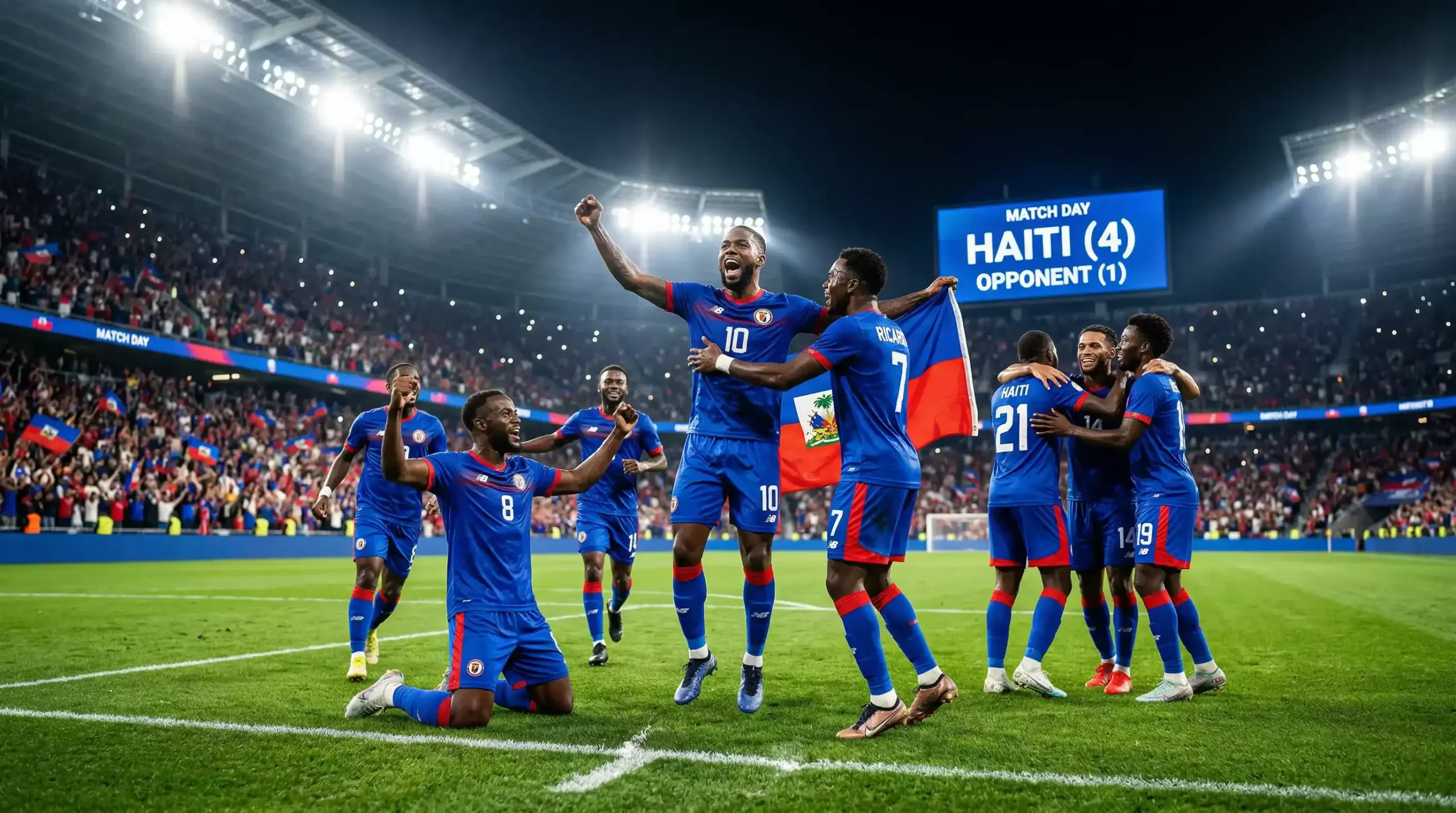
Fifty-two years. That’s how long Haiti have waited to return to the World Cup. Their last appearance, in 1974 in West Germany, is a faded memory that most of the current squad’s grandparents barely recall. An island of eleven million people, battered by earthquakes, hurricanes, political instability, and economic hardship that would have crushed a lesser footballing culture — and yet here they are, heading to North America with a squad that qualified on merit through the most competitive CONCACAF qualifying process in history. Haiti at the 2026 World Cup isn’t just a football story. It’s a story about resilience, identity, and the irrational, beautiful belief that sport can transcend circumstance.
For Irish fans, Haiti carry a particular resonance. We know what it means to wait for a World Cup — 24 years and counting since our last appearance in 2002 — and we know the heartbreak of coming close and falling short. Haiti didn’t fall short. They made it. And the fact that they landed in Group C alongside Scotland, the team we’ve adopted as our own, makes them the most emotionally compelling underdog at the tournament. I’ll be cheering for Scotland to beat them, of course, but I won’t pretend I won’t feel a twinge of joy if Haiti produce a result that nobody outside of Port-au-Prince expected.
How Haiti Qualified: A Journey Like No Other
Haiti’s path to the World Cup began in the CONCACAF qualifying rounds, where they needed to navigate a process designed to whittle 35 Caribbean and Central American nations down to the six that would join the United States, Mexico, and Canada at the tournament. The journey started in the preliminary rounds against smaller Caribbean islands — matches played on pitches that would be rejected by most amateur leagues in Europe, in front of crowds that arrived on foot because there was no parking, under floodlights powered by generators because the local grid couldn’t be trusted.
The breakthroughs came in the later rounds. A 2-1 victory over Jamaica in Kingston — Haiti’s first competitive win on Jamaican soil in over a decade — announced their credentials to the wider CONCACAF community. A 1-0 home win over Honduras in Port-au-Prince, played in front of 30,000 supporters who created an atmosphere that visiting teams described as the most intimidating in the region, sealed their place in the final qualifying round. The decisive match was a 0-0 draw against Costa Rica that secured qualification on goal difference — a result achieved through 90 minutes of defensive discipline so complete that Costa Rica managed just one shot on target.
The squad’s composition tells the story of the Haitian diaspora. The majority of the players were born or raised in the United States, Canada, or France — children of Haitian immigrants who chose to represent their parents’ homeland rather than the country where they grew up. This decision, often made in the face of opportunities to represent wealthier, more competitive national teams, speaks to a connection with Haiti that transcends football. These players carry the flag not because it advances their careers — it doesn’t — but because representing Haiti means something to their families and their community that no club contract can replicate.
Frantzdy Pierrot, born in Leogane, Haiti, leads the attack with the raw physicality and aerial ability that CONCACAF defenders fear. His strength in holding up the ball and bringing teammates into play gives Haiti an outlet when they’re under sustained pressure — and against Brazil, Morocco, and Scotland, they’ll be under sustained pressure for large stretches of every match. Behind him, a midfield built around players from MLS, the Canadian Premier League, and French lower divisions provides the technical platform that the coaching staff has refined over three years of competitive matches. Derrick Etienne Jr., born in New York to Haitian parents, offers pace and directness from the wing that can trouble any defence in transition. The goalkeeper, Josue Duverger, plays for a French Ligue 2 club and brings European-level shot-stopping to a defence that will need every save he can produce in Group C.
Group C: Brazil, Morocco, Scotland — and Haiti
There is no gentle way to say this: Haiti will almost certainly finish last in Group C. The quality gap between them and Brazil, Morocco, and Scotland is substantial, and any honest assessment of their chances must acknowledge that winning a match against any of these three opponents would be one of the greatest results in World Cup history. The odds reflect this reality — Haiti are 500/1 to win the tournament and available at 10/1 to win any individual group match.
But World Cups are not played on spreadsheets. Haiti will bring an energy and fearlessness that more established teams can’t replicate because they have nothing to lose and everything to gain. Their opening match against Scotland on June 15 in Houston will be the first World Cup match most of these players have ever experienced, and the adrenaline of that occasion could produce a first-half performance that catches Scotland off guard. The Haitian diaspora in Houston and across Texas will fill their section of NRG Stadium with noise and colour, creating a pocket of support that could rival anything Scotland’s Tartan Army generates.
Against Morocco, Haiti’s physical approach could disrupt the African champions’ passing game for periods, though Morocco’s quality will eventually tell. Against Brazil, the fixture becomes a carnival — the Caribbean meeting the South American giants in a match that represents everything the expanded 48-team World Cup was designed to produce. A Haiti goal against Brazil would generate one of the most joyous celebrations in World Cup history, regardless of the final score. At 5/2, Haiti to score in the Brazil match is a bet that their fearless attacking approach and the emotional energy of the occasion support.
Why Every Neutral Should Adopt Haiti
The case for adopting Haiti as your secondary team at this World Cup writes itself. They represent everything that football romantics value — the triumph of passion over resources, the belief that eleven players from an island in the Caribbean can compete on the same pitch as five-time World Cup winners. Their story resonates with Irish sensibilities in a way that few other teams at the tournament can match. We understand what it means to be the underdog. We understand the pride that comes from simply being there, regardless of the results. And we understand that football is at its most beautiful when the smallest teams produce the biggest moments.
Haiti’s presence in Group C adds a dimension that pure footballing quality can’t provide — romance, hope, and the possibility of a moment that transcends the sport itself. When Haiti take the field against Brazil, every neutral in every pub in Ireland will want them to score. That universal goodwill, earned through the hardship their country has endured and the journey their team has undertaken, makes Haiti the spiritual heart of the 2026 World Cup. I’ll have a small bet on them to score in every match — not because the odds justify it, but because some bets are about more than money. They’re about being part of a story that deserves a happy chapter.