
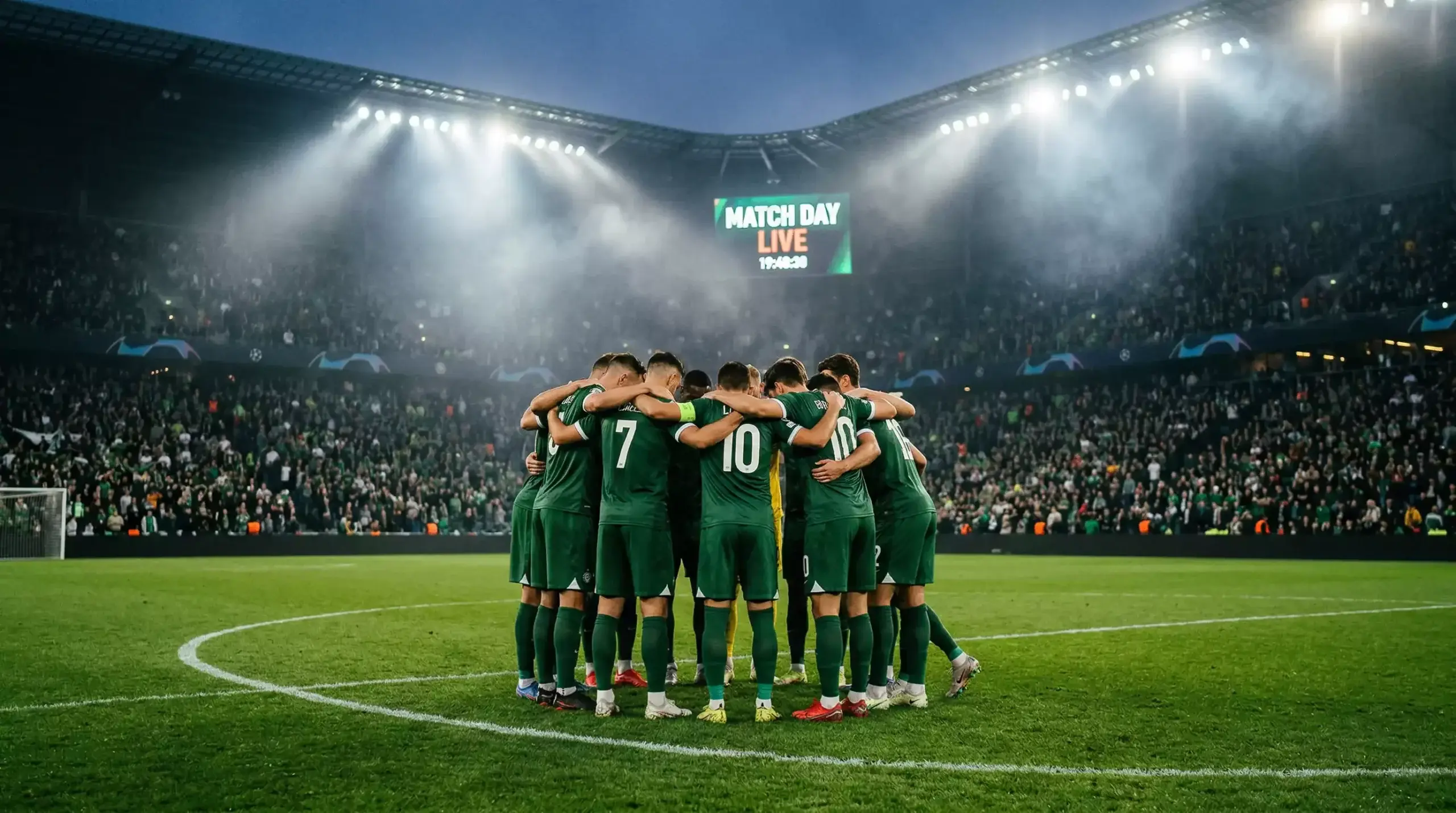
We have not been at a World Cup since 2002. That sentence has become a kind of liturgy for Irish football fans — repeated so often that it has lost some of its sting, worn smooth by years of near-misses and qualifying campaigns that ended one goal, one penalty, one agonising moment short. The 2026 campaign was supposed to be different. For the first time in a generation, Ireland did not just compete in their qualifying group — they dominated it, beating Portugal at home, grinding past Hungary when it mattered, and earning a playoff place that put them 90 minutes from a World Cup that expanded to 48 teams specifically to give nations like ours a chance. And then Prague happened. And here we are again.
This is the story of how Ireland’s World Cup 2026 qualification campaign came closer than any since 2002 — and how the cruellest of exits left an entire country staring at a tournament they should have been part of.
Group F: Portugal, Hungary, Armenia — and Ireland’s Fight
When the draw placed Ireland in Group F alongside Portugal, Hungary, and Armenia, the reaction was cautious optimism. Portugal were the clear top seed — Cristiano Ronaldo’s shadow still looming, even as the squad transitioned to a new generation. Hungary, under Marco Rossi, had become one of Europe’s most disciplined defensive sides, difficult to beat and dangerous on set pieces. Armenia were the weakest team on paper but capable of complicating anyone’s campaign with compact defending and the occasional inspired result.
Ireland’s campaign opened with a grinding 1-0 win over Armenia in Dublin — not pretty, not convincing, but a professional three points that set the tone for what followed. The away fixture in Yerevan was harder, a 1-1 draw that felt like two points dropped at the time but would look considerably better by the end of the campaign. Hungary presented the real test of Ireland’s credentials, and the home match at the Aviva Stadium delivered one of the most electric nights in recent Irish football history.
Hungary came to Dublin sitting second in the group, a point ahead of Ireland, with a defensive record that had conceded just once in three matches. The match was tense, cagey, and goalless until the 84th minute. Then Troy Parrott, lurking on the edge of the box after a half-cleared corner, struck a low shot that deflected off a Hungarian defender and crawled inside the near post. The Aviva erupted. Three points, second place, and a trajectory that suddenly felt real. Ireland followed that with a disciplined draw in Budapest — 0-0, the result they went to Hungary to get — and entered the final group matches knowing that two results against Armenia and Portugal would secure at least second place and a playoff spot.
The Armenia away match, second to last in the group, was nervy. Ireland conceded early from a set piece — a recurring vulnerability — and spent most of the first half chasing the game. Parrott equalised before half-time with a brilliant header from a Robbie Brady cross, and Ireland ground out a 1-1 draw that was enough to keep them in second place heading into the final matchday. The group came down to the last round: Ireland at home to Portugal, with second place and automatic playoff qualification on the line.
The Night Ireland Beat Portugal
June 2025. The Aviva Stadium. A Tuesday evening in Dublin that felt like a Saturday in Rome. Portugal had already qualified as group winners, but their squad was close to full strength — pride, professionalism, and the knowledge that a loss to Ireland would hand their rivals a platform of belief that could carry them all the way to the World Cup. The atmosphere was unlike anything the Aviva had produced since the Euro 2016 qualifiers. Every seat was filled an hour before kick-off. The noise was physical.
Ireland set up in a compact 3-5-2, the shape that had become the team’s identity under the coaching staff’s tactical evolution. The first half was Portugal’s — they had 63% possession and created three clear chances, two of which forced excellent saves from the Irish goalkeeper. Ireland’s back three held firm, the wing-backs tracked every Portuguese run, and the midfield duo screened the defence with an intensity that bordered on reckless. The plan was clear: survive the first half, stay in the game, and strike when Portugal’s concentration dipped.
It happened in the 71st minute. A long ball over the top, played more in hope than precision by the Irish centre-back. Portugal’s defensive line pushed up but failed to coordinate. Troy Parrott, timing his run to perfection, latched onto the ball behind the last defender, took one touch to control, and slotted it past the advancing goalkeeper with the calm of a player who had been waiting his entire career for this moment. 1-0. The Aviva did not just roar — it shook. You could feel the vibration in the press box, in the stands, in the streets outside where thousands who could not get tickets were watching on screens.
Ireland defended for 19 minutes with everything they had. Bodies in front of shots. Clearances that flew into row Z and were cheered like goals. A Portugal free kick in the 88th minute that crashed against the crossbar and bounced out, the Irish goalkeeper rooted to the spot and saved by the woodwork. When the final whistle blew, the pitch invasion was immediate and uncontrollable. Ireland had beaten Portugal. Ireland were in the playoffs. For the first time since 2009, the World Cup felt genuinely, tangibly possible.
Troy Parrott: The Man Who Nearly Took Us There
Six goals in qualifying. Six. For a striker playing in the Irish setup, where chances are rationed and the system prioritises defence, that is an extraordinary return. Troy Parrott did not just score goals in this campaign — he scored the goals. The ones that mattered, at the moments when Ireland needed them most. The deflected strike against Hungary. The equaliser in Yerevan. The winner against Portugal. Every pivotal moment in Ireland’s qualification story had Parrott at the centre of it.
What made Parrott’s campaign so remarkable was the context. He was not playing for a club side regularly contending for trophies or Champions League places. He was a young Irish striker fighting for minutes at club level, arriving at international duty with the kind of hunger that only comes from wanting to prove something beyond club football. The green shirt elevated him. The responsibility of leading the line for his country, in a campaign that genuinely meant something, unlocked a version of Parrott that club managers had been waiting to see.
His goal against Portugal was the moment that defined the campaign, but it was the goal against Hungary — the 84th-minute deflection that kept Ireland in the race — that changed the entire trajectory. Without that goal, Ireland finish third in the group. Without that goal, there is no playoff. Without that goal, the night against Portugal never carries the same stakes. Parrott was the difference between Ireland being part of the conversation and Ireland being an afterthought, and every Irish fan who watched those qualifiers knows it.
The cruel irony is that Parrott’s penalty miss in Prague was the moment that ended the dream he had done more than anyone to create. Sport does that sometimes — it gives the story to the person least equipped to bear its ending. Parrott will carry Prague with him, but the six goals that came before it deserve to be remembered with at least as much clarity.
Prague, 26 March 2026: The Cruellest Exit
Playoff Path D. Semi-final. Czechia versus Ireland. The Sinobo Stadium in Prague, a compact ground that amplified every Czech chant and swallowed every Irish voice. The conditions were cold — early spring in central Europe, a biting wind that made the ball unpredictable and the pitch hard. Ireland had drawn Czechia, a side they had never lost to in competitive football, and the pre-match mood was one of cautious confidence. We had beaten Portugal. We had earned this. Surely, this was the night.
Ireland took the lead in the 23rd minute through a set-piece routine that had been rehearsed specifically for this fixture. A short corner, a low cross to the near post, and a bundled finish that sent the travelling Irish support into delirium. 1-0 away from home in a playoff — the dream was alive. Czechia equalised before half-time from a direct free kick that curled over the wall and nestled in the far corner. 1-1 at the break, and the momentum had shifted.
The second half was chaotic. Ireland scored again in the 58th minute — a counter-attack finished by the right wing-back after a flowing move that covered 60 metres in four passes. 2-1. Fifteen minutes from the World Cup. Every Irish fan watching — in the stadium, in the pubs, on sofas across the country — allowed themselves to believe. Then Czechia scored in the 74th minute from a corner that Ireland failed to clear, a header at the back post that the goalkeeper could not reach. 2-2. Extra time beckoned, but the match ended in regulation, and the penalty shootout arrived with the inevitability of a storm you could see approaching but could not avoid.
The shootout was savage. Czechia scored their first three penalties. Ireland scored their first two but missed the third — the miss that changed everything. Czechia scored their fourth. Ireland’s fourth penalty flew in. Czechia’s fifth was saved — a lifeline, a chance. Ireland stepped up for their fifth, needing to score to keep the shootout alive. Parrott placed the ball on the spot. The same Parrott who had scored six qualifying goals, who had beaten Portugal, who had carried this team to this moment. His penalty went low to the left. The Czech goalkeeper dived the right way and pushed it wide. 4-3 on penalties. Czechia through. Ireland out. The World Cup, which had felt so close that you could almost taste the summer, was gone.
What Now? Ireland’s Football Future
The immediate aftermath of Prague was grief. Not the melodramatic grief of a football disappointment inflated by social media — genuine, heavy, sit-in-silence grief. The kind that comes from watching something beautiful die in front of you, knowing that it will not come back in the same form. The squad that took Ireland to the playoffs will be older by the time the next World Cup qualification cycle begins. Some players will have retired. The window that opened in 2024 and 2025, when a young, hungry Irish team played with a fearlessness that the country had not seen since the Robbie Keane era, may have closed.
But Irish football has been here before, and the pattern is always the same: mourning, followed by renewal, followed by a new generation that carries the same fury and the same impossible hope. The players who came through this campaign — Parrott, the young midfielders who outran Portugal, the centre-backs who shut down Hungary — are still developing. The system that produced a competitive qualifying campaign is still in place. The fan base, which filled the Aviva against Portugal and travelled to Prague in their thousands, is not going anywhere.
The 2026 World Cup will be watched in Ireland with the same passion and the same pain as every tournament since 2002. We will adopt Scotland. We will cheer for the underdogs. We will bet on matches with the analytical clarity of neutrals and the emotional intensity of people who know exactly what it feels like to be one penalty away from belonging. Prague was the cruellest exit in a qualification campaign full of beautiful moments, and the story of Ireland’s World Cup 2026 qualification deserves to be told as what it was — not a failure, but the closest we have come in a generation, and the foundation for everything that comes next.
The World Cup starts on June 11th. Ireland will not be there. But the spirit that beat Portugal, that scored six goals through Troy Parrott, that filled stadiums and broke hearts in Prague — that spirit will be in every Irish pub and every Irish sofa from the opening whistle to the final. We are still here. We always will be.