
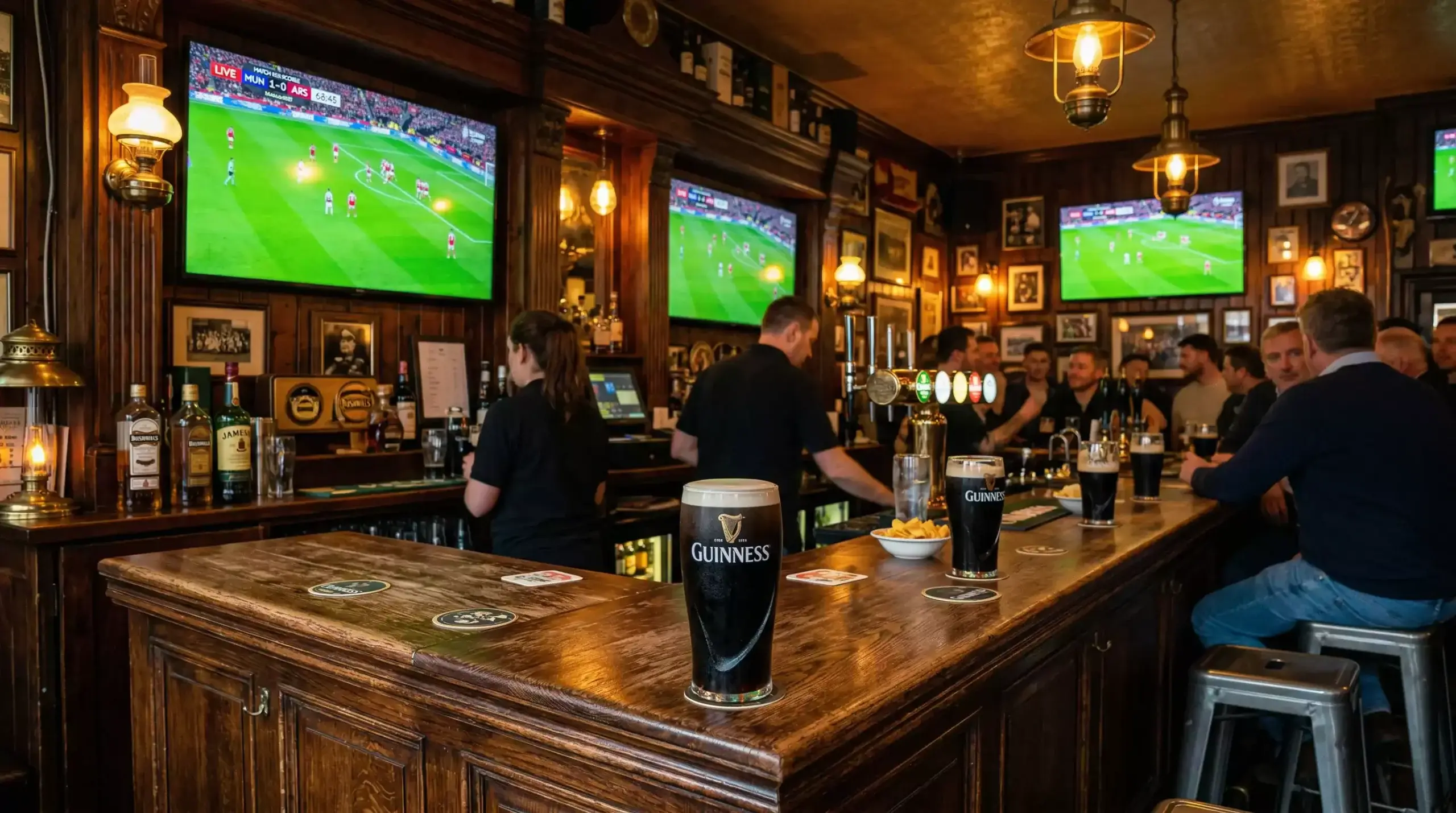
We have been here before. Prague broke our hearts — again. Troy Parrott put everything into that qualifying campaign, scored six goals, dragged a squad beyond what anyone thought possible, and then a penalty shootout in the Czech capital on a cold March evening ended it all. Ireland will not be at the 2026 World Cup. That is six tournaments in a row since 2002, and every time the pain arrives in a slightly different shade. But the World Cup waits for no one, and neither does an Irish football fan with a remote control, a pint, and an opinion on every team in the draw.
This is the guide for every Irish neutral who will spend 39 days watching football that does not involve their own team but will feel every goal, every upset, every penalty as if it did. We have always been good at this — the adopted team, the underdog we claim as our own, the group where we know every player’s name by the end of matchday two. The 2026 World Cup, with 48 teams across three time zones, gives us more football to fall in love with than any tournament in history. The question is not whether you will watch. The question is who you will watch for.
Scotland: The Obvious Choice — and Why It’s Genuine
When the draw paired Scotland with Brazil in Group C, every pub in Dublin roared. Not because anyone expected Scotland to beat Brazil — though stranger things have happened — but because the fixture represented something irresistible: our Celtic cousins on the biggest stage in football, playing the most glamorous team in the sport’s history, with the Tartan Army doing what they do best in the stands. If you are Irish and you do not feel something watching Scotland walk out to face Brazil, I question whether you have a pulse.
The Celtic bond between Ireland and Scotland in football is not a marketing invention. It runs through shared culture, shared history, and a shared understanding of what it means to love a national team that rarely makes it easy on you. Scottish and Irish fans have travelled together to tournaments since the 1990s, and the Tartan Army’s reputation as the best supporters in world football mirrors the standard the Irish set at Euro 1988, Italia 90, and every tournament since. When Scotland play in 2026, there will be more tricolours in the stands than you might expect — and the Scots will welcome every one of them.
Beyond the emotion, Scotland are genuinely worth watching. Steve Clarke has built a squad that competes above its weight through defensive organisation and a fighting spirit that mirrors the Irish approach to international football. John McGinn provides the driving runs from midfield. Andrew Robertson is still among the Premier League’s finest left-backs. Billy Gilmour has matured into a proper midfield conductor. And the squad’s depth has improved markedly from the team that went to Euro 2024 — younger players from the Scottish Premiership and the lower reaches of the English leagues have pushed competition for places to a level Scotland have not enjoyed in decades.
Group C also features Morocco and Haiti, which makes it one of the most compelling groups in the tournament. Scotland versus Morocco is a match that could decide second place in the group. Scotland versus Haiti is a fixture the Tartan Army must win. And Scotland versus Brazil is the fixture that will fill every Irish pub on whatever evening it is scheduled, regardless of the kick-off time. If that is 02:00 IST, so be it. Some matches justify the alarm clock.
England: It’s Complicated, But We’re Watching
I know. I can already hear the groans. But let us be honest with ourselves: more Irish people will watch England’s World Cup matches than any other team’s, and not because they want England to win. The relationship between Irish and English football is woven through decades of the Premier League, through Sunday afternoons at Anfield and Saturday evenings watching Match of the Day, through the dual identity of players like John O’Shea, who played most of his career in England and managed to be both completely Irish and completely at home in Manchester.
England’s Group L — Croatia, Panama, Ghana — is exactly the kind of draw that will produce excellent football and at least one result that sends the Irish internet into meltdown. England versus Croatia is a fixture with genuine World Cup history: Croatia knocked England out in the 2018 semi-final, and every Irish person who watched that match had conflicted feelings that they probably still cannot fully articulate. Panama and Ghana add the underdog factor that makes group stages compelling — a Ghanaian goal against England will be celebrated in certain corners of Ireland more loudly than in Accra itself.
The squad is packed with Premier League names that Irish fans know intimately. Jude Bellingham, the most talked-about young player in world football. Bukayo Saka, whose penalty redemption arc since Euro 2020 has been remarkable. Phil Foden, Declan Rice, Cole Palmer — these are players Irish fans watch every week, argue about in every WhatsApp group, and have strong opinions on regardless of national allegiance. Watching England at the World Cup from an Irish sofa is complicated, yes, but it is also unavoidable, and there is nothing wrong with admitting that some of the football will be thrilling to watch.
My advice for the Irish neutral watching England: embrace the contradictions. Cheer for Croatia in the group stage because the 2018 semi-final was glorious. Back Ghana to cause an upset because the story is irresistible. And then, when England reach the quarter-final against a team you actually like, allow yourself the guilty pleasure of not caring who wins because the match itself will be brilliant. That is the gift of neutrality — you can enjoy the football without the burden of caring about the result.
Underdogs Worth Adopting: Haiti, Curaçao, and More
If there is one thing Irish fans understand, it is the underdog. We have been the underdog at every major tournament we have attended, and the affection we feel for small nations punching above their weight is genuine and deeply rooted. The 2026 World Cup delivers underdog stories that rival anything from previous tournaments, and the Irish neutral should have at least one adopted team from the bottom of the draw.
Haiti are the obvious choice, partly because they are in Scotland’s group and partly because their story is extraordinary. The smallest nation in the Western Hemisphere to qualify for a World Cup in over fifty years, Haiti’s journey to 2026 came through the CONCACAF pathway that required them to beat teams with larger populations, bigger budgets, and more established footballing traditions. Their squad is built on players scattered across the French and Belgian lower divisions, a few MLS regulars, and a core of domestic-based players whose passion for the shirt transcends any conversation about quality. When Haiti take the pitch against Brazil in Group C, it will be the most romantic fixture of the group stage — and Irish fans will know exactly which side they are on.
Curaçao’s story is even more improbable. An island of 150,000 people — smaller than County Cork — playing at a World Cup. Their squad draws heavily on dual-nationality players from the Netherlands, where the Curaçaoan diaspora is concentrated, and the mix of Dutch tactical training and Caribbean flair creates a team that is far more competitive than their FIFA ranking suggests. Group E places them alongside Germany, Ecuador, and Côte d’Ivoire — a brutal draw, but any points they take will feel like a triumph. Curaçao are the 2026 equivalent of Iceland at Euro 2016, and Irish fans fell hard for Iceland’s story then.
Beyond Haiti and Curaçao, keep an eye on Cabo Verde in Group H and New Zealand in Group G. Cabo Verde, an archipelago off the west coast of Africa with a population of 600,000, qualified for their first World Cup through a campaign that united the tiny island nation. New Zealand are the only Oceanian team in the draw and will enter every match as underdogs — a role that Irish fans understand better than most. The All Whites’ fans, small in number but passionate, deserve the same respect and affection that the Tartan Army and the Green Army have earned over decades.
Follow the Premier League Thread
One of the quiet pleasures of a World Cup for any Premier League viewer is recognising the player you watch every week wearing a different shirt and playing in a different system. Irish fans, who consume more Premier League football per capita than almost any nation outside England, will find familiar faces in nearly every squad at the 2026 World Cup. Following the Premier League thread through the tournament is one of the most natural ways to pick which matches to watch.
Start with the obvious: Mohamed Salah with Egypt in Group G. Salah is the most watched player in Irish football by virtue of Liverpool’s massive following on this island, and his World Cup campaign — likely his last — will carry emotional weight regardless of your club allegiance. Watching Salah try to drag Egypt past Belgium and Iran is a narrative arc worth following from matchday one.
Then there is Kaoru Mitoma with Japan in Group F. Brighton’s electrifying winger has become a cult figure among Premier League watchers, and his dribbling style — low centre of gravity, sudden acceleration, defenders left grasping at air — translates perfectly to the wide-open spaces of World Cup football. Japan versus the Netherlands is a fixture where Mitoma could produce the kind of moment that defines a tournament.
Across the draw, the Premier League connections multiply. Bruno Fernandes with Portugal. Virgil van Dijk anchoring the Netherlands. Moisés Caicedo driving Ecuador’s midfield. Son Heung-min leading South Korea. William Saliba in France’s defence. Matheus Cunha for Brazil. For an Irish neutral wondering which group match to watch on a Tuesday evening, the answer is often the one with the Premier League players you know best. The tactical context is different, the shirt is different, but the quality and the intensity are immediately recognisable.
An Irish Neutral’s Viewing Schedule — What’s Worth the Late Night
The brutal reality of a World Cup hosted in North America is that most matches will kick off late by Irish standards. The four daily time slots translate to approximately 17:00, 20:00, 23:00, and 02:00 IST during the group stage. The 17:00 and 20:00 matches are manageable for anyone with a normal schedule. The 23:00 matches require commitment. The 02:00 matches require either dedication, insomnia, or an understanding employer the following morning.
Not every late match is worth the sacrifice. My rule of thumb: stay up for matches that feature either a genuine upset potential, a team you have adopted, or a fixture with historical significance. Scotland versus Brazil, regardless of the kick-off time, is non-negotiable. England versus Croatia is a must-watch. USA versus Turkey in Group D has the ingredients for a dramatic, hostile atmosphere that will be unlike anything you see in European international football. Haiti versus anyone is worth the late night purely for the emotional investment.
For the 02:00 IST matches, I would suggest recording and watching the following morning rather than destroying your sleep schedule during the group stage. The group stage runs for 18 days — you cannot survive two-and-a-half weeks of 02:00 kick-offs without it affecting your work, your mood, and your ability to enjoy the football. Save the truly late nights for the knockout rounds, when the stakes are higher and every match matters more. A round-of-32 match between two evenly matched sides at 02:00 IST has a drama that a group-stage dead rubber simply cannot match.
The weekends are your best friend. Group-stage matchdays that fall on Saturdays and Sundays allow for the 23:00 and 02:00 kick-offs without the Monday morning consequences. Plan your social viewing — pub screenings, mates’ houses, organised watch parties — around the weekend late matches. The atmosphere in an Irish pub at midnight watching Scotland versus Morocco, pints flowing and the whole room invested in every tackle, is one of the great joys of being a football fan in this country.
Betting Without Bias: A Neutral’s Edge
Here is the secret that most betting analysts will not tell you: the best position from which to bet on a World Cup is as a neutral. When your own team is not involved, you are free from the emotional distortion that clouds every single bet placed by a partisan supporter. English punters will back England at prices that do not reflect reality because they cannot bring themselves to bet against their own team. Brazilian punters will overvalue Brazil for the same reason. The Irish neutral, freed from that burden, can assess every match on its merits and find value that biased punters leave on the table.
The practical application is straightforward. When France play Iraq, you do not care about either team — you can assess the handicap line, the goals market, and the match result without any emotional interference. When Scotland play Brazil, you might care more, but the Celtic bond is not the same as genuine national allegiance — you can still recognise that Brazil are likely to win and place your bet accordingly, even while hoping Scotland pull off the shock. That separation between emotional support and analytical betting is the Irish neutral’s greatest asset at a World Cup.
I would also argue that the neutral position makes in-play betting easier. Watching a match without a rooting interest allows you to read the tactical patterns more clearly. You notice when a team’s pressing is starting to tire because you are not distracted by anxiety about your own side’s chances. You spot the substitution that changes the game because you are watching both teams equally. That observational advantage, applied to live betting markets during the 39 days of the World Cup, can turn the emotional disappointment of Ireland’s absence into a profitable summer of football.
Ireland may not be at the 2026 World Cup, but the Irish neutral is the most well-equipped football fan in the world for a tournament like this. We know the sport, we know the players, we understand the stakes, and we bring an emotional generosity to other nations’ stories that enriches the entire experience. Pick your team, set your alarm, pour your pint, and enjoy the greatest show on earth from the best seat in the house — the Irish neutral’s sofa.