
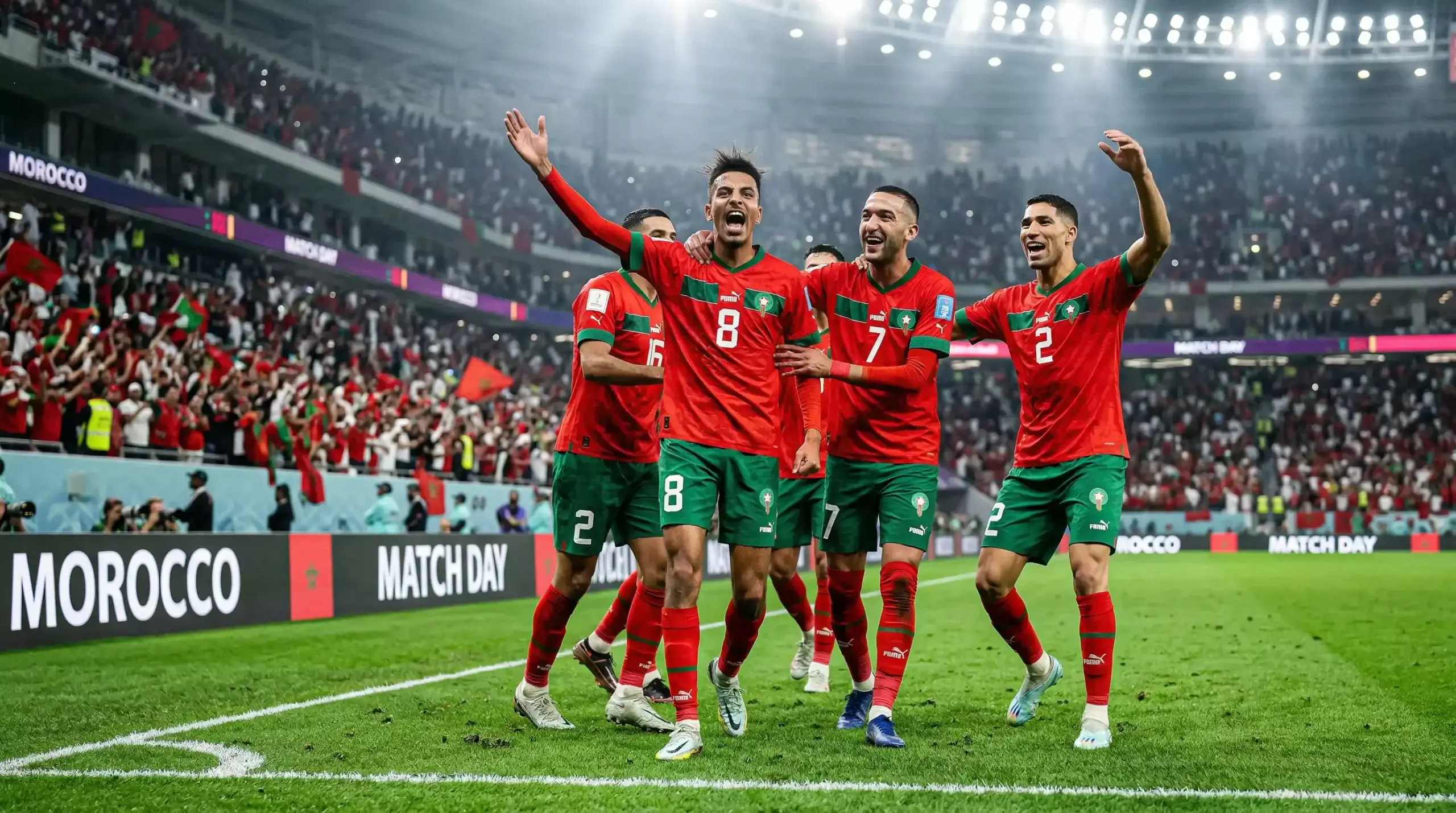
Qatar was no fluke. I want to establish that immediately, because the temptation with Morocco’s 2022 semi-final run — beating Belgium, Spain, and Portugal before falling to France — is to dismiss it as a one-off, a tournament anomaly fuelled by proximity to home and the unique conditions of a winter World Cup. It wasn’t. Morocco’s run was the product of elite coaching, a squad filled with European-based talent, and a defensive system so well-drilled that it took France’s best team in a generation to finally break it down. Morocco at the 2026 World Cup aren’t underdogs riding a wave. They’re established contenders with a squad that has only improved since Doha.
The odds tell a story of respect tempered by scepticism. Morocco are 20/1 to win the tournament — shorter than Belgium, longer than the Netherlands — a price that acknowledges their 2022 achievement without fully committing to the possibility that they could repeat it. I think that scepticism is misplaced. The squad has improved since Qatar, with younger players like El Khannouss and Brahim Díaz adding creative quality to an already formidable defensive foundation. The coaching stability — Regragui has been in charge for four years now, an eternity in international football management — has allowed the system to deepen and the players’ understanding of their roles to become instinctive. The 20/1 represents one of the better value bets in the outright market for punters willing to back an African nation at a World Cup, and the each-way potential alone makes it worth a look.
Squad and Key Players
Achraf Hakimi is the most complete full-back in world football. His ability to attack with the pace and crossing quality of a winger while defending with the positioning and tackling of a centre-back gives Morocco a weapon that no other team at the tournament can match. At Paris Saint-Germain, Hakimi has been the most consistent performer in a squad filled with superstars, and his understanding of Walid Regragui’s defensive system — where the full-backs tuck inside to form a back five out of possession — is so ingrained that it looks instinctive rather than coached.
Youssef En-Nesyri provides the goalscoring threat that Morocco’s defensive system requires to be effective. His aerial ability is extraordinary — he outjumps centre-backs who are four inches taller, timing his runs to meet crosses at the highest point of their trajectory. His 2025-26 season at Fenerbahce produced 19 league goals, confirming that his finishing instincts remain sharp. Hakim Ziyech, despite his advancing years, continues to provide the creative quality from wide positions that unpicks defences — his left-footed crossing is among the best at the tournament, and his ability to deliver set pieces with precision gives Morocco a reliable route to goal when open play is stifled.
Azzedine Ounahi’s emergence in midfield was one of the stories of the 2022 World Cup, and his subsequent development at Marseille has confirmed his status as one of the most technically gifted central midfielders in European football. His ability to receive the ball under pressure, turn away from opponents, and drive forward through the middle third gives Morocco a ball-carrying threat from deep that complements the width provided by Hakimi and Ziyech. Sofyan Amrabat provides the defensive solidity alongside him — his time at Manchester United sharpened his positioning and his understanding of high-level European tactical demands.
The defensive backbone is where Morocco’s strength truly lies. Nayef Aguerd and Romain Saiss formed the partnership that kept three consecutive clean sheets in Qatar’s knockout rounds, and their understanding — verbal, spatial, and tactical — is among the best of any centre-back pairing at the tournament. Yassine Bounou in goal adds a final layer of security, his shot-stopping and penalty-saving record providing the platform that Morocco’s system is built upon.
Group C: Scotland’s Biggest Rival in the Group
For Irish fans, Morocco’s placement in Group C alongside Scotland, Brazil, and Haiti creates a complicated dynamic. We want Scotland to qualify, but Morocco stand directly in their path. The Morocco-Scotland fixture on matchday two could be the most important match of the group stage for both teams — a result that will likely determine who finishes second behind Brazil and who is left fighting for a best third-place spot.
My analysis of the matchup gives Morocco a slight edge over Scotland. Their defensive system is more sophisticated, their wide players are quicker, and their experience of tournament knockout football — having navigated four consecutive elimination matches in Qatar — gives them a psychological advantage that Scotland’s group-stage-exit history can’t match. Morocco have also won the Africa Cup of Nations since Qatar, adding another layer of tournament-winning experience that compounds their already formidable CV. The odds reflect this: Morocco are approximately 6/4 to beat Scotland, with the draw at 2/1 and Scotland at 3/1. I’d lean toward a low-scoring draw — both teams are defensively solid, both will prioritise not losing in a match where a point is valuable for either side — which would leave the final matchday as the decider for second place.
Against Brazil, Morocco have the tactical template from 2022 to draw upon. Their deep defensive block and rapid transitions troubled every opponent they faced in Qatar, and Brazil’s defensive vulnerabilities — documented extensively during qualifying — play directly into Morocco’s counter-attacking strengths. The 14/1 for Morocco to beat Brazil is the kind of speculative bet that their 2022 record justifies. Against Haiti, Morocco should win comfortably, though the Caribbean debutants’ fearless approach could produce a chaotic opening period before Morocco’s quality asserts itself.
The Qatar Legacy: What That Semi-Final Run Built
Morocco’s 2022 semi-final run did something that results alone can’t quantify: it changed African football’s relationship with the World Cup. Before Qatar, no African team had reached the semi-finals. The assumption was that African squads lacked the tactical organisation and mental fortitude to compete with European and South American nations in knockout football. Morocco dismantled that assumption match by match — beating Belgium through superior tactical preparation, eliminating Spain on penalties after 120 minutes of disciplined defending, and destroying Portugal 1-0 in a quarter-final that could have been 3-0.
The legacy manifests in concrete ways for the 2026 squad. First, confidence. These players know they can compete with anyone because they’ve done it. They’ve looked Mbappé in the eye in a World Cup semi-final and given him the hardest match of his tournament. That experience is invaluable and irreplaceable — it can’t be coached, bought, or simulated in training. When Morocco face Brazil in the group-stage opener, the players who were in Qatar will look across the pitch and see opponents, not idols. That psychological shift — from respectful underdog to confident equal — is the most significant change in Moroccan football since the federation began investing in European-based dual-nationality players two decades ago.
Second, tactical sophistication. Regragui’s system has been refined over four years since Qatar, with adjustments to the pressing triggers, the transition speed, and the set-piece routines that make Morocco the most well-drilled defensive team at the tournament. The evolution has been subtle but significant: Morocco’s press now starts higher up the pitch than in 2022, and their transition from defence to attack has become faster — they averaged 2.4 seconds from winning the ball to creating a shooting opportunity during qualifying, the fastest transition speed in African football. Third, squad depth. Morocco’s success attracted investment in their domestic league and increased the number of dual-nationality players choosing Morocco over France, Belgium, and the Netherlands — expanding the talent pool that Regragui can draw from. Players like Bilal El Khannouss, who could have represented Belgium, chose Morocco because of the 2022 legacy. That pipeline of talent ensures Morocco’s competitive window extends well beyond this tournament.
Morocco’s Odds: Dark Horse or Genuine Contender?
At 20/1, Morocco are priced as a dark horse — a team capable of a deep run but not expected to win the tournament. I think that’s about right for the outright market, but the subsidiary markets offer better value for punters who believe Morocco’s defensive system can replicate its Qatar effectiveness. Morocco to reach the quarter-finals at 3/1 is the bet I’d make first — their defensive system is designed for knockout football, where single-match elimination favours teams that don’t concede rather than teams that score prolifically. Their Group C position means they’ll likely face a beatable Round of 32 opponent even if they finish third — and eight of twelve third-placed teams qualify in the new format, which dramatically improves Morocco’s chances of reaching the knockout rounds regardless of the Scotland result.
Morocco to keep a clean sheet in all three group matches at 8/1 is a speculative but defensible bet given their Qatar record (four clean sheets in five matches, conceding just one goal before the semi-final against France). Their defensive organisation hasn’t deteriorated since then — if anything, it’s improved with the addition of younger, quicker defenders who complement the experience of Aguerd and Saiss. En-Nesyri to score three or more goals in the tournament at 5/1 offers value given his aerial threat against set-piece-vulnerable opponents, particularly Haiti and Scotland, where his height advantage over the opposing centre-backs creates mismatches at corners.
The outright at 20/1 is a genuine each-way proposition that I’d recommend to any Irish punter looking for a speculative World Cup bet with real upside. If Morocco reach the semi-finals — which their 2022 performance and improved squad suggest is within their capability — the each-way payout delivers a healthy return without requiring the tournament victory that remains unlikely against France or Spain in a final. For Irish punters watching Group C with a Scotland-first mentality, keeping a small position on Morocco is prudent hedging — if Scotland falter, Morocco become the team to follow from the group, and having a financial interest adds spice to every remaining match. The Atlas Lions have earned the right to be taken seriously as contenders, and the 20/1 price doesn’t yet reflect how far they’ve come.