
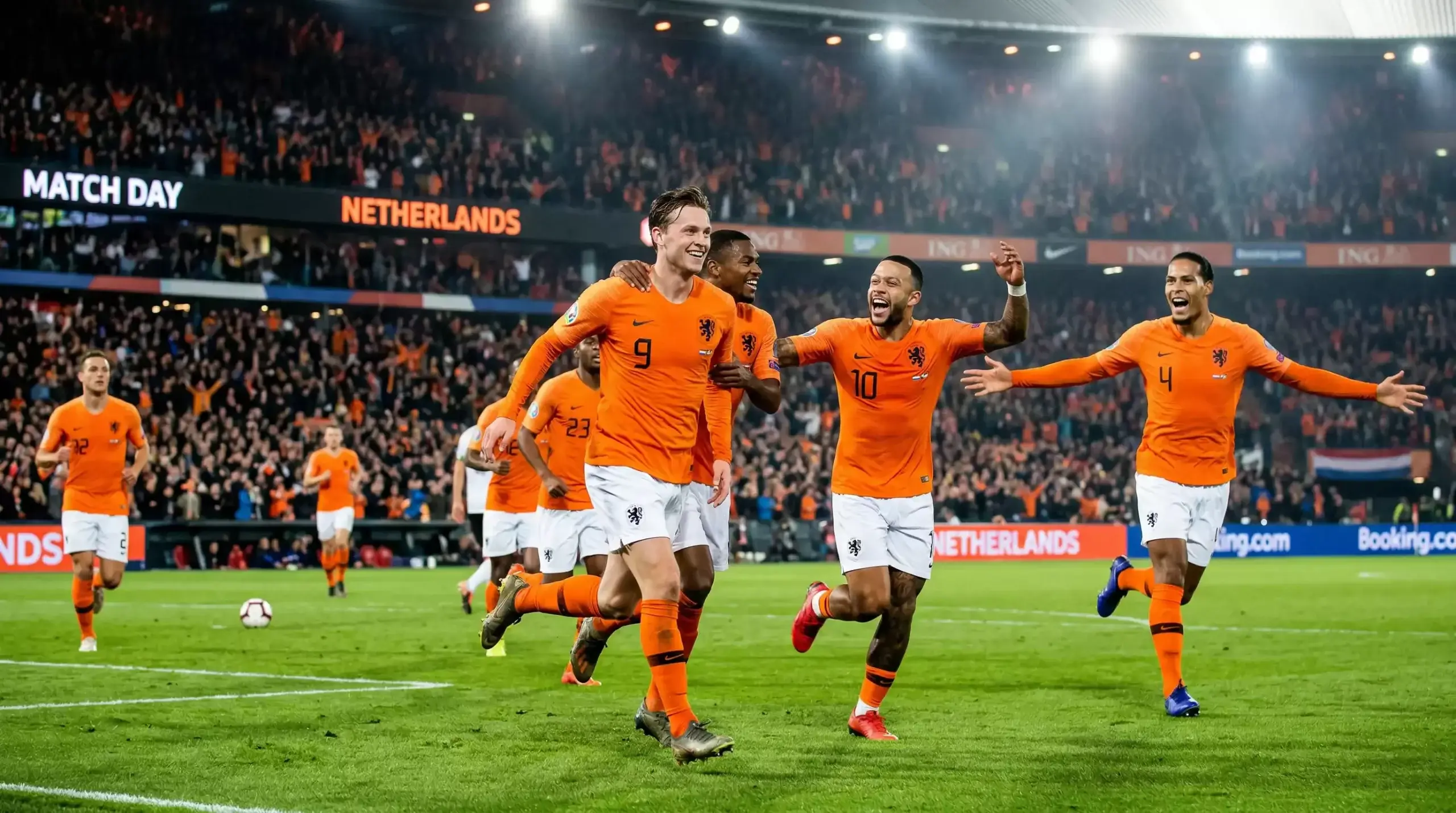
Three World Cup finals. Zero victories. No statistic in football carries more bittersweet weight than the Netherlands’ tournament record — a nation that has produced Cruyff, Van Basten, Bergkamp, and Robben, that invented Total Football and changed how the game is played, and yet has never lifted the trophy that would validate its place among football’s true elite. The Netherlands at the 2026 World Cup arrive with a squad that blends Premier League familiarity with Eredivisie innovation, and a group draw that should deliver knockout-round football. Whether they can finally break through to the ultimate stage is the romantic subplot that every neutral — Irish fans included — secretly hopes for.
I’ve watched the Oranje’s odds settle at 14/1 since the draw, a price that places them alongside Germany in the second tier of contenders. That ranking feels about right — the Netherlands have the individual quality to beat anyone on a given day but lack the squad depth and defensive consistency to sustain a seven-match run against the tournament’s elite. For punters, that profile creates value in specific markets rather than the outright.
Qualification and Squad
The qualifying campaign was a mixed affair that reflected the broader uncertainty around this Dutch generation. The Netherlands finished second in their group behind France, a familiar position for a team that consistently competes at the top of European football without quite reaching the summit. The 4-0 defeat in Paris was chastening — France’s pressing overwhelmed the Dutch midfield and exposed defensive vulnerabilities in the transition from attack to defence that better teams will target at the World Cup. But the response was telling: the Netherlands won their remaining seven matches after the Paris defeat, scoring 24 goals and conceding just 5, a run of form that included an impressive 3-0 victory over Scotland in Amsterdam and a 4-1 dismantling of Hungary in Budapest. That response suggested the Paris humiliation served as a wake-up call rather than a confidence destroyer, and the coaching staff used it to implement tactical adjustments — a deeper defensive line and a more conservative approach in away matches — that improved the squad’s results without sacrificing their attacking identity.
The squad’s spine is built around Premier League talent that Irish fans know intimately. Virgil van Dijk remains the defensive leader at 34, and while his pace has declined from its peak, his reading of the game, aerial dominance, and organisational skills make him indispensable for one more tournament cycle. The question is whether his ageing legs can handle the demands of seven matches in North American heat — a concern that the bookmakers haven’t fully priced into their defensive markets. Alongside him, Jurrien Timber provides the modern centre-back profile — quick, comfortable on the ball, and capable of stepping forward into midfield when the Netherlands build from the back.
In midfield, Frenkie de Jong’s fitness is the single biggest variable in the Netherlands’ campaign. When fit, he’s one of the most elegant ball-carriers in world football — his ability to receive in tight spaces, turn away from pressure, and drive forward with the ball is the foundation of the Dutch attacking system. His injury record over the past three seasons has been poor, and the coaching staff face a dilemma: risk De Jong from the start and hope his body holds, or manage his minutes and lose the creative fulcrum that makes the system work. Ryan Gravenberch has emerged as a genuine alternative at Liverpool, his physicality and passing range offering a different midfield profile that sacrifices De Jong’s silk for greater defensive solidity.
Cody Gakpo leads the attack, having developed into one of the most complete forwards in the Premier League at Liverpool. His ability to play across the front line — left wing, right wing, centre-forward — gives the coaching staff tactical flexibility, and his tournament record is outstanding: five goals across the 2022 World Cup and Euro 2024 combined. Behind him, Xavi Simons provides the creative spark that the Dutch system demands from its number 10 position. Simons’s movement between the lines, combined with his shooting ability from distance, makes him one of the most dangerous attacking midfielders at the tournament. Memphis Depay, now 32, offers experience and a left-footed finish that can punish any defensive lapse.
Key Players: Premier League Names Irish Fans Know
The Dutch squad reads like a Premier League team sheet with a few Bundesliga and La Liga additions. Van Dijk at Liverpool. Gakpo at Liverpool. Gravenberch at Liverpool. Timber at Arsenal. Nathan Ake at Manchester City. Micky van de Ven at Tottenham. For Irish fans who spend every weekend watching the Premier League, this is a squad you could pick blindfolded from a lineup. That familiarity gives Irish punters a genuine edge in player markets — you know Van de Ven’s blistering pace at centre-back, you know Ake’s reliability in big matches, you know Gakpo’s habit of raising his game in tournament football.
Van de Ven deserves particular attention. His pace at centre-back is extraordinary — he’s been clocked at 37.38 km/h in a sprint, the fastest by a Premier League defender — and his ability to recover from positional errors through sheer speed gives the Netherlands a defensive insurance policy that most teams can’t replicate. If Van Dijk’s pace fails him against faster forwards in the knockout rounds, Van de Ven can cover. That partnership — experience and pace, reading and recovery — could be the defensive foundation that takes the Netherlands deeper than their recent tournament record suggests.
Group F: Japan, Tunisia, Sweden
Group F is the group that could produce the most competitive three-way battle in the tournament. Japan are a genuine dark horse with Premier League and Bundesliga stars across their squad — Takefusa Kubo at Real Sociedad, Wataru Endo at Liverpool, Kaoru Mitoma at Brighton — and their 2022 World Cup performances, beating Germany and Spain in the group stage, proved they can compete with and overcome the very best European teams. Their pressing intensity is among the highest at the tournament, and their willingness to attack regardless of the opponent makes them compulsively entertaining and deeply unpredictable. Tunisia bring African grit and tactical discipline, having qualified with the best defensive record on the continent. They held Denmark to a 0-0 draw at the 2022 World Cup and beat France in the group stage (albeit a rotated French side), proving they understand how to compete in the tournament format. Sweden, returning to the World Cup after missing 2022, have rebuilt around a younger generation led by Alexander Isak and Dejan Kulusevski — two Premier League attackers that Irish fans know well from Newcastle and Tottenham respectively.
The Netherlands are 2/5 to win the group, a price that feels slightly short given Japan’s quality and recent World Cup pedigree. The Japan-Netherlands fixture is the standout — Simons and Gakpo against Japan’s organised pressing system will be a tactical battle that could go either way. Japan at 7/2 to win Group F is the upset pick that I think offers genuine value — their ability to shock European heavyweights is well-documented and their squad has improved since Qatar. My prediction: Netherlands top with 7 points, Japan qualify in second with 5, Tunisia finish third with 3 points. But this is the group most likely to deviate from the expected outcome, and punters should approach the markets with appropriate caution.
Odds and Value Assessment
At 14/1, the Netherlands sit in the same price band as Germany — respected but not feared. I think 14/1 is about right, which means the outright market doesn’t offer clear value for punters looking for an edge. Instead, I’d target the Netherlands to reach the quarter-finals at 6/4, a bet that captures their expected group-stage progression and a beatable Round of 32 opponent without requiring the deep run that their squad depth might not sustain. The quarter-final is where the Netherlands’ challenge begins in earnest — they’ll likely face a team from the top tier of contenders, and their ability to compete with France, Spain, or Argentina over ninety minutes (plus potential extra time) depends on whether De Jong is fit and whether Van Dijk’s legs hold up in the North American heat.
Gakpo to be the tournament’s top scorer at 16/1 is the speculative punt that catches my eye. His record in tournament football — five goals in his last two major tournaments — suggests he raises his game when the world is watching, a quality that separates tournament players from those who merely accumulate goals in qualifying. He’ll play every match, he takes penalties for the Netherlands, and the group-stage opponents offer opportunities to pad his tally before the knockout rounds begin. At 16/1, you’re getting a player with a proven tournament record at a price that reflects his club status rather than his international pedigree. The other market worth considering is over 2.5 goals in Netherlands matches at 10/11 — the Dutch style inherently produces open, entertaining football with goals at both ends, and their group opponents (particularly Japan and Sweden) play in a similarly attacking fashion.
Three Finals, No Trophy: The Eternal Bridesmaids
The Dutch relationship with the World Cup is football’s greatest unrequited love story. Runners-up in 1974 (losing to West Germany), 1978 (losing to Argentina), and 2010 (losing to Spain), the Netherlands have been the best team in the tournament without winning it more often than any other nation. The 1974 side, built around Cruyff’s Total Football, is still regarded by many as the greatest team never to win the World Cup — a squad that revolutionised football tactics and lost the final to a German side that was efficient where the Dutch were beautiful.
That history creates a specific emotional dynamic for the 2026 squad. The players know the narrative — they’ve grown up with it, been asked about it in every pre-tournament press conference, and felt the weight of it in every knockout match where the margins tightened and the ghosts of 1974, 1978, and 2010 loomed over the stadium. The question is whether the 2026 generation can use that history as fuel rather than burden. Van Dijk has spoken about wanting to give the Netherlands their first World Cup trophy before he retires — a sentiment that carries more weight because everyone knows his international career will end after this tournament. If the Netherlands reach the semi-final, the emotional narrative will be overwhelming. Whether they can channel it into performance rather than pressure will determine whether this is the year the eternal bridesmaids finally say “I do.”
For Irish neutrals, the Netherlands offer one of the tournament’s most appealing storylines. A squad full of familiar faces, a place among the 48 teams that few would begrudge them, and the tantalising possibility that football’s longest-running near-miss story could finally reach its happy ending. I’ll be watching their matches with the same mix of admiration and wistfulness that the Dutch football experience always inspires — beautiful, frustrating, and impossible to look away from.