
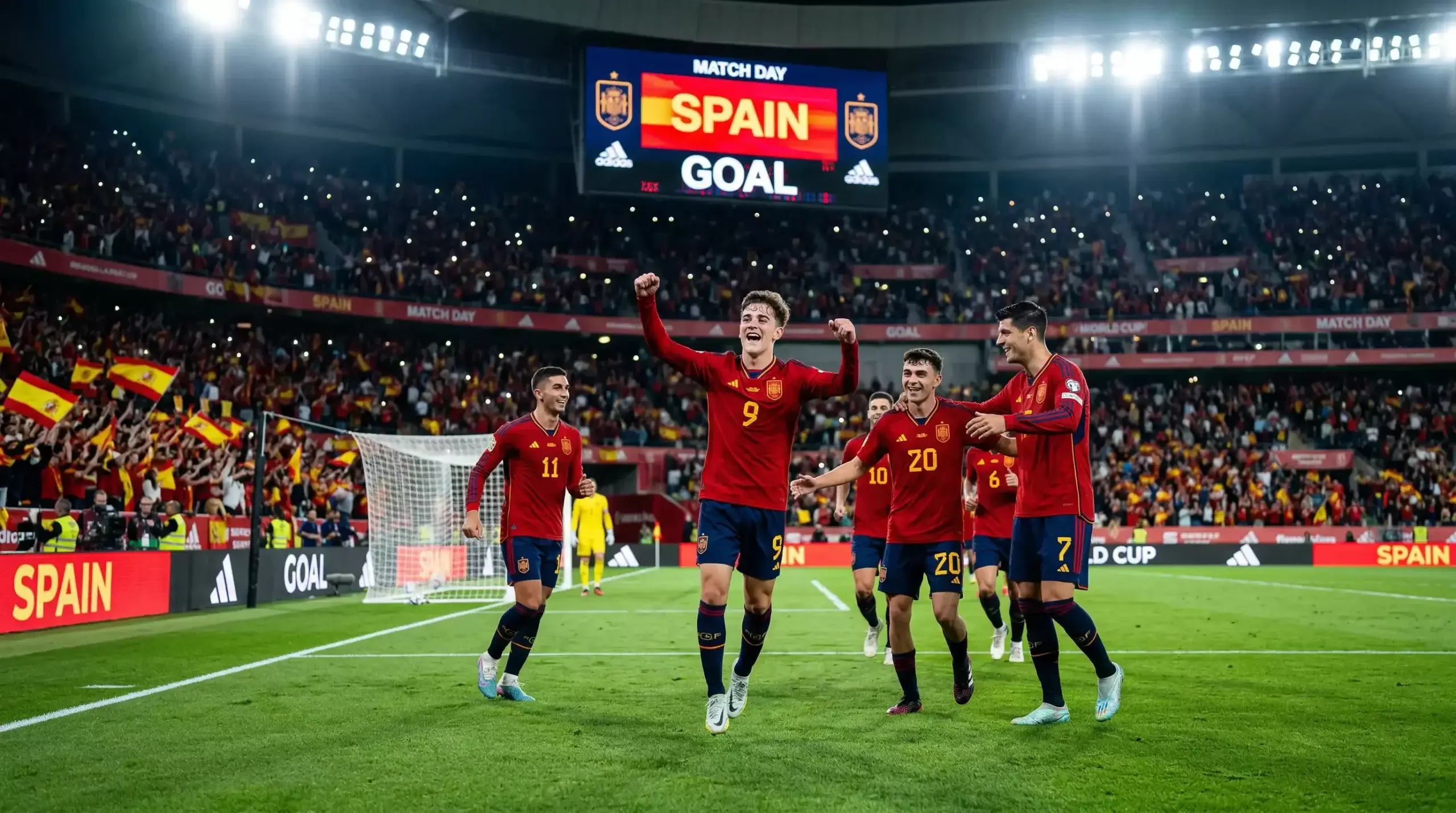
Euro 2024 was supposed to be a rebuilding tournament for Spain. Nobody told the players. A squad with an average age of 24.5 swept through Germany, beating every opponent they faced, playing the most exciting football of any team at the competition, and lifting the trophy with a performance that announced a new era of Spanish dominance. That triumph didn’t feel like a peak — it felt like a preview. Spain at the 2026 World Cup arrive not as faded champions clinging to past glories but as the youngest contender in the tournament, driven by players who are getting better with every match.
I’ve tracked Spain’s odds movement more closely than any other team in the draw, and the trajectory is telling. They opened at 10/1 after the draw, drifted to 12/1 during a quiet autumn of friendlies, then shortened dramatically to 7/1 after a qualifying campaign that saw them play some of the best football in Europe. The market is waking up to what the data already confirms: this Spain squad is special, and 7/1 might be the last time you get this price before it shortens further.
Qualification: Smooth Sailing with a New Identity
The first thing that struck me watching Spain’s qualifying campaign was the speed. Not just physical speed — though Lamine Yamal and Nico Williams provide that in abundance — but the speed of thought. Spain moved the ball from defence to attack in fewer passes than any European qualifier except France, a departure from the tiki-taka possession game that defined Spanish football for a decade. The evolution is deliberate. This team still controls the ball — they averaged 64% possession across ten qualifiers — but they do it with purpose rather than patience, looking forward first rather than recycling through the back line.
Spain topped their qualifying group with 26 points from ten matches, losing just once — a 2-1 defeat in Georgia that served as a rare reminder of their vulnerability against organised, defensive opponents who sit deep and counter-attack with pace. They scored 30 goals, the second-highest total in European qualifying behind France, and their goal difference of +24 reflected a squad that was equally proficient in attack and defence. The 5-1 demolition of Northern Ireland in Belfast was the statement performance — Spain scored five goals of such quality that the match resembled a training exercise rather than a competitive fixture. Yamal scored twice in that match, both from inside the box, both demonstrating a finishing maturity that no seventeen-year-old should possess.
The home form was similarly dominant. Five matches on Spanish soil produced five victories with an aggregate score of 17-3, and the atmosphere at the grounds reflected a country that has fallen back in love with its national team. The sterile, sometimes tense environment that accompanied Spain’s later tiki-taka years has been replaced by genuine excitement — fans who know they’ll see goals, pressing, and attacking intent from the first whistle. The 3-0 victory over Georgia at home was a correction of the away defeat, demonstrating the squad’s ability to learn from setbacks and implement tactical adjustments within the same qualifying cycle.
The away record was particularly impressive. Five wins from five on the road, with clean sheets in three of those matches, showed a defensive maturity that previous Spanish generations lacked. The old criticism of Spain — that they could dominate possession but couldn’t defend transitions — has been addressed by a tactical shift that prioritises high pressing and quick recovery rather than passive ball retention. When Spain lose the ball now, they hunt it immediately rather than retreating into shape. That intensity requires extraordinary fitness, and the youth of this squad makes it sustainable across a seven-match tournament in a way that wouldn’t be possible with an older group of players.
The Squad: Youth Served at the Highest Level
Lamine Yamal will be 18 years old during the 2026 World Cup. Let that sink in. An 18-year-old who has already won a European Championship, scored in a semi-final against France, and established himself as a first-choice starter for Barcelona and Spain. His talent is so extreme that comparisons feel inadequate — he doesn’t play like any specific predecessor because no player at his age has combined his dribbling ability, passing range, and scoring threat in the same package. Yamal is the most exciting young player to appear at a World Cup since Mbappé in 2018, and the tournament could be his coronation as the best footballer in the world.
On the opposite flank, Nico Williams provides the kind of direct, explosive wing play that terrifies full-backs. His pace in the first five metres is devastating, his crossing has improved markedly, and his work rate off the ball makes him a genuine two-way player. The Yamal-Williams combination on opposite wings gives Spain the most dangerous wide pairing at the tournament — opposing teams have to choose between defending the left or the right, knowing they can’t adequately cover both. Williams’s decision to remain at Athletic Club in Bilbao rather than pursuing a move to a bigger league speaks to a self-assurance that will serve him well under World Cup pressure.
In midfield, Pedri and Gavi represent the creative heartbeat of this team. Pedri’s ability to receive the ball under pressure, turn, and find a forward pass is the most refined in world football — he sees angles that other midfielders don’t even know exist, threading passes through gaps that appear to close before the ball arrives. His fitness has been the only concern, with Barcelona managing his minutes carefully to avoid the muscle injuries that plagued his earlier career, but the signs from 2025-26 are encouraging — over 40 appearances across all competitions, his most productive campaign to date. Gavi, recovered from the serious knee injury that cost him most of the 2024-25 season, adds combativeness and pressing intensity to the midfield. His return to full fitness in early 2026 immediately upgraded Spain’s World Cup prospects — Gavi without the knee injury is a genuinely world-class midfielder whose energy transforms Spain’s pressing game.
Behind them, Rodri anchors everything. The Ballon d’Or winner and Manchester City’s most indispensable player, Rodri provides the defensive security that allows Pedri and Gavi to push forward. His reading of the game, his positioning, and his ability to break up opposition attacks before they develop make him the most important defensive midfielder at the tournament. When Rodri plays, Spain concede an average of 0.4 goals per match. When he doesn’t, the average rises to 1.2. That statistical gap is the starkest illustration of any single player’s impact at the 2026 World Cup, and it explains why Rodri’s fitness is the single biggest variable in Spain’s campaign. If he’s fit for all seven matches, Spain can win the tournament. If he’s injured, their defensive structure collapses.
The centre-back pairing of Pau Cubarsí and Robin Le Normand represents a generational shift in Spanish defending. Cubarsí, still only 19, plays with the composure of a veteran — his positioning, his timing in the tackle, and his ability to play out from the back under pressure are already world-class. Le Normand provides the aerial presence and physical dominance that Cubarsí’s slight frame can’t offer. Together, they’ve conceded fewer goals per match than any centre-back partnership in the European qualifiers. In goal, Unai Simón offers reliability and shot-stopping quality that has improved season by season at Athletic Club.
The depth of Spain’s squad is remarkable for a team so young. Dani Olmo provides a different creative option from midfield, his ability to play in tight spaces and score from range offering an alternative to the wide-play approach — he scored four goals at Euro 2024 and his knack for arriving in the box at the right moment gives Spain a goal threat that opponents don’t see coming from the central areas. Ferran Torres, Mikel Oyarzabal, and Ayoze Pérez give the coaching staff attacking options from the bench that would start for most other nations at this tournament. Álvaro Morata, despite the criticism that follows him, remains a functional target man whose movement and link-up play create space for the creative players around him — his selfless running was a key factor in Spain’s Euro 2024 success, even when the headlines went to Yamal and Williams.
Alejandro Grimaldo at left-back offers the most attacking full-back at the tournament, his deliveries from wide positions a potent weapon at set pieces and in open play. His seasons at Bayer Leverkusen, including their invincible Bundesliga campaign, proved he can sustain elite performance across a long season — a quality that translates directly to the demands of a 39-day World Cup. On the right, Dani Carvajal provides veteran stability, his Champions League experience with Real Madrid giving Spain a player who has won everything at club level and understands the mentality required to close out tight matches. The full-back pair represents a microcosm of the squad’s blend: youth and experience, attack and defence, risk and security.
Group H: Uruguay, Saudi Arabia, Cabo Verde
Spain drew a group that looks straightforward on paper but contains a genuine threat in Uruguay. La Celeste are perennial overachievers at World Cups — their aggressive, physical style of play is designed for tournament football, and they have a squad filled with players who perform above their club level when wearing the national shirt. Darwin Núñez at Liverpool has developed into one of the Premier League’s most dangerous strikers, his chaotic energy and raw power making him a handful for any defence. Federico Valverde brings a box-to-box dynamism from Real Madrid that gives Uruguay a world-class presence in midfield. The Spain-Uruguay fixture will be a tactical chess match between two teams that understand how to win at tournaments, and Uruguay’s ability to disrupt Spain’s rhythm through pressing and physicality shouldn’t be underestimated. The South Americans have won two World Cups in their history and carry a self-belief that far exceeds their FIFA ranking.
Saudi Arabia return to the World Cup as the team that shocked Argentina in Qatar’s opening match — a result that proved they’re capable of raising their game to extraordinary levels for a single performance. Their squad has improved since 2022, with several players now competing in European leagues rather than the Saudi Pro League, and their domestic league’s investment in high-profile coaches has raised the tactical standard across the board. Their pressing against Argentina in 2022 was among the most intense defensive performances in World Cup history, and if they can recreate that intensity against Spain, the group could produce an upset. The 25/1 available for Saudi Arabia to beat Spain is long but not dismissible given the precedent. Spain’s coaching staff will have studied that Argentina match in detail and will prepare accordingly — but preparation and execution are different things when the pressure of a World Cup group match bears down.
Cabo Verde are the group’s debutants, qualifying for their first World Cup from the African confederation. With a population of just over 500,000 — smaller than any Dublin suburb — their presence at the tournament is a remarkable achievement that mirrors the kind of underdog stories Irish fans instinctively warm to. They’ll be outmatched against Spain but will bring enthusiasm, physicality, and energy that could unsettle opponents in the opening exchanges. Their qualification journey through the African qualifiers involved victories over teams with five times their population, and the squad contains several players based in Portuguese and French lower divisions who will experience nothing like a World Cup in their careers. Spain should handle them comfortably, but the romance of Cabo Verde’s story will make it a fixture worth watching for neutrals.
Spain are 1/6 to win the group, and I can’t see past them topping it with maximum points. The value in Group H lies in the Uruguay market — La Celeste at 5/2 to finish second represents fair odds, and Uruguay to qualify at 4/9 is close to a certainty given the weakness of Saudi Arabia and Cabo Verde beneath them.
Spain’s Odds and Value Assessment
At 7/1 to win the World Cup, Spain are the value bet of the tournament. That’s a bold claim, and I’ll back it up with data. Spain’s Euro 2024 victory proved that this group of players can win a major tournament — and they did it by beating Germany, France, and England in successive knockout rounds, the three toughest opponents possible. Their qualifying campaign proved they can sustain that level over a prolonged period rather than peaking for a single three-week tournament. Their squad’s youth means they’ll be physically sharper in the later rounds than older teams like France and Argentina, who’ll feel the cumulative fatigue of seven matches in the North American heat. And their tactical evolution — from possession-based to pressing-based — has solved the defensive vulnerability that cost them at the 2022 World Cup, where they were eliminated by Morocco in a penalty shootout after dominating possession but failing to create clear chances.
The 7/1 price implies a win probability of approximately 12.5%. My model gives Spain closer to 15%, which means there’s roughly 2.5 percentage points of value in the current price. That might not sound like much, but in a market this efficient, 2.5 points is significant. It’s the difference between a fair bet and a value bet, and it’s the kind of edge that professional punters build entire strategies around. The market tends to overweight recent World Cup history — Spain’s group-stage exit in 2022 still depresses their price — and underweight current form, which strongly favours La Roja as the most improved team in world football over the past two years.
The specific markets I’d target: Spain to reach the final at 7/2 (they have the squad depth and draw to get there), Yamal to be named the tournament’s Best Young Player at 5/2 (he’s the obvious favourite and the price doesn’t reflect his quality), and Spain to keep a clean sheet in all three group matches at 7/1 (their defensive improvement is the most underappreciated aspect of this team). For Irish punters looking for a single outright bet on the 2026 World Cup, Spain at 7/1 is the pick I’m most confident in.
From Tiki-Taka to Whatever This Is — Spain’s Tactical Evolution
The ghost of tiki-taka still haunts Spanish football, even though the current team plays nothing like the Xavi-Iniesta-Busquets sides that won everything between 2008 and 2012. That era produced the most dominant period in international football history — three consecutive major tournament victories — but it also created an expectation that Spain should always play in that style. The evolution has been gradual but decisive, driven by coaches who recognised that the game had moved on and that Spain’s insistence on possession for its own sake had become a liability against teams that could counter-attack with speed. Spain no longer try to pass opponents to death. They still value possession — it’s in the national footballing DNA, embedded at every level from academy to senior team — but they use it as a platform for vertical attacks rather than an end in itself. The ball moves forward now, not sideways.
The pressing game is the most significant tactical development. Spain’s high press during qualifying was the most aggressive in European football, with the team averaging 22 presses per match in the opposition’s final third — more than any other qualified team. Yamal, Williams, and whoever plays centrally (Olmo or Morata) press the opposition’s defensive line with the intensity normally associated with club sides like Liverpool or Bayern Munich. The result is that Spain win the ball higher up the pitch than any other national team, creating chances from turnovers in dangerous areas rather than relying on patient build-up from the back.
The transition from tiki-taka to press-and-attack has implications for punters. Spain’s matches are now higher-scoring affairs — they averaged 3.7 goals per match during qualifying (both scored and conceded combined), up from 2.4 during the 2022 World Cup cycle. The over 2.5 goals line in Spain matches is likely to be priced around 4/5, and based on their recent form, that looks like value. Spain don’t grind out 1-0 victories the way France sometimes do — they play in a way that produces goals at both ends, making them ideal for goals markets rather than correct-score betting.
The other tactical element worth noting is the use of inverted full-backs. Grimaldo on the left tucks inside to create a midfield overload, while Carvajal or Pedro Porro on the right overlap to provide width. This asymmetric approach — inside on the left, outside on the right — creates numerical advantages that are difficult to defend against, particularly when Yamal drifts infield from the right wing and Grimaldo occupies the space he vacates. It’s a system that requires extraordinary spatial awareness from every player, and Spain’s young squad has internalised it to the point where the rotations look instinctive rather than rehearsed. For a team built on intelligence rather than physical dominance, that level of tactical sophistication could be the decisive edge at a World Cup where every knockout match is won on fine margins.