
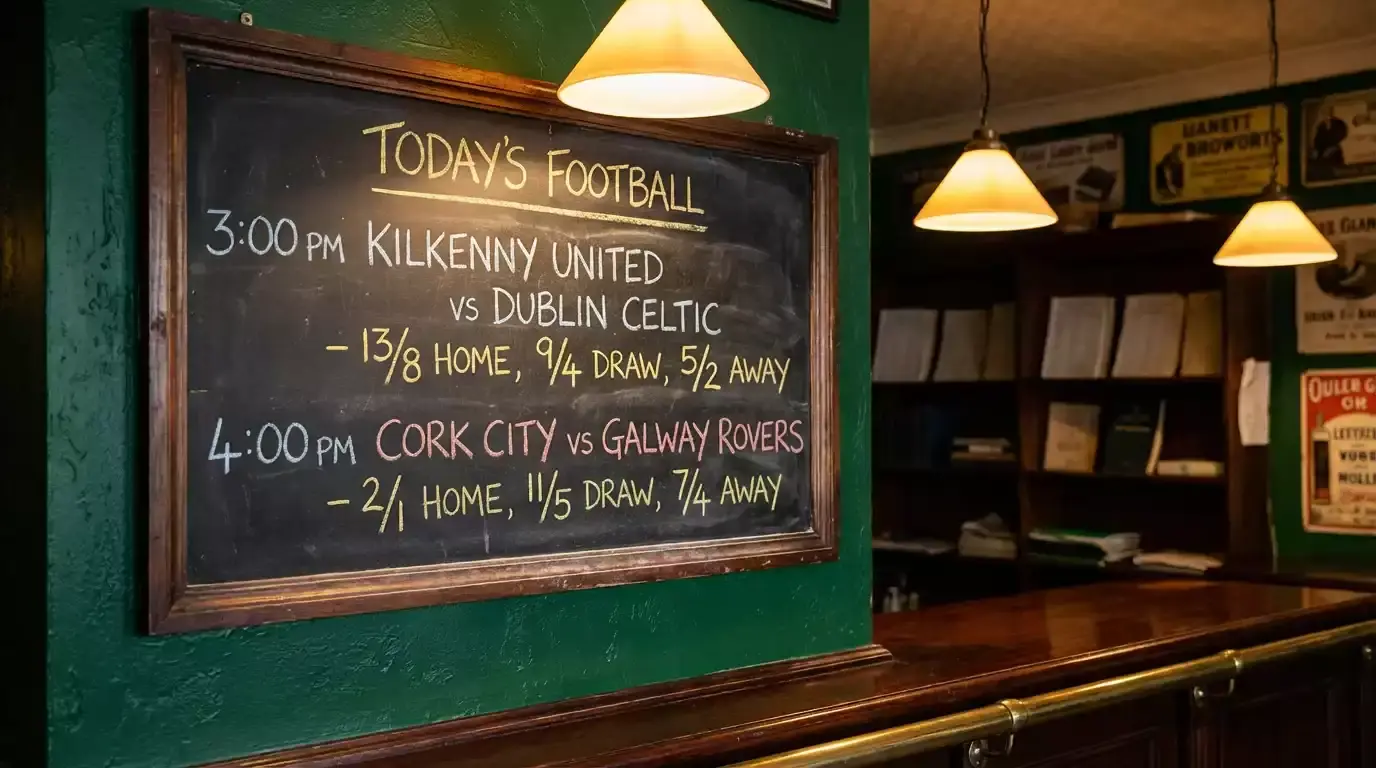
The first time I saw 5/1 chalked on a board in a betting shop on Grafton Street, I was sixteen and had no idea what it meant. I knew it was about football and I knew it involved money, but the mechanics — the relationship between that fraction and the cash in my future pocket — were a complete mystery. Two decades later, I read odds the way a musician reads sheet music: instantly, instinctively, hearing the story that the numbers are telling before anyone has kicked a ball. This guide is for the version of me that stood in that shop, confused but curious, and for every Irish punter who wants to understand World Cup odds well enough to find the value hiding inside them.
Fractional vs Decimal: The Two Languages of Odds
Ireland and Britain speak fractional. The rest of Europe speaks decimal. Online bookmakers offer both, and the 2026 World Cup will be the first major tournament where a generation of younger Irish punters — raised on decimal odds from their phone apps — outnumber the older generation who grew up with fractions on the shop boards. Understanding both formats is not optional. It is the foundation of everything that follows.
Fractional odds express profit relative to stake. When you see Brazil at 5/1 to win the World Cup, the fraction tells you that for every one euro you stake, you will receive five euro in profit if Brazil win — plus your original euro back. Your total return on a one-euro bet at 5/1 is six euro. The fraction is a ratio: the left number is profit, the right number is stake. At 11/4, you profit eleven euro for every four euro staked. At 1/3, you profit one euro for every three euro staked — a heavy favourite where the risk outweighs the reward unless you are very confident in the outcome.
Decimal odds express total return per euro staked. Brazil at 5/1 fractional becomes 6.00 decimal. The conversion is simple: divide the fraction and add one. 11/4 becomes 3.75 (eleven divided by four equals 2.75, plus one). 1/3 becomes 1.33 (one divided by three equals 0.33, plus one). Decimal odds are mathematically cleaner because they include the stake in the number — a 6.00 decimal price means your one-euro bet returns six euro total, and you do not need to mentally add the stake back as you do with fractional odds.
The choice between formats is purely personal, but I would recommend learning to read both fluently. Fractional odds are what you will see in Irish betting shops and hear in conversation — “Brazil are fives,” “France are nines-to-two.” Decimal odds are what most online platforms default to, and they make comparison shopping between bookmakers easier because the maths is simpler. Throughout this site, I use fractional odds as the primary format with decimal equivalents where they aid clarity, because that reflects how most Irish punters talk about betting.
One format quirk to watch for: “evens” in fractional odds means 1/1 — you profit one euro for every euro staked, total return of two euro. In decimal, that is 2.00. “Odds-on” means the odds are shorter than evens — 4/5, 1/2, 1/3 — where you risk more than you stand to win. “Odds-against” means the odds are longer than evens — 6/4, 2/1, 5/1 — where your potential profit exceeds your stake. Most World Cup match favourites will be odds-on, meaning you need to stake more than your potential profit. Most outright tournament bets will be odds-against, meaning the payoff exceeds the stake by a meaningful margin.
Implied Probability: What Odds Really Mean
Every set of odds is a probability estimate wearing a price tag. When a bookmaker prices France at 9/2 to win the World Cup, they are implicitly saying that they assess France’s probability of winning at roughly 18%. When they price Curaçao at 500/1, they are saying the probability is around 0.2%. The ability to convert odds into implied probability — and then compare that probability to your own assessment — is the single most important skill in betting. It is where every edge begins.
The formula for converting fractional odds to implied probability is straightforward: divide the right number by the sum of both numbers, then multiply by 100. At 9/2: 2 divided by (9 + 2) equals 0.1818, which is 18.18%. At 1/3: 3 divided by (1 + 3) equals 0.75, which is 75%. At 5/1: 1 divided by (5 + 1) equals 0.1667, which is 16.67%. For decimal odds, the formula is even simpler: divide 100 by the decimal price. At 5.50 decimal: 100 divided by 5.50 equals 18.18%.
Here is where it gets interesting — and where the bookmaker makes their money. If you add up the implied probabilities of all outcomes in a market, the total will exceed 100%. In a match result market where the favourite is priced at 1/3 (75%), the draw at 4/1 (20%), and the underdog at 10/1 (9.09%), the total implied probability is 104.09%. That extra 4.09% above 100% is the bookmaker’s margin — also called the overround or the vig. It is the built-in profit that ensures the bookmaker wins over time regardless of which team the public backs.
Understanding the overround matters because it varies between bookmakers and between markets. A bookmaker with a 102% overround on the World Cup outright market is offering you better value than one with a 108% overround, even if the individual odds look similar. The lower the overround, the closer the implied probabilities are to the bookmaker’s true assessment of each outcome — and the more room there is for your own analysis to find an edge. Comparing overrounds across bookmakers before placing your World Cup bets is a five-minute exercise that can save you significant money over 104 matches.
When Odds Move: What the Market Is Saying
I placed a bet on Morocco to qualify from their group at the 2022 World Cup in September of that year, three months before the tournament started. The odds were 5/4. By November, when the tournament kicked off, those odds had shortened to 4/6. The same bet, on the same outcome, was now returning less than half the profit — because the market had moved. Understanding why odds move, and when to act on those movements, is worth more to a punter than any single tip or prediction.
Odds move for two reasons: information and money. When a key player gets injured in training camp, the bookmaker adjusts the team’s odds to reflect the reduced probability of success. When a large volume of bets comes in on one side of a market — say, thousands of punters backing France after a strong friendly performance — the bookmaker shortens France’s odds and lengthens the prices on other teams to balance their book. Both types of movement carry information, but they mean different things for the punter.
Information-driven movement is genuine. If Kylian Mbappé tears a hamstring in France’s final pre-tournament friendly, France’s outright odds will lengthen from 9/2 to perhaps 8/1 or longer. That movement reflects a real change in France’s probability of winning, and the new price is more accurate than the old one. Betting against the movement — backing France at 8/1 because “they were 9/2 last week” — is a mistake unless you have a specific reason to believe the injury is less significant than the market assumes.
Money-driven movement is noise. If England’s outright price shortens from 7/1 to 11/2 purely because a wave of English punters have backed their team after a confidence-boosting result, the underlying probability has not changed — only the volume of money on one side of the book has shifted. This type of movement creates value on the other side. If England shorten from 7/1 to 11/2 without any new information justifying the move, the teams that were previously priced alongside England at similar odds are now relatively better value, even though their absolute prices have not changed.
The practical takeaway for the 2026 World Cup: place your outright and group winner bets early, before the pre-tournament money floods in and shortens the prices on popular selections. The odds available in April and May 2026 will almost certainly be longer than the odds available in the first week of June, once squad announcements and friendly results drive a surge of public betting. Early money gets the best price. Late money gets the crowd’s price.
Spotting Value: The Punter’s Holy Grail
Value is the only word that matters in betting, and most punters misunderstand it completely. Value does not mean backing a team at long odds because the payout looks attractive. Value means backing a team at odds that are longer than the team’s true probability of winning justifies. If you believe France have a 25% chance of winning the World Cup and the bookmaker is offering 9/2 — which implies an 18% probability — that is a value bet, because the market is underestimating France by seven percentage points. If you believe France have a 15% chance and the bookmaker is offering 9/2, that is not a value bet, because the market is already pricing France higher than you rate them.
The challenge is obvious: how do you assess a team’s “true” probability? I use a combination of three inputs. First, historical base rates — how often have teams of similar quality, in similar groups, at similar odds, reached specific stages of the tournament? Second, current form — qualifying results, recent competitive fixtures, and the trajectory of the squad’s development over the current cycle. Third, structural factors — the group draw, the knockout bracket, home advantage, and the impact of the 48-team format on the probability of deep runs.
None of these inputs produce a precise probability. What they produce is a range — a confidence interval that tells me whether the bookmaker’s implied probability falls inside or outside my assessment. If my range for France winning the World Cup is 20-28%, and the market implies 18%, I have value. If my range is 12-20% and the market implies 18%, I do not. The discipline of working in ranges rather than point estimates prevents the overconfidence that destroys most betting bankrolls.
For the 2026 World Cup specifically, I see the clearest value in three areas. First, dark horse outright bets where the market has not adjusted for the 48-team format’s lower threshold for qualification — Morocco, Turkey, and Colombia are all priced longer than their realistic ceiling justifies. Second, group winner markets where name recognition distorts the pricing — Morocco to top Group C ahead of Brazil, for instance, is significantly underpriced relative to the probability. Third, over/under goals in the group stage, where the influx of mismatches between elite sides and debutants should push the average above the 2.5 line that most pre-match totals are set at.
Understanding World Cup odds is not about memorising formulas or becoming a mathematician. It is about developing the instinct to look at a price, convert it to a probability, compare it to your own assessment, and act only when the gap between the two is wide enough to justify risking your money. That instinct develops with practice, and the 2026 World Cup odds landscape offers 104 matches across 39 days to sharpen it. Start with the fundamentals in this guide, and by the time the final whistle blows at MetLife Stadium on July 19th, you will read odds the way I do — as stories waiting to be told.