
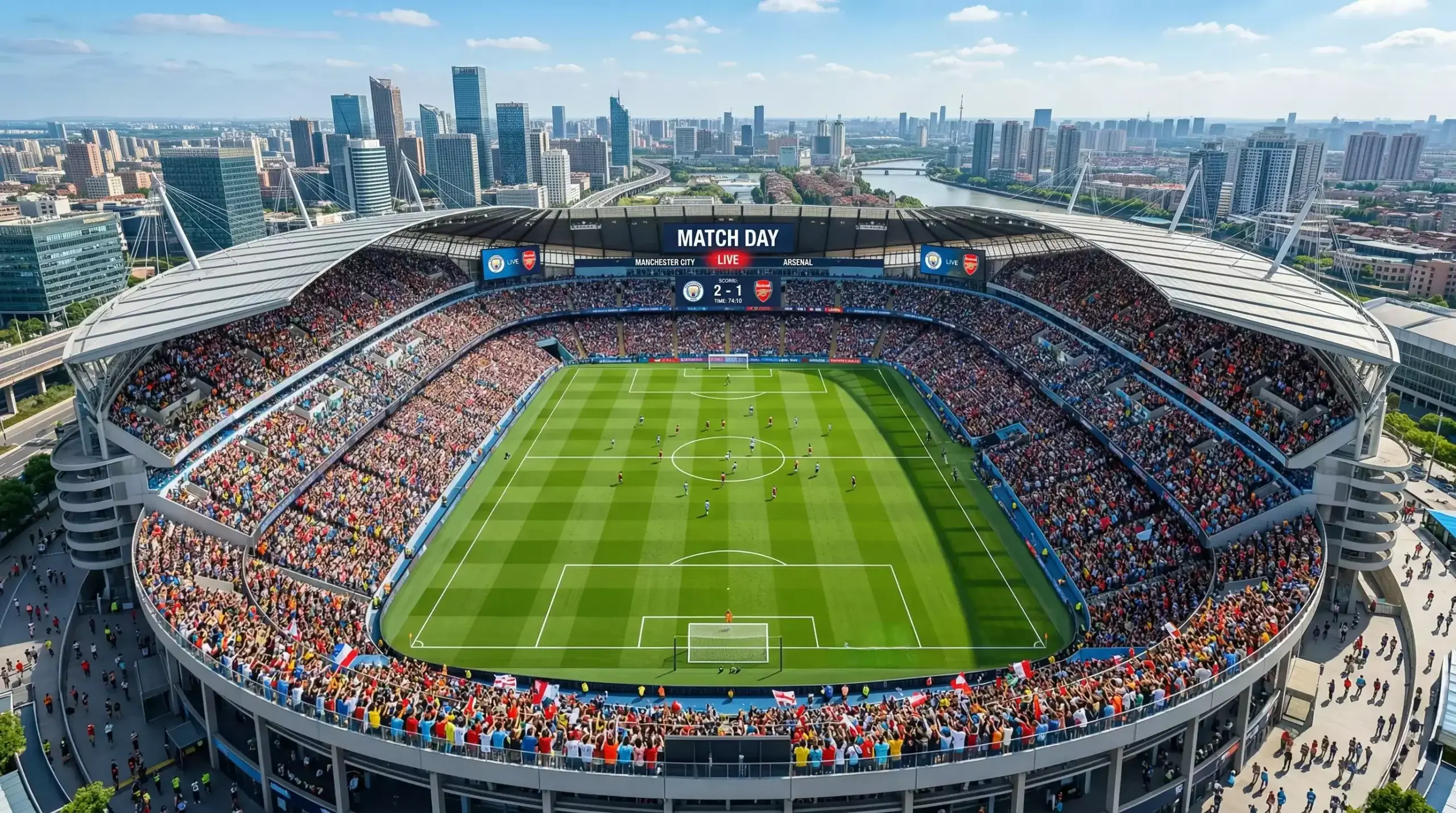
Sixteen stadiums. Three countries. One summer. The 2026 World Cup will be played across the most geographically diverse set of venues in tournament history, stretching from Vancouver on Canada’s Pacific coast to Miami on the tip of Florida, from the altitude of Mexico City to the humidity of Houston. For Irish fans watching from home, the venues are more than backdrops — they dictate kick-off times, playing conditions, and the kind of football each match is likely to produce. A match at the Estadio Azteca at 2,200 metres above sea level in 30-degree heat is a fundamentally different proposition from a match at Lumen Field in Seattle’s mild Pacific Northwest climate, and those differences matter for how you watch, how you bet, and which matches are worth the late night.
USA: Eleven Stadiums, Coast to Coast
MetLife Stadium in East Rutherford, New Jersey, will host the World Cup final on July 19th. The stadium sits in the shadow of Manhattan, within the metropolitan area that contains more Irish-Americans than any other in the United States. MetLife holds 82,500 for football configurations and was built in 2010, primarily as the home of the NFL’s New York Giants and New York Jets. It is an open-air stadium with no retractable roof, which means the final’s conditions will depend entirely on the July weather in the New York metropolitan area — typically hot and humid, with temperatures in the high 20s to low 30s Celsius and the possibility of summer thunderstorms. The playing surface will be natural grass installed specifically for the World Cup, replacing the artificial turf used for American football.
SoFi Stadium in Inglewood, just outside Los Angeles, is the most expensive stadium ever built, at a cost exceeding five billion US dollars. Its semi-enclosed roof and translucent panels create a unique light environment that will look spectacular on television. SoFi will host multiple group-stage matches and at least one semi-final, making it one of the tournament’s marquee venues. The LA climate — dry heat, minimal humidity, virtually no rain in summer — creates ideal playing conditions. For Irish fans, matches at SoFi will typically kick off between 23:00 and 02:00 IST due to the Pacific time zone, so prioritise the weekend fixtures here.
Hard Rock Stadium in Miami Gardens, Florida, brings the tournament’s most challenging climate. Miami in June and July means temperatures above 30 degrees Celsius, extreme humidity, and frequent afternoon thunderstorms. Matches scheduled for the afternoon local time will test the physical endurance of every squad, and the climate will disproportionately affect European teams less accustomed to tropical conditions. CONCACAF sides — particularly the Caribbean and Central American qualifiers — will feel at home. Hard Rock is an open-air stadium that underwent significant renovations, including a partial canopy, but the playing surface remains exposed to Miami’s intense summer heat.
AT&T Stadium in Arlington, Texas, near Dallas, is one of two fully enclosed, air-conditioned venues in the tournament. The retractable roof will almost certainly remain closed during summer matches, creating a controlled indoor environment that eliminates the heat factor entirely. This is significant for betting: matches at AT&T Stadium are the closest thing to a neutral, climate-controlled environment in the entire tournament. The stadium holds 80,000 and was built for the NFL’s Dallas Cowboys, with a massive video board suspended over the pitch that has become an icon of American sports architecture.
NRG Stadium in Houston is the other fully enclosed venue, with a retractable roof that will be closed for all World Cup fixtures. Houston’s summer heat — regularly exceeding 35 degrees Celsius with oppressive humidity — makes outdoor football in June and July impractical. The air-conditioned interior levels the playing field and removes the climate advantage that CONCACAF sides might enjoy at open-air southern venues. NRG holds approximately 72,000 and has hosted multiple international friendlies and Gold Cup matches, giving it some existing football pedigree.
Mercedes-Benz Stadium in Atlanta is a fully enclosed venue with a distinctive retractable oculus roof that opens in a pinwheel pattern. Like AT&T and NRG, the controlled environment removes the heat variable. Atlanta has emerged as a genuine football city in the US — the MLS club Atlanta United regularly draws crowds above 40,000 — and the atmosphere at Mercedes-Benz should be among the best of any American venue. The stadium is located in downtown Atlanta, which has a significant Irish-American population and a pub culture that will come alive during the tournament.
Lumen Field in Seattle offers the most European-like conditions of any US venue. The Pacific Northwest climate means summer temperatures in the low 20s, occasional cloud cover, and almost no humidity. European and South American teams will find the conditions comfortable and familiar, while teams from warmer climates will need to adjust. Lumen Field is open-air, holds 69,000, and is renowned in MLS for its intense atmosphere — the steep stands and roof overhangs trap sound in a way that creates a wall of noise. Group G matches — Belgium, Iran, Egypt, New Zealand — are scheduled for Seattle, and the atmosphere for Salah’s Egypt against Belgium should be electric.
Levi’s Stadium in Santa Clara, near San Francisco, sits in the heart of Silicon Valley. The climate is mild compared to southern California — warm but not oppressive, with cool evening breezes from the Pacific. The stadium is open-air, holds 68,500, and hosted the Super Bowl in 2016. The natural grass pitch was installed ahead of the tournament, and the Bay Area’s temperate summer — rarely exceeding 28 degrees — provides conditions that suit possession-based teams accustomed to European weather patterns.
Lincoln Financial Field in Philadelphia is another open-air venue, seating 69,000, located in a city with deep Irish roots — the Philadelphia Irish community is one of the largest and most vibrant in the US, and the local pub scene will transform into a World Cup village during June and July. Gillette Stadium in Foxborough, outside Boston, brings New England’s moderate summer climate and another city with a massive Irish diaspora — the Boston metropolitan area’s Irish heritage runs so deep that World Cup matches here will feel like a home fixture for any Irish fan who makes the trip. GEHA Field at Arrowhead Stadium in Kansas City completes the US roster — known as the loudest stadium in American football, its steep bowl design traps noise in a way that amplifies every cheer and every groan, and the atmosphere for World Cup matches will be unlike anything the tournament has experienced. Kansas City’s central US location also means a six-hour time difference with Ireland, placing most fixtures at 23:00 or 01:00 IST.
Mexico: The Azteca and Two Modern Arenas
Estadio Azteca in Mexico City is the most historically significant football stadium on earth. It has hosted two World Cup finals — 1970 and 1986 — and witnessed Pelé’s coronation as the greatest player in history, Maradona’s Hand of God goal, and countless other moments that define the sport’s mythology. In 2026, the Azteca will host the tournament’s opening match on June 11th: Mexico versus South Africa, a fixture that deliberately echoes the 2010 World Cup opener in Johannesburg. The Azteca holds 83,000, though its capacity for 2026 may be slightly reduced due to ongoing renovations.
The altitude is the critical factor. Mexico City sits at 2,240 metres above sea level, which reduces oxygen availability and affects the flight of the ball — shots travel further, crosses dip less predictably, and players from sea-level nations fatigue faster. Teams that fail to acclimatise risk significant performance drops in the second half. The altitude disproportionately benefits Mexico and other teams accustomed to playing at elevation — Bolivia, Ecuador, and Colombia have all trained at altitude during their careers and will adapt more quickly than European sides arriving from sea-level training camps.
Estadio BBVA in Monterrey is one of the finest modern football stadiums in the Americas. Opened in 2015, it holds 53,000 and features a striking angular design that has been compared to a steel canyon. Monterrey’s climate is hot and dry in summer, with temperatures often exceeding 35 degrees, but the altitude is only 540 metres — significantly more manageable than Mexico City. Estadio Akron in Guadalajara, home of Chivas, holds 49,850 and sits at 1,500 metres. The altitude is noticeable but not debilitating, and Guadalajara’s summer climate is warm with afternoon rainfall from the rainy season that begins in June.
Canada: Toronto and Vancouver
BMO Field in Toronto is the smallest venue in the tournament at just over 30,000 capacity, expanded from its usual 21,000 configuration for the World Cup. Toronto’s summer climate is pleasant — temperatures in the mid-20s, moderate humidity, and long daylight hours. The city’s multicultural population means that virtually every World Cup nation will have a significant supporter base in the stands, creating an authentic international atmosphere that most other North American venues cannot match. BMO Field is located on the waterfront near downtown Toronto, and the surrounding area’s bars and restaurants will become a tournament hub.
BC Place in Vancouver is a fully enclosed stadium with a retractable roof, holding 54,000 for football. Vancouver’s summer weather is among the mildest in North America — dry, warm but not hot, with temperatures around 22-25 degrees. The controlled environment of BC Place, combined with the mild external climate, creates ideal playing conditions that will suit technically gifted European sides. Vancouver also has one of the largest and most diverse populations in Canada, with significant communities from virtually every qualifying nation. Its time zone — Pacific, the same as Seattle and Los Angeles — means that matches here will kick off late by Irish standards, typically 23:00 to 02:00 IST. For Irish fans planning to follow the tournament closely, Vancouver and Seattle fixtures are the ones that will test your commitment to the alarm clock most severely.
Which Stadiums Host the Biggest Matches?
The final is at MetLife Stadium, New Jersey — July 19th, kick-off expected around 01:00 IST on the morning of July 20th for Irish viewers. The opening match is at Estadio Azteca, Mexico City — June 11th, with a late-evening IST kick-off. Both semi-finals are split between SoFi Stadium in Los Angeles and MetLife Stadium. The quarter-finals are spread across multiple venues, with AT&T Stadium in Dallas and Hard Rock Stadium in Miami among the confirmed hosts.
For Irish fans tracking Scotland’s Group C campaign, the venue assignments matter significantly. Scotland’s matches will be played at specific US venues that determine the kick-off times in IST. Brazil’s group fixtures are likely to be assigned to premium venues — SoFi, MetLife, or Hard Rock — which means late-night viewing for Irish audiences. The full fixture-to-venue assignments will be confirmed by FIFA closer to the tournament, but the general principle holds: matches in eastern US venues kick off five hours ahead of IST, matches in central venues six hours ahead, and matches in Pacific venues eight hours ahead.
The venue also affects the style of play. Enclosed, air-conditioned stadiums like AT&T, NRG, Mercedes-Benz, and BC Place remove the weather variable entirely and favour technically gifted teams who thrive in controlled conditions. Open-air venues in hot, humid locations — Miami, Houston’s external areas, Monterrey — favour physically robust teams accustomed to heat. The Azteca’s altitude favours teams with high-altitude experience. These are not trivial factors for betting: a match between two evenly matched sides can be swung by the venue’s conditions, and the bookmakers do not always price this accurately in the pre-match market.
Time Zones: What It Means for Irish Viewers
The 16 venues span four time zones in normal US reckoning, but during summer daylight saving time, the practical spread for Irish viewers is straightforward. Eastern Time venues — MetLife, Hard Rock, Mercedes-Benz, Lincoln Financial Field, Gillette Stadium — are five hours behind IST. Central Time venues — AT&T, NRG, GEHA Field at Arrowhead — are six hours behind. Mountain Time does not host any venue directly, but Mexico City operates on Central Standard Time year-round, making it six hours behind IST in summer. Pacific Time venues — Lumen Field, Levi’s Stadium, SoFi, BC Place — are eight hours behind.
What this means in practice: a match kicking off at 12:00 noon Eastern Time starts at 17:00 IST — perfectly watchable. A match at 15:00 Eastern starts at 20:00 IST — ideal evening viewing. A match at 18:00 Eastern starts at 23:00 IST — a late night but manageable. A match at 21:00 Eastern starts at 02:00 IST — that is the alarm-clock territory, and it will apply to most evening fixtures on the Pacific coast and some prime-time fixtures in the eastern US.
The group stage will feature four kick-off slots per day during the busiest matchdays, which means Irish fans could theoretically watch football from 17:00 IST through to 04:00 IST the following morning. That is eleven hours of live World Cup football in a single day. Nobody is doing that for 18 consecutive days, so the smart approach is to prioritise: catch the 17:00 and 20:00 IST matches live, record the 23:00 matches for the following morning unless they feature Scotland or another must-watch fixture, and accept that the 02:00 IST matches are weekend-only viewing unless you have an extraordinarily forgiving employer.
The knockout rounds simplify the schedule. Fewer matches per day means fewer time-zone conflicts, and the biggest matches — quarter-finals, semi-finals, the final — will be scheduled for prime-time in the eastern US, which translates to 23:00 or 01:00 IST. Those are late nights, but they are the kind of late nights that every football fan in Ireland has been training for since they stayed up to watch Champions League finals and Super Bowls. The 2026 World Cup demands endurance from Irish viewers, but the 16 stadiums across North America will deliver football in settings that make the sleep deprivation worthwhile.